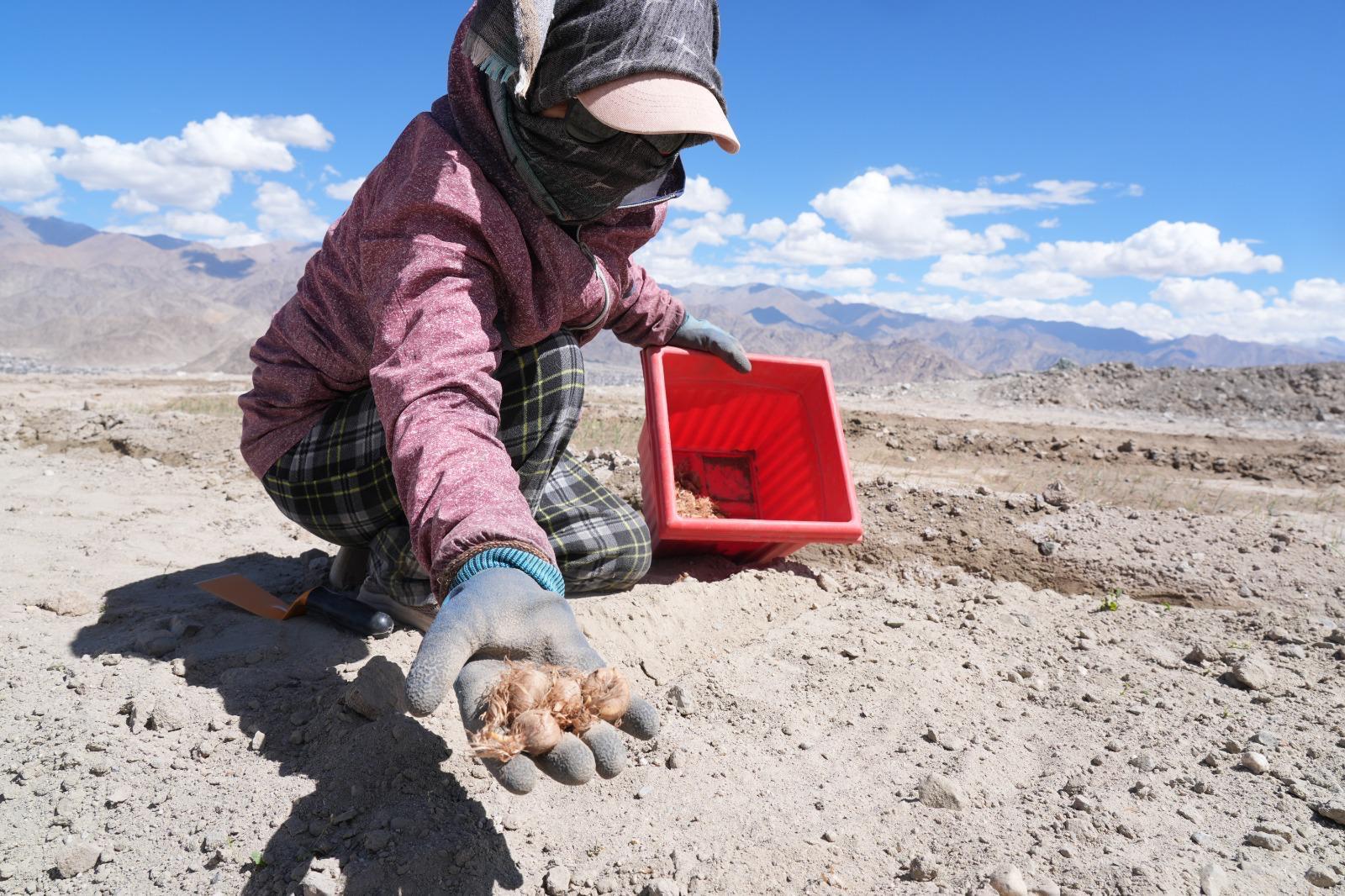
Leh: Saffron cultivation has begun in Ladakh for the first time under a pilot project aimed at assessing the feasibility of growing the high-value crop in the Union Territory’s cold desert conditions.
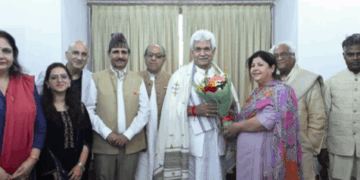
The initiative, undertaken under the guidance of Ladakh Lieutenant Governor Vinai Kumar Saxena, involves the plantation of nearly 800 kg of premium Iranian saffron corms, comprising around 90,000 corms, on about 4,000 square metres of land at Spituk Pharka in Leh.
Officials said the plantation site was barren until recently and has been restored under Project Him Sarovar, a land and water conservation initiative. Agriculture experts associated with the project expect the corms to yield saffron if the crop adapts successfully to local climatic conditions.
The pilot project is part of efforts to diversify agricultural practices in Ladakh and follows recent experiments with high-value floriculture crops such as Lilium and Gladiolus, which have been promoted in the region to generate livelihood opportunities for farmers, self-help groups and local entrepreneurs.
According to officials, high-quality Iranian saffron corms measuring 8 to 10 centimetres in circumference and weighing at least 10 grams have been used for the plantation. These are considered suitable for producing high-quality saffron.
In a statement, Lieutenant Governor Saxena said the project was aimed at exploring the potential of saffron cultivation under Ladakh’s high-altitude agro-climatic conditions and creating additional income opportunities for farmers through crop diversification.
He said the initiative would also test the possibility of converting degraded and barren land into productive agricultural assets.
Saffron is one of the world’s most expensive agricultural commodities and enjoys strong market demand. Jammu and Kashmir remains India’s principal saffron-producing region, accounting for nearly 90 per cent of the country’s production.
Officials said the Ladakh project would help assess whether the crop can be successfully cultivated outside its traditional growing areas and contribute to local economic development.
The plantation site forms part of nearly 800 acres of land being restored in Leh through the use of water from the Igoo-Phey irrigation canal, which has recently been revived and made operational. Excess water from the canal is being diverted to previously barren land to improve soil moisture and support cultivation.
The area is also supported by four water reservoirs developed under Project Him Sarovar, with a combined storage capacity of around 24 million litres, officials said.
Centre identifies 28 geographical features in Ladakh on official maps
The Government of India has formally identified and standardised the names of 28 geographical features in the Union Territory of Ladakh on the official maps of the Survey of India (SoI), officials said on Friday.
According to an official statement, the exercise was carried out in consultation with the Ladakh administration and is aimed at ensuring accurate recognition and greater public awareness of these locations and natural features.
The identified features include peaks, mountains, passes, glaciers, valleys, rivers, lakes and land areas spread across different parts of Ladakh.
Among the newly standardised names are Atisha Giri, Kanishka Peak, Martand Giri, Zorawar Peak, Rinchen Zangpo, Sakyasri Giri, Marpa Lotsava Ri, Milarepa Kangri, Shiva Ri and Maheshvara Ri. Other features include Karun Pir, Drak Karpo and Jolmori mountains; Chapchingal Pass and Shachmirk Pass; Parpik and Skamri glaciers; Shkorga Valley; Guru Rinpoche Lake; Yangpa River; and Hot Spring water body.
The list also includes land areas identified as Brangsa, Kuksel, Dehra Compass, Gogra, Kumarayana Point, Panglung and Shamal Lungpa.
Officials said the names have now been incorporated into the official Survey of India map of the Union Territory, providing a standard reference for administrative, cartographic and public use.
The move comes as part of efforts to improve geographical documentation and standardisation of place names in the region, the statement said.