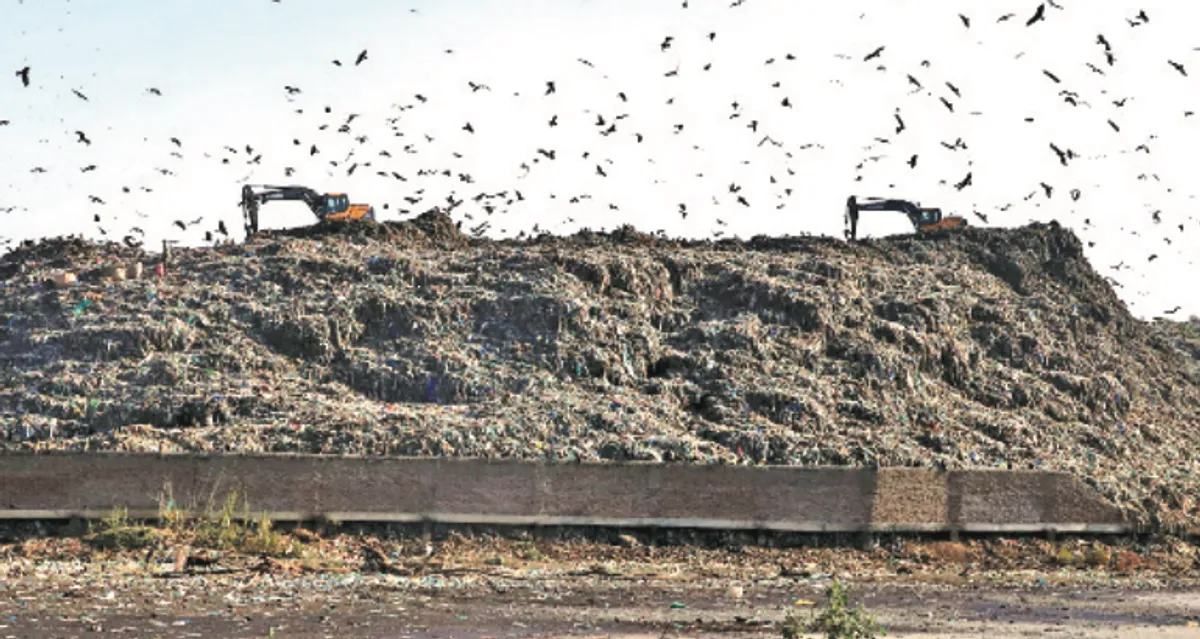
Srinagar: For years, Achan has been a name synonymous with Srinagar’s growing waste problem—massive heaps of garbage, a foul smell that often travels far beyond the dumping site, and residents repeatedly taking to the streets seeking relief.
What was meant to be a place to dispose of the city’s waste gradually became a problem of its own, with no lasting solution in sight as the garbage continued to pile up.
However, now the government is making a fresh push to change that.
Under the Waste to Energy program, around 11 lakh tonnes of legacy waste at Achan is set to be processed, with the administration planning to turn the waste into energy, while a separate CBG plant is being planned to deal with the city’s fresh waste.
After years of stalled efforts, the government hopes to clear the accumulated waste within one to one-and-a-half years and eventually give Achan a new identity as a “bio-reservable” area.
Commissioner Secretary, Housing and Urban Development Department, J&K, Mandeep Kaur, while talking to ‘Kashmir Images,’ said the process has already been initiated and work on converting the accumulated waste into energy is expected to begin soon.
Kaur acknowledged that Achan has remained a major challenge for the government for years, with several attempts to find a sustainable solution facing hurdles along the way.
The idea of a waste-to-energy project for Srinagar is not new. According to Kaur, the project was first introduced in 2016 but could not take off due to several issues. The proposal eventually entered litigation, further delaying efforts to find a solution to the city’s growing waste burden.
She said the quantity of waste generated in Srinagar, when assessed according to the norms of the Government of India at the time, also raised questions about the project’s viability.
There were other unresolved issues as well, including the Power Purchase Agreement (PPA), which prevented the project from moving forward.
Kaur said the government succeeded in closing the issue in 2024 without further litigation, settling it amicably and paving the way for a fresh approach to Srinagar’s waste-management problem.
“We succeeded in closing it without any litigation and settled the issue amicably,” she said.
Following this, the government prepared the Srinagar Waste Management Program, which was subsequently approved by the Government of India.
At the center of the new plan is the huge quantity of waste that has already accumulated at Achan.
Kaur said the government has received approval from the Centre to process around 11 lakh tonnes of waste lying at the site.
The task is substantial. Years of accumulated garbage have created massive heaps that now have to be excavated, processed, and dealt with scientifically.
The Assembly Committee on Environment has also visited Achan, Kaur said, adding that the committee was satisfied with the work being carried out at the site and with efforts to address the long-pending issue of waste remediation.
The project was given around 30 months for removing the accumulated waste. The administration, however, is hopeful of completing the work much earlier.
Kaur said she expects the remediation process to be completed within one to one-and-a-half years.
If the timeline holds, the intervention could mark the beginning of a major change at a site that has for years remained one of Srinagar’s most visible waste-management challenges.
For residents living around Achan, however, the issue has never been limited to figures, tenders, or project timelines. The smell emanating from the accumulated waste has repeatedly triggered complaints and protests, with residents demanding that authorities find a permanent solution.
During periods of warmer weather, the problem becomes more difficult, adding to the frustration of people living close to the site.
The concern also extends beyond the immediate neighborhood. The foul odor from the dumping site has at times been reported in other parts of Srinagar, turning Achan from a local waste-disposal issue into a wider urban problem.
For years, residents have wanted the same thing: relief from the garbage and a solution that would prevent the problem from returning.
The latest government plan is therefore significant not only because of the amount of waste it seeks to remove, but because it attempts to address what happens after that waste is cleared.
Clearing the existing garbage mountain will only solve half the problem if Srinagar continues sending fresh waste to the same site.
The government says it is therefore working on the second component of its plan—creating infrastructure to process fresh municipal waste.
Kaur said a Compressed Biogas (CBG) plant has already been established in Jammu on similar lines, while a Detailed Project Report has been prepared for setting up a CBG plant in Srinagar.
The tender for the Srinagar project has already been issued, she said, adding that the government hopes to allot the work within about a month.
The proposed arrangement is aimed at creating a system in which fresh waste can be processed instead of simply being added to the existing heaps at Achan.
In other words, the administration is attempting to tackle the problem at both ends—removing the waste that has accumulated over the years while creating capacity to deal with what Srinagar generates every day. The government’s long-term vision goes beyond clearing the garbage.
Kaur said the administration intends to transform Achan into a “bio-reservable” area once the waste-remediation and fresh-waste management components are put in place.
“There is many a slip between the cup and the lip”. The proposal looks so nice on the paper, and sounds attractive when officials talk about it. But Kashmir lacks a good track in executing lofty plans into viable and efficient projects on the ground. So let’s see if HUDD is able to change this legacy while dealing with the legacy waste at Achan!