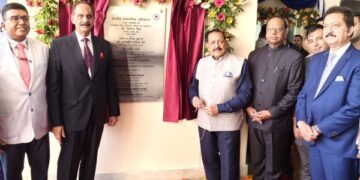
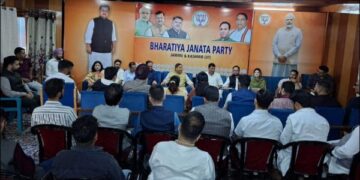
SRINAGAR: Agriculture Production, Rural Development and Panchayati Raj Minister Javid Ahmad Dar on Monday inaugurated a horticulture buyer-seller meet at SKICC and a zonal workshop on the National Supportive Supervision Framework (NSSF) under the Deendayal Antyodaya Yojana–National Rural Livelihoods Mission (DAY-NRLM), highlighting efforts to strengthen horticulture marketing and women-led rural institutions in Jammu and Kashmir.
The buyer-seller meet, organised by the Department of Horticulture Planning and Marketing under the theme “Transforming Horticulture Marketing in Jammu & Kashmir”, brought together growers, traders, buyers and other stakeholders to discuss market infrastructure, post-harvest management and value-chain development.
Inspecting exhibition stalls and interacting with stakeholders, Dar stressed the need for transparent and farmer-centric marketing mechanisms, stronger buyer-seller linkages, improved post-harvest facilities and greater emphasis on value addition.
He said horticulture remains a key pillar of Jammu and Kashmir’s rural economy and called for coordinated efforts to reduce post-harvest losses, improve storage and handling facilities and expand market access for growers.
The department also presented its achievements and ongoing initiatives aimed at modernising horticulture marketing infrastructure and enhancing the competitiveness of J&K produce.
Among those present were several legislators, including Bashir Ahmad Shah Veeri, Mohammad Yousuf Tarigami, Nizamuddin Bhat, Hilal Akbar Lone, Abdul Majeed Bhat Larmi, Sheikh Khursheed, Reyaz Ahmad Khan, Irshad Rasool Kar and Irfan Hafiz Lone.
Later, Dar inaugurated the four-day zonal workshop on the National Supportive Supervision Framework (NSSF), attended by representatives from Jammu and Kashmir, Ladakh, Himachal Pradesh, Uttarakhand, Punjab and Haryana.
The workshop focuses on strengthening Cluster Level Federations (CLFs), identifying institutional gaps and formulating state-specific strategies to improve governance, financial sustainability and self-reliance of women-led community institutions under DAY-NRLM.
Addressing the participants, Dar said DAY-NRLM has evolved into a major platform for women-led socio-economic transformation, with more than 10 crore rural women linked to over 93 lakh self-help groups across the country.
Highlighting J&K’s progress under the mission, he said more than eight lakh rural women have been mobilised into nearly one lakh self-help groups across all districts and blocks of the Union Territory, supported by around 7,000 village organisations and 652 cluster-level federations.
He said JKRLM has provided ₹532 crore as institutional capitalisation, while self-help groups have accessed ₹3,489 crore in bank credit through repeated credit linkages. He added that J&K currently has around 2.40 lakh Lakhpati Didis and another two lakh potential beneficiaries identified for focused livelihood interventions.
Dar also highlighted the establishment of 176 Integrated Farming Clusters, 249 Producer Groups and 12 Farmer Producer Organisations, besides support to more than seven lakh women farmers and promotion of around 30,000 rural enterprises.
He said initiatives such as “Umeed Ka Zaika”, aimed at promoting women-led food enterprises, are helping strengthen local value chains and improve market access for rural women entrepreneurs.
The minister said the success of the NSSF framework would ultimately depend on the ability of CLFs to emerge as accountable, financially sustainable and self-reliant community institutions capable of driving grassroots development and rural transformation.