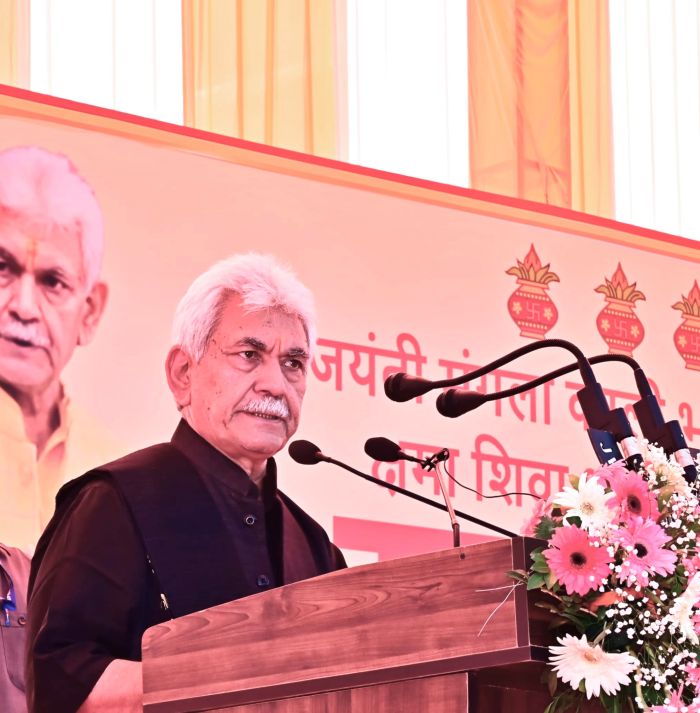
Jammu: Just as a tree without roots cannot withstand a storm, a society disconnected from its foundational visionaries, cultural heritage and the philosophy of its sages loses its balance, sensitivity and sense of direction, Lieutenant Governor Manoj Sinha said on Saturday.
Sinha, who laid the foundation stone for the Mata Lalleshwari Cultural-cum-Heritage Centre at Mata Bhaderkali Asthapan in Thalwal near here, said the project will boost spiritual tourism, preserve the legacy of the 14th-century mystic, and contribute to the region’s economic revitalisation.
The project, sanctioned under the Capex budget with an allocation of Rs 4.5 crore, is envisioned to preserve and promote the legacy of Yogini Lalleshwari, also known as Lal Ded, an official press release said.
“Jammu and Kashmir has, since ancient times, been a cradle of sages, saints and seekers of truth. The centre, dedicated to Mata Lalleshwari, will embody India’s civilisational consciousness and serve as a beacon of cultural harmony, spiritual tourism, and academic research.
“This project reminds us of our timeless civilisational consciousness. Today, we stand at a significant juncture in our history, where the blessings of our ancestors and their timeless wisdom are converging with the aspirations for a confident, developed and self-reliant Jammu & Kashmir,” he said.
The LG underlined that Mata Lalleshwari’s teachings transcended social divisions and embodied the ideals of tolerance, equality and inner transformation. Her verse, resonating with the highest truths of the Upanishads, continue to inspire generations, he said.
“The centre will act as a living repository of her philosophy, enabling scholars, artists and seekers to engage with her wisdom and disseminate it globally through modern platforms,” the LG said.
He also stated that the centre will not be merely a physical structure but an institutional foundation for cultural preservation. It will host exhibitions, translation initiatives, and archival facilities, while also fostering fellowships in Kashmir Shaivism.
“The centre will empower youth through art and creative expression, promote social harmony, and strengthen national integration,” the LG said.
The LG emphasised that cultural and heritage centres are a national imperative. He said beyond economic growth, a nation requires civilisational memory and moral direction.
“The Mata Lalleshwari Centre will reconnect society with its roots, provide spiritual resources for mental peace, and contribute to grassroots economic vitality by attracting seekers, historians and tourists. The initiative aligns with the vision of the Prime Minister, Narendra Modi, who has consistently underscored the importance of integrating heritage with development. The centre will stand as a monument to India’s cultural soul and a source of national strength,” the LG said.
“In today’s fast-paced life, people are facing unprecedented mental stress, crises of identity and the challenges of existential loneliness. It is equally true that external, material success alone cannot fill the emptiness within. I believe that the teachings of saints such as Mata Lalleshwari, and the cultural centre dedicated to her, will help fill that void and provide spiritual resources for self-discipline, mental peace and emotional resilience.
“Mata Lalleshwari Cultural and Heritage Centre will contribute to spiritual tourism and economic revitalisation. In this sacred land, where holy pilgrimage sites, ancient temples and centres of spiritual practice are spread across the region, this centre will attract seekers, historians and travellers from all over the world,” the LG said.
Brij Mohan Sharma, Principal Secretary, Culture Department; Ramesh Kumar, Divisional Commissioner Jammu; Tejinder Singh, IGP, Jammu; Shridhar Patil, DIG, JSK Range; Dr. Rakesh Minhas, Deputy Commissioner Jammu; K.K. Sidha, Director, Archives, Archaeology and Museums; Arvind Karwani, Relief and Rehabilitation Commissioner; Dileep Pandita, President, Mata Bhaderkali Asthapan Trust; Ashok Kaw, General Secretary, Mata Bhaderkali Asthapan Trust; Chand Ji Pandita, Organizing Secretary and other members of the Trust, senior officials, prominent citizens and devotees in large number attended the foundation stone laying ceremony.
Time has come to correct historical oversights: LG
“The time has now come to correct historical oversights,” Lieutenant Governor Manoj Sinha said Saturday as he unveiled the statue of Acharya Abhinavagupt, launched new logo of the J&K Academy of Art, Culture and Languages, and released two books, besides inaugurating a welfare scheme for artists and writers.
The LG described the occasion as the beginning of a “cultural renaissance — reawakening the soul of the Union Territory”.
According to an official press release, the LG noted that the welfare scheme for artists and writers, conceived in 2021–22 and formalised in August 2024, reflects the nation’s gratitude towards those who preserve collective memory through stories, songs and our priceless traditions.
“I believe that artists and writers are not only creators but also guardians of society’s collective memory. They have given words to Jammu and Kashmir’s priceless culture, voice to the emotions of society, and have shouldered the duty of carrying this Union Territory’s heritage to future generations. Therefore, honouring them is nothing less than honouring our own civilization, our own culture, and our own identity,” the LG said.
The LG paid tribute to Acharya Abhinavagupt as a philosopher, spiritual practitioner, poet, and master of aesthetics whose profound contributions to Kashmir Shaivism and Pratyabhijna philosophy remained confined to limited scholarly circles for centuries.
He termed this neglect not merely academic but a “damage to civilizational memory,” and called for correcting historical oversights so India’s youth can access their intellectual heritage.
“The time has now come to correct these historical oversights. This task must be inspired by our commitment to truth, because our youth have the right to know how vast, how ancient, and how connected to the global community is the intellectual depth of the civilization they inherit,” he said.
Highlighting Abhinavagupt’s seminal work ‘Tantraloka’ and his theory of ‘rasa’, the LG said that art serves as a doorway to inner awakening, reflecting the unique Indian vision where art, life, and the pursuit of truth are inseparable.
The LG congratulated Dr. Vaidehi Taman on her book ‘Abhinavagupt: The Voice of Eternal Shiva’ and Akriti Sharma on ‘Raghunath Temple, Channi Parat: Hidden Heritage of Sunderbani’, describing both works as vital contributions connecting Jammu & Kashmir’s heritage to India’s shared civilizational consciousness.
He noted that the Raghunath Temple at Channi Parat exemplifies Jammu & Kashmir’s rich tangible heritage.
“I want the new generation to remember that our ancestors built this nation with their wisdom, with their questions, with their experiences, and with their continuous search for truth. It is our sacred responsibility to ensure that this knowledge does not fade from memory. Our duty is to understand that knowledge, honour it, pass it on to new generations, and preserve it for the times to come,” the LG said.
The LG highlighted that “under the leadership of Prime Minister Narendra Modi new energy has been infused into Jammu & Kashmir’s economic and cultural landscape.”
He called upon universities, schools, and cultural institutions to introduce young people to thinkers like Abhinavagupt as living voices relevant to contemporary questions of consciousness and creativity, and urged greater private and institutional support for research and publishing in this field.
“We must encourage writers like Dr. Vaidehi Taman and Akriti Sharma, who, through the difficult and patient work of research, study, and interpretation, can build a bridge between ancient heritage, knowledge, and modern understanding. Such work should not only be a matter of appreciation; it must also receive our active encouragement and institutional support,” he said.
The LG expressed hope that the two books would reach readers across the country and that the J&K Academy of Art, Culture and Languages would continue driving the region’s cultural renaissance forward.
“We must place the historical facts in the right perspective with confidence. We must adopt the same curiosity and the same honest scholarship that characterized our ancestors,” he said.