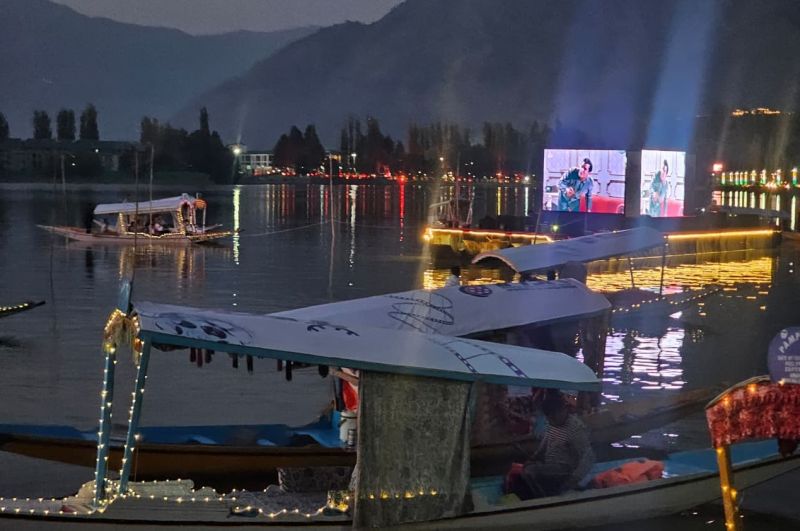
SRINAGAR: Cinema has found an extraordinary setting in Kashmir, as the tranquil waters of world famous Dal Lake have been transformed into a floating theatre during the first International Film Festival of Jammu & Kashmir (IFFJK), an official spokesman said.
He said, in a setting where the lake, mountains and city lights come together, audiences are experiencing films on a large floating screen, with the banks of Dal Lake serving as an open-air auditorium. The initiative has emerged as one of the most distinctive attractions of the four-day festival that began on September 07, giving the celebration of cinema a setting deeply connected with Kashmir’s visual and cinematic heritage.
The Floating Cinema opened on the first day of the festival with the screening of the evergreen 1961 film Junglee. The screening drew audiences to the lakefront, creating a memorable spectacle as a classic Hindi film played out against the waters of Dal Lake, said the official
As the screen lights up over the waters of Dal Lake, families, visitors, film enthusiasts from different parts of the country and abroad and curious onlookers have been turning up along the banks, making the screenings a lively public experience, he added.
He further said that the experience goes beyond conventional film viewing, allowing audiences to watch cinema while surrounded by the very landscapes that have inspired filmmakers for generations. The initiative also reflects IFFJK’s effort to take cinema beyond traditional theatre spaces and bring it into public and culturally significant settings.
He said, on Wednesday, the Floating Cinema featured the timeless ‘Kashmir Ki Kali’, bringing to the waters of Dal Lake the infectious energy and charisma of Shammi Kapoor at his energetic best, alongside the effortlessly graceful and captivating Sharmila Tagore.
The film, remembered for its romance, music and vibrant performances, offered audiences an opportunity to revisit one of Hindi cinema’s most beloved classics in a setting that feels naturally connected to its story.
The nostalgia will continue on the concluding day on September 10 with the screening of Yash Chopra’s Kabhi Kabhie (1976), another celebrated classic associated with the cinematic tradition of Kashmir, added the spokesperson.
Meanwhile, the cinematic spirit of Jammu & Kashmir came alive on the third day of the 1st International Film Festival of Jammu & Kashmir (IFFJK), as SKICC Srinagar played host to a rich mix of thought-provoking discussions, masterclasses, and interactive sessions.
An official spokesman said that the day’s programme brought into focus youth-led storytelling, emerging cinematic voices, international co-productions and opportunities for Jammu & Kashmir cinema to reach global audiences.
The day began with an In-Conversation Session, “Echoes of the Chinar: Empowering J&K’s Next Generation of Storytellers,” explored the role of youth, local institutions and new cinematic voices in shaping the representation of Jammu & Kashmir on screen. The session was moderated by Danish Renzu, with Rahhat Shah Kazmi, film director and writer, as the speaker, said the spokesperson.
Another key session, “Global Partnerships in the Valley: Co-Producing Jammu and Kashmiri Cinema for the World,” examined avenues for international collaboration and strengthening the region’s presence in the global film ecosystem. The panel discussed international co-production, sustainable financing, creative partnerships and festival-market strategies for Jammu and Kashmiri cinema.
The spokesperson said the session was moderated by Rabiranjan Maitra, Indian director and editor, and featured Kapil Matoo, Munjal Shroff and Saba Bhat as speakers.
Speakers emphasised that Kashmir has a wealth of stories waiting to be told and stressed the need to nurture storytellers from within the region. They said that a strong cinematic ecosystem must be developed in Jammu & Kashmir itself, providing young people with opportunities to learn, create and collaborate. He also called for greater engagement of youth from diverse academic and professional backgrounds and departments to build a vibrant and inclusive creative ecosystem for cinema in the region.
They emphasised Jammu & Kashmir is rich in talent, stressing the need to provide its young storytellers with the right direction, opportunities and ecosystem to realise their creative potential.
The panel discussion, “The Gentle Truth: AI and the Beautiful Soul of Jammu and Kashmir,” explored the evolving relationship between artificial intelligence and documentary cinema, with speakers reflecting on the possibilities and challenges of using emerging technologies in non-fiction storytelling. The discussion covered ethics in documentary filmmaking, observational cinema and hybrid forms, while also examining how technology can complement authentic human stories and the rich cultural landscape of Jammu and Kashmir. The session was moderated by Sanskar Desai and featured Subbiah Nallamuthu, Arun Chadda, Yadu Vijaykrishnan, Supriyo Sen and Raja Shabbir Khan, said the spokesperson.
The panel discussion “Local Voices, Global Hearts: Celebrating Regional Cinema in the Valley” explored how compelling regional stories from across India are shaped, narrated and brought to audiences. The session also reflected on the rich cultural traditions and diverse storytelling potential of Jammu and Kashmir, and how its distinctive voices can contribute to and become part of India’s vibrant regional cinema landscape. The discussion was moderated by Arfi Laamba and featured Tribeny Rai, Dr. Pradeep Kenchanuru, Haobam Paban Kumar and Madhavi Tangella.
Among the day’s key highlights was the masterclass, “Cutting Visuals, or Cutting Emotions,” which explored the art and psychology of film editing, including rhythm, spatial continuity, temporal manipulation and the emotional impact of the cut. The session featured acclaimed Indian director and editor Rabi Ranjan Maitra, who shared insights into the craft of editing, exploring how rhythm, continuity, temporal manipulation and the psychology of the cut shape the emotional impact of a film.
Another major attraction was the masterclass, “Beyond the Stage: Inside the Actor’s Craft,” which examined the interplay between theatrical training, embodied performance and contemporary approaches to cinematic acting. The session featured noted Indian actor and director Chittaranjan Tripathy, who shared insights into the craft and evolving dynamics of screen performance.
The interactive sessions drew enthusiastic participation from film enthusiasts, students and aspiring filmmakers, who engaged with the speakers through questions and discussions. The exchanges offered participants valuable insights into filmmaking practices, emerging technologies, creative processes and the evolving opportunities within the film industry, added the spokesperson.