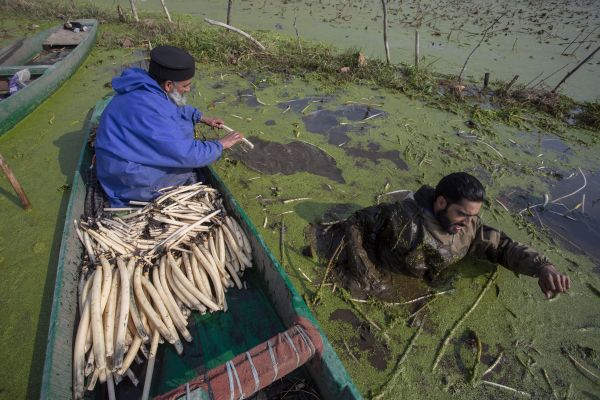
SRINAGAR: Beneath the familiar taste of Dal Lake’s famed ‘Nadru’ lies a food-safety concern that Kashmir can no longer afford to overlook.
Scientific investigations have detected potentially toxic metals in lotus rhizomes grown in the lake, raising serious questions over what consumers may be putting on their plate with a delicacy so lovingly cherished in Kashmiri cuisine.
The strongest evidence comes from a 2025 study published in the journal Toxics, which specifically examined the uptake of potentially toxic elements by lotus (Nelumbo nucifera) grown in Dal Lake. The researchers collected lotus, water, and sediment samples from four areas—Hazratbal, Bod Dal, Gagribal, and Nigeen Lake—during August to October 2024.
The 10-member research team led by Mohssen Elbagory of King Khalid University, Saudi Arabia, included researchers from Kafrel Sheikh University and Benha University in Egypt, India’s Agricultural Research Center and Graphic Era University, the Society for AgroEnvironmental Sustainability in Dehradun, and the University of Zagreb in Croatia.
The study detected cadmium, chromium, cobalt, copper, iron, manganese, nickel, and zinc in the lotus tissues. More importantly, its health-risk assessment identified chromium as the biggest concern in the edible rhizome, with a hazard-risk index of 1.8.
In the assessment framework used by the researchers, a value above one indicates a potential health concern.
The authors consequently called for continued monitoring, particularly because of possible long-term exposure to chromium and cadmium.
The findings, however, do not establish that every piece of Nadru from Dal Lake is immediately poisonous or unsafe to eat.
The study’s cumulative target-hazard quotient for the rhizome remained below one. What it does establish is that potentially toxic elements are being taken up by the edible part of a crop directly grown in a contaminated lake environment, warranting closer food-safety scrutiny.
The concern becomes more significant when viewed against other investigations into Dal Lake.
A 2024 study in Environmental Advances by Arfat Nazir, Shaik Mohammad Hussain, Muzafar Riyaz, and colleagues examined 32 sediment samples from Dal Lake and found significant heavy-metal contamination, with nickel exceeding ecological-risk thresholds across the study sites. The researchers concluded that the lake required continuous monitoring and better pollution management.
Another 2024 study, published in Heliyon by Siraj Yousuf Parray, Simranjeet Singh, Bhupendra Koul, Nadeem A Khan, Praveen C Ramamurthy, and Joginder Singh, also reported heavy-metal contamination in Dal Lake and linked the deteriorating water quality to anthropogenic pressures.
The latest evidence comes from a February 2026 study in Scientific Reports examining water chestnut (Trapa Natans) from Dal Lake, Hokersar, Manasbal, and Wular.
The nine-member team led by Mohssen Elbagory found Dal Lake had the highest pollution load among the four water-bodies, while heavy metals accumulated in different parts of the edible aquatic plant. The researchers said such accumulation raised unresolved food-safety and ecological concerns.
Speaking to ‘Kashmir Images’ senior scientist at Sher-e-Kashmir University of Agricultural Sciences and Technology (SKUAST-K), Dr. Khurshid said the findings highlight the need for a closer scientific assessment of Nadru and that a broader study could help provide a clearer picture of the situation.
Dr. Khurshid suggested a planned, statistically designed study involving broad-based sampling from Dal Lake and other water-bodies as well as markets to assess the actual levels of heavy metals, if any, in the produce.
“When health concerns are associated, scientists can plan a comprehensive study to find the facts. Sampling has to be broad-based and statistically comprehensive,” he said.
Dr. Khurshid said such an exercise would help put the available findings in perspective and provide a stronger scientific basis for assessing any potential health concerns associated with Nadru.
Although the 2026 study concerns water chestnut rather than Nadru, it provides additional evidence that aquatic food crops growing in Kashmir’s water bodies can absorb contaminants from their surrounding environment.
The emerging picture therefore points to a need for independent testing of commercially sold Nadru, particularly the edible rhizome, rather than relying solely on water-quality assessments.
Hydraulic engineering expert and noted environmentalist Er. Ajaz Rasool, while pointing to the possible sources of heavy-metal contamination in Dal Lake, said the problem could be linked to nutrient ingress from the lake’s peripheral areas as well as hamlets located within the lake, many of which still lack proper sewage management infrastructure.
He also flagged the possible role of chemical fertilizers, pesticides, and insecticides used in vegetable cultivation within the lake and in orchards and vegetable-growing areas around its shoreline.
Untreated sewage and nutrient ingress from peripheral areas and hamlets within the lake, Rasool said, can contribute significantly to the deterioration of the lake environment. The use of chemical fertilizers, pesticides, and insecticides in vegetable cultivation within the lake and in orchards and vegetable-growing areas around the shoreline can further add to the contaminant load.
These pollutants, he said, can eventually accumulate in the lake sediments and may become available for uptake by aquatic vegetation.
“A thorough scientific investigation is therefore required to identify and quantify the different sources of heavy metals in the lake sediment. It is equally important to determine the extent to which these contaminants are being taken up by edible aquatic plants such as Nadru, and whether this poses any potential risk to consumers. Without such source-specific and quantitative assessment, it would be difficult to arrive at a definitive conclusion regarding the safety of Nadru grown in Dal Lake,” Rasool told ‘Kashmir Images’.
The issue also raises questions over regulatory surveillance. The scientific studies reviewed for this report do not identify any publicly available Food Safety Department or Lakes Conservation and Management Authority advisory specifically declaring Dal Lake Nadru unsafe for consumption.
For now, the scientific evidence supports caution rather than a blanket declaration that all Dal Lake Nadru is unsafe. But with a Nadru-specific study already flagging potentially hazardous metal uptake—and newer research continuing to document contamination in aquatic food plants—the safety of a vegetable so important to Kashmiri cuisine deserves an official answer.
Calling the situation unfortunate, environmental expert and NLCO Chairman Manzoor Wangnoo stressed the need for regular monitoring of pollution levels in Dal Lake and a clear official advisory on the safety of Nadru being cultivated there.
Wangnoo said independent testing of the lotus rhizomes, regular monitoring, and pollution control measures were urgently required, along with a clear advisory to consumers. “This is a serious public health and environmental warning that cannot be ignored. We must neither create panic nor dismiss the findings,” he said.