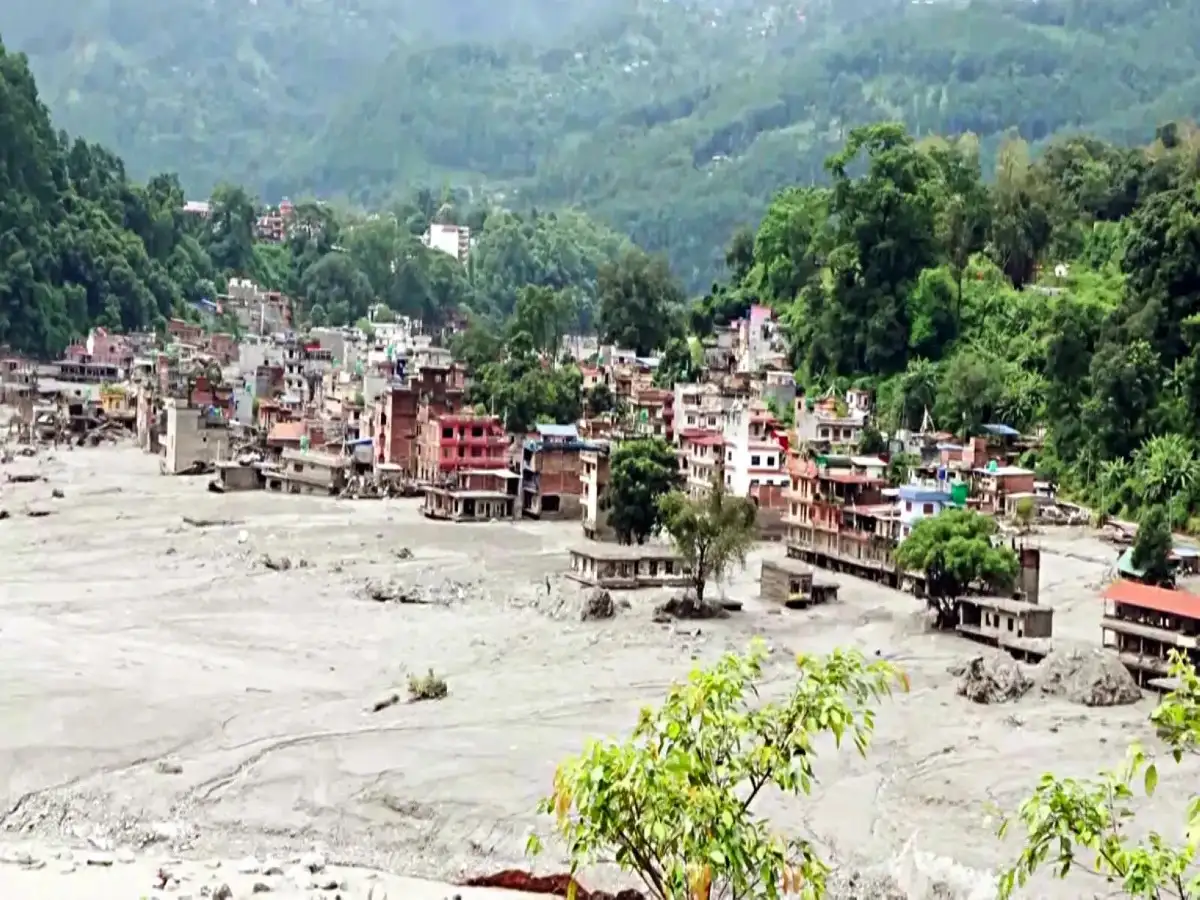
Kathmandu: When a wall of water, rocks and mud tore through her remote village in Nepal last week, Pema Tamang and her neighbours fled uphill to a Buddhist shrine that had been rebuilt the previous year after a 2015 earthquake.
The steep mountain folds of the Himalayas, already prone to earthquakes, have seen more frequent flash floods as high mountain glaciers melt, redrawing rivers at sometimes terrifying speed. Residents have had little time to rebuild from one disaster to the next, raising concerns over whether their communities can endure as climate change accelerates.
“We were able to rebuild the stupa only last year after it was destroyed during the earthquake,” Tamang told The Associated Press, referring to the shrine. “Sheltering in it was how we saved our lives from the floods,” she said in a makeshift shelter at a monastery in Kathmandu.
The Aug. 26 floods in Nepal and neighbouring China have killed more than 1,000 people and left thousands missing, including hundreds feared trapped in tunnels at hydropower projects. The floods were triggered after a collapse of bedrock and glacier ice sent debris and water surging through multiple Himalayan rivers.
Scientists say it is too early to directly link Wednesday’s catastrophe to global warming. But as Earth’s temperature rises at a faster rate because of the burning of oil, gas and coal, the chances of such disasters increase, especially in the Himalayan mountains, which are warming considerably faster than many other parts of the world.
“Climate change has been playing a large role in the Hindu Kush Himalayas, causing these kinds of complex disasters which have really impacted downstream communities and investments,” said Saswata Sanyal, a disaster risk resilience expert at the International Centre for Integrated Mountain Development based in Kathmandu.
Global warming’s effects are heightened in the Himalayas
———————————————————
Sanyal said the region is increasingly confronting hazards that trigger one another.
Warmer temperatures cause high mountain ice to melt, leading to more frequent rockslides, avalanches and floods. An avalanche can dam a river before unleashing a flash flood. Heavy rain after an initial disaster can compound the destruction.
Flash floods last year in the same region in Nepal claimed nine lives and caused millions of dollars in damage. Across the wider Himalayan region, the 2013 Kedarnath floods, the 2021 Chamoli disaster, the 2023 South Lhonak glacial lake outburst flood, and other recent landslides and floods, have killed thousands of people and caused hundreds of billions of dollars in damage.
People in Nepal were still recovering from last year’s floods, Sanyal said, “and before they could fully adapt, the next one came.”
The Hindu Kush Himalaya stretches across parts of Afghanistan, Pakistan, India, Nepal, Bhutan, Bangladesh, Myanmar and China, and contains the largest concentration of ice outside the polar regions. River systems originating in the mountains support nearly 2 billion people.
Glacier ice loss has accelerated sharply since 2000, according to Sanyal’s intergovernmental climate research group. Another risk is thawing permafrost — ground that has remained frozen for long periods — that can weaken mountain slopes.
Satellite imagery of the glacial collapse last week indicates that a huge mass of bedrock and glacial ice plunged into a valley below, sending a wall of water and mud several stories high through communities many kilometers (miles) downstream.
Adaptation has limits in the mountains
——————————————
Climate experts say that in some places the danger may become so great that rebuilding is no longer viable, forcing residents to move. Climate change could also have implications for efforts to develop the region through the construction of roads, bridges and hydropower plants.
“The adaptation threshold has been crossed in some areas,” said Manjeet Dhakal, a Nepali climate policy expert and United Nations climate negotiator.
When an earthquake destroys a house, belongings can sometimes be recovered, he said. A catastrophic flood can wipe out not only the house, but the land beneath it, along with roads, water systems, schools and electricity. He said future resettlement would have to incorporate climate risk from the beginning.
The consequences can be mitigated by stricter land-use rules, better assessments before infrastructure is approved, stronger cross-border monitoring and early warning systems.
Still, Sanyal said that of the 670,000 people who received text alerts about the Aug. 26 floods, some were visitors or migrant workers who could not understand Nepali while others downplayed the risk. Other systems designed to measure rivers were overwhelmed or washed away.
Chanda Lal Chitrakar, a 62-year-old resident of Nuwakot in Nepal, told the AP that he paid little attention to warning messages. As the waters rose, he ran uphill to save himself.
Nepal suffers from the much larger emissions of wealthier countries
———————————————————————–
Sanyal said such warnings need to provide more information on what actions to take. He also suggested prioritizing development in less-dangerous areas, assessing infrastructure for multiple hazards and incorporating the knowledge of Indigenous communities into disaster planning.
Dhakal, the climate negotiator, noted that Nepal has emitted less than 0.1% of the greenhouse gases that cause global warming, even as it grapples with some of its most severe effects.
“We should blame those who are responsible for increasing the global temperature, those who have benefited from the fossil fuel economy for such a long time,” he said. “We can at least use this devastating example as an inspiration to urgently reduce carbon emissions.”