

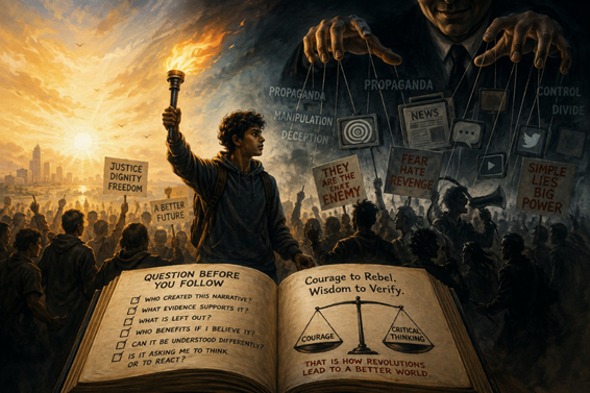
Revolutions are rarely born among those comfortable with the existing order. They are most often carried by the young, people willing to question what previous generations have accepted, challenge authority, and act before fully calculating the consequences. Youth see possibility where others see permanence and injustice where others have learned to live with compromise.
But youthful energy alone does not create a revolution. Narratives do.
Before people take to the streets, they must believe that change is necessary and justified. Stories of injustice, oppression, dignity, betrayal, and freedom turn individual frustration into collective action. History repeatedly shows the power of such narratives. The French Revolution challenged inequality and privilege. India’s independence movement transformed resistance to colonial rule into a struggle for dignity and self-government. The American civil-rights movement challenged racial segregation, while Gandhi’s philosophy of non-violence and Martin Luther King Jr.’s rhetoric connected political action with a larger moral vision.
But history offers an uncomfortable warning: a just cause does not guarantee a just outcome.
Once an established order begins to collapse, a vacuum of power emerges. Political organisations, ideological movements, ambitious leaders and external actors can enter that vacuum, often with interests very different from those who began the struggle. The French Revolution moved from liberty and equality to the Reign of Terror and eventually Napoleon’s authoritarian rule. The Russian Revolution, born amid genuine social and economic grievances, ultimately produced Bolshevik one-party rule. The Arab Spring began with demands for dignity, opportunity, and accountable government, yet in several countries those aspirations were overtaken by instability, military intervention, ideological conflict and civil war.
The lesson is not that revolutions are wrong, or that young people should accept injustice. It is that the moment a revolution begins is not the moment its story ends.
A movement may begin with justice and gradually be redirected toward revenge. A demand for freedom can become ideological conformity. Opposition to corruption can become a power struggle. Those who ignite a revolution are not necessarily those who eventually control it.
This is where rhetoric becomes both powerful and dangerous.
History has repeatedly shown how selective facts, rumours, propaganda and emotionally charged stories can mobilise societies. Nazi Germany demonstrated the catastrophic consequences of turning grievance and prejudice into political narratives. Wartime propaganda has repeatedly dehumanised enemies. During the Cold War, competing narratives about capitalism, communism and freedom shaped generations.
Today, the machinery is far more powerful. A manipulated photograph, short video or provocative slogan can reach millions before its authenticity is questioned. Social media rewards emotional reaction, while artificial intelligence is making fabricated voices, images and videos increasingly convincing. The future challenge may therefore not simply be misinformation, but the erosion of our ability to distinguish reality from a compelling story.
This makes narrative literacy as important as traditional literacy.
Before joining a movement, sharing a message or condemning an enemy, the questions should be simple:
Who created this narrative?
What evidence supports it?
What has been left out?
Who benefits if I believe it?
Could the same event be understood differently?
Is this asking me to think, or simply asking me to react?
These questions do not weaken a just cause. They protect it.
The greatest vulnerability of youthful idealism is also its greatest strength: moral urgency. Young people may genuinely believe that immediate action is necessary, and sometimes they are right. But urgency can also make people vulnerable to those who provide simple answers to complicated problems, define convenient enemies, and turn legitimate anger into political capital.
The greatest tragedy is therefore not necessarily that a revolution fails. It is that it succeeds in destroying one injustice only to create another.
The responsibility of youth is consequently twofold: the courage to challenge and the intelligence to question. Courage without critical thinking can produce chaos; critical thinking without courage can produce complacency. Both are necessary for meaningful change.
Every generation inherits narratives of heroism, victimhood, humiliation, conquest, and revenge. Some contain truth; others contain selective memory. The most dangerous narrative is not always a complete lie. It is often a partial truth presented as the whole truth.
A genuine historical grievance can become hatred of an entire community. A legitimate demand for justice can become revenge. A movement demanding freedom can eventually demand that everyone think alike. This is how revolutions can be captured by those who did not create them.
History should therefore not teach the young to fear revolution. It should teach them to understand it.
The young may light the spark, but they must also ask who is carrying the torch, where it is leading, and who will inherit the world after the fire has passed.
A revolution may begin with a just cause, but whoever controls the narrative can decide what the revolution ultimately becomes.
Aijaz Qaisar Azad, the author, is a professional artist (painter) and has over 25 years of experience in managing global marketing communications for major semiconductor MNCs and can be reached at aijazqaisar@yahoo.com.


