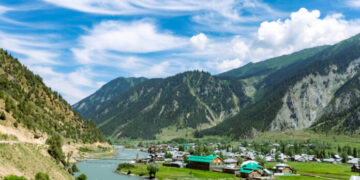
Kashmir Valley is experiencing environmental changes that can no longer be treated as a distant global concern. Situated in the fragile Himalayan ecosystem, the Valley is vulnerable to changing temperature and precipitation patterns, erratic snowfall, intense rainfall, cloudbursts, floods and landslides. These changes have implications for water resources, agriculture, biodiversity, infrastructure and livelihoods. The devastating floods of 2014 demonstrated how environmental vulnerability and extreme weather can combine to produce widespread consequences.
While government policies, scientific interventions and disaster-management systems remain essential, a sustainable response also requires changes in public behaviour. Education can become one of the most effective tools for bringing about that behavioural change.
Climate change should not be treated merely as a chapter in a textbook or an isolated topic within a lesson. It should be systematically integrated into the school curriculum and progressively taught according to students’ age and level of understanding. Children should learn not only the scientific meaning of climate change but also how it affects their own surroundings and what they can do about it.
A simple school-level observation illustrates the importance of this approach. In an activity involving 50 students of Classes 9 and 10, 27 students, or 54 percent, recognised climate change as a serious issue, while only 20 students, or 40 percent, were aware of the greenhouse effect. This observation cannot be generalised to all students of Kashmir, but it points towards an important concern: awareness of climate change does not necessarily mean adequate scientific understanding.
The greater challenge is therefore to bridge the knowledge–action gap. Knowing that climate change is harmful does not automatically lead to water conservation, responsible waste management, energy saving or other environmentally responsible practices. School education must help students move from awareness to understanding and from understanding to action.
This requires a shift from routine, examination-oriented learning towards activity-based and experiential education. Students can conduct water and energy audits, examine waste-management practices, maintain school gardens, observe local biodiversity and record weather conditions. They can study rainfall and snowfall patterns, investigate local water resources and understand the importance of wetlands and natural drainage systems in reducing flood vulnerability.
Climate quizzes, debates, exhibitions, field visits and student-led environmental projects can further strengthen learning. Such activities should not be viewed merely as extracurricular programmes. When connected with classroom teaching, they can help students develop curiosity, critical thinking and practical environmental skills.
Kashmir’s local environment should also become part of classroom learning. Students can investigate why wetlands are important, how waste can obstruct drainage, why water conservation matters, how changing weather affects agriculture and why mountain ecosystems require special protection. Connecting lessons with the immediate environment can make climate change more meaningful than learning it only as a global concept.
Climate education should also be interdisciplinary. Science can explain greenhouse gases and climate processes; geography can examine floods, landslides and changing landscapes; mathematics can help students analyse rainfall and temperature data; and social science can explore the social and economic consequences of environmental change. Language classes can provide opportunities for essays, debates and awareness campaigns.
Teachers are central to this transformation. They need appropriate training and resources to connect climate science with Kashmir’s environmental realities. Their role should increasingly involve facilitating inquiry, discussion, problem-solving and environmental action rather than simply transmitting information.
This is particularly important because climate risks in Kashmir interact with human pressures such as unplanned urbanisation, degradation of wetlands, encroachment on natural drainage channels, waste accumulation and increasing pressure on natural resources. Students who understand these connections can become more responsible citizens and influence environmental practices within their families and communities.
If we can successfully bridge the knowledge–action gap, it could be a transformative step towards building a climate-resilient Kashmir. A generation equipped with scientific understanding, practical skills and opportunities to act can contribute to reducing environmental pressures and strengthening society’s capacity to cope with the increasing impacts of climate change in the Valley.
Climate education alone cannot prevent cloudbursts, floods or global climate change. Effective policies, scientific planning and disaster preparedness remain indispensable. But an informed and environmentally responsible generation can make these efforts more effective.
For Kashmir Valley, the message is clear: we must move from climate awareness to climate understanding, from understanding to responsible behaviour, and from behaviour to collective climate action. The classroom can be the starting point of this transformation.
Educating Kashmir’s children about climate change is therefore not simply about teaching them what is happening to the environment. It is about preparing them to become informed, responsible and active participants in protecting the future of the Valley.
The author is a Research Scholar in Environmental Science. aqibiqbal192@gmail.com