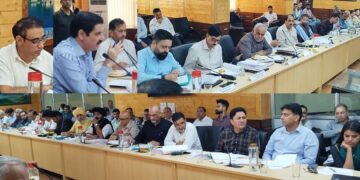
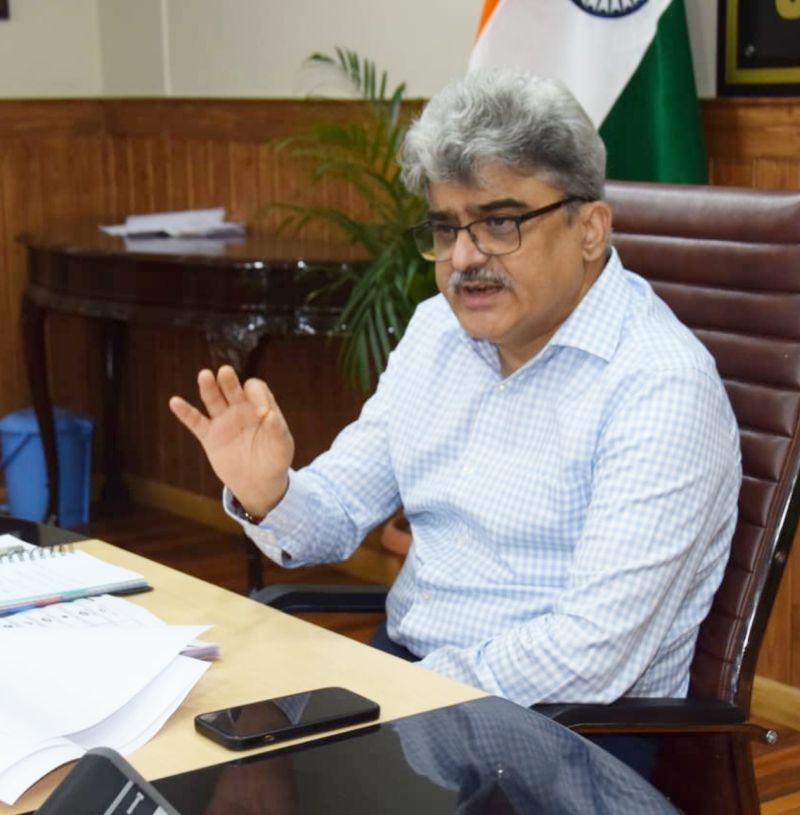
Srinagar: Chief Secretary Atal Dulloo on Thursday reviewed the progress of renewable energy initiatives and emerging green-energy policies in Jammu and Kashmir, directing departments to ensure coordinated and time-bound implementation of key projects.
Chairing a meeting of the Science and Technology Department, Dulloo called for completion of a district-wise biomass survey and identification of suitable government land for creation of a centralised Green Land Bank.
He said J&K has immense potential in solar, hydro, wind and biomass resources and stressed the need to convert this potential into viable projects that can strengthen energy security, generate employment and support sustainable development.
The meeting reviewed initiatives related to floating solar projects, small hydro power, solarisation of government buildings, wind-energy assessment, battery energy storage systems and compressed bio-gas (CBG) production.
Officials informed the meeting that five reservoirs have been identified for floating solar projects with a combined potential of 83.51 MW. Among them, Manasbal Lake in Ganderbal and Mansar Lake in Samba were found highly suitable for development.
The meeting was told that seven small hydro projects with a total capacity of 35.25 MW are currently operational, while another 3 MW project is nearing completion. Detailed project reports have also been prepared for 132 additional small hydro projects with a combined capacity of 449 MW.
Reviewing the PM Surya Ghar: Muft Bijli Yojana, officials said J&K has secured approval for eight Detailed Project Reports under the Model Solar Village component, attracting Central assistance of ₹7.99 crore.
The meeting was also informed that wind-resource assessments have been conducted at Bidda and Ijara, with Bidda found suitable for development of a full-scale wind farm. JAKEDA has additionally proposed pilot installation of 5-10 kW vertical-axis wind turbines.
A roadmap presented by the Centre for Innovation and Technology Transformation (CITaG) envisages development of 500 MW of solar power, 150 MW of battery energy storage systems and 50 MW of wind power by 2030, with further expansion planned by 2040.
The proposed Compressed Bio-Gas Policy aims to utilise municipal wet waste, livestock manure, orchard waste and agricultural residue to produce clean fuel. Under the plan, at least six major CBG plants with a combined production capacity of 32 tonnes per day are proposed to be operational by March 2030.
Officials said the initiative could generate more than 700 direct jobs while creating a network of biomass and feedstock aggregators across the Union Territory.
The meeting was attended by Commissioner Secretary Science and Technology Babila Rakwal, Director CSIR-IIIM Jammu, CEO JAKEDA, CEO CITaG and other senior officers.