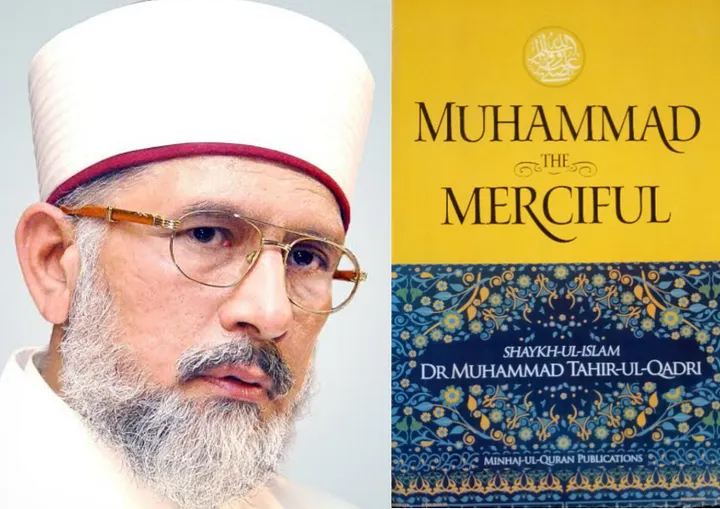
Dr. Muhammad Tahir-ul-Qadri is not just a preacher but also a writer, appealing to both youth and elders with a taste for reading. He does not confine his ideas to Muslims alone, but presents his opinions in a way that is accessible to a wider audience.
Years ago, my hands fell on the thick book with an elegant cover page, captivating title, and aesthetic paper. It was ‘Muhammad (pbuh) – The Merciful’, a topic that the contemporary world needs to know, necessitated by prevalent immorality, diversion from religion, and Islamophobic missionaries working at full speed.
The book is so interesting that I re-read it and was goaded into sharing my views about it. The book is divided into two parts, with the first part consisting of four chapters and the second half comprising fourteen chapters spanning over 410 pages, along with a bibliography and keywords.
The first part of the book deals with topics that underline the mission Messenger of Allah (pbuh) was entrusted with. It focuses on mercy and expounds how Prophet Muhammad (pbuh) is different from other Prophets on that count. Each chapter brings forth a new idea and gives adequate sense about the Prophet’s attribute of being ‘Rehmah’ (mercy). Concepts like the Prophet as clement and compassionate to the believers, his humility, non-stern and non-harsh behaviour, how he lightened the burden of communities and is mercy for everyone in this world, etc. leave the reader spellbound. The doctrine of Islam and therefore Muhammad (pbuh) is perfectly encapsulated in this portion of the book. Towards the closure of this section, a page has been dedicated to a summary, which summarises the entire chapter and helps the reader to arrive at a certain conclusion in an exact manner.
The second part of the book furthers the interest as it delves into themes like the Prophet’s kindness towards women, infants, young children, youth, weak, poor, ignorant, widows, orphans, slaves, servants, sick and deceased, disobedient and sinful, hypocrites, enemies, disbelievers, idolaters, non-Muslim citizens and those under an agreement of protection. These domains are ever-relatable, ever-concerning, and the Prophet (pbuh) offers an ever-applicable perspective across all such domains through his imitable and exemplary role.
The issue we are grappling with is ‘women empowerment and our failure to secure their rights’. We claim to have evolved a lot, but female of our society still face harshness. Domestic violence is something where we safely blame the woman for their part. But who will answer for victims of rape? What sort of logic can one use to justify one’s inhuman instincts? Hence, we need to understand the sanctity of women, value it, like we hold our worship close to us. Because both are ordains of Quran and hadith. Dr. Tahir-ul-Qadri merits commendation for not undermining this crucial issue while scribing. The author rightly defends his title of being a global religious leader with an acute sense of awakening.
The last two chapters explore the areas like Holy Prophet’s mercy and kindness towards animals, birds, plants, and inanimate objects. These are the issues that shatter the myth that Muslims are merciless, savage towards other beings, and their religion is outdated. It amplifies and vindicates the opinion that illustrious and prudent scholars have been debating for a long time that Islam recognises the rights of all.
Not only does this book provide an answer to anti-Islamic activists, organisations, and protagonists, who put exhaustive efforts to nullify the universality and comprehensiveness of Islam, but it is also enough to wake the self-styled, worldly-oriented clergy up to rethink their style of preaching rooted in sectarianism and mutual mudslinging. It could help liberate them from intellectual zones and encourage greater diversity in their sermons, making them both informative and meaningful. For the common masses, this book brings information to their doorsteps, enabling them to appreciate the pertinence of a 1400 years old religion- one we must all be proud of.
The writer mentions Quranic verses and Ahadith profusely to prove his point, which makes the book incontestable. The mention of classical scholars and their books exhibits the academic rigor and scholarly depth of the writer. Also, it spurs a reader to reach the depths of religious studies; for it proves ‘superficial knowledge can be perilous’. It corroborates the fact that superficial knowledge of Islam will always fail us to address our own existing and imminent global issues. Contrary, a thorough understanding of Islam can help us to withstand and conquer every challenge, as our religion is universal in scope and enduring in relevance.
The author is a Student, Educator, and Columnist.