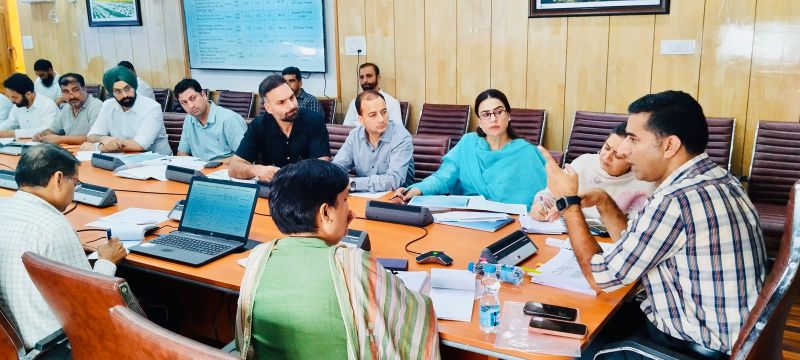
Jammu: More than 570 sports and youth infrastructure projects worth over ₹650 crore are at various stages of planning and execution across Jammu and Kashmir during the current financial year, Commissioner Secretary, Youth Services and Sports, Dr Shahid Iqbal Choudhary, said while reviewing the department’s first quarterly implementation roadmap on Tuesday.
The review meeting was attended by Director General, Youth Services and Sports, the Special Secretary, Secretary of the J&K Sports Council, senior officers of the department, engineering agencies, District Youth Services and Sports Officers from all 20 districts and officials of the Sports Council.
The review covered progress under Capital Expenditure (CapEx), Special Assistance to Capital Investment (SASCI), Centrally Sponsored Schemes including the Khelo India Mission, revenue expenditure, budget announcements and district-wise implementation of sports infrastructure projects.
According to officials, the Directorate of Youth Services and Sports is implementing 315 CapEx projects during 2026-27, comprising 167 ongoing works, 140 new projects and eight non-construction initiatives, besides projects under SASCI and other flagship schemes.
The J&K Sports Council is simultaneously executing 263 infrastructure projects, including 195 ongoing works, 57 new projects and 11 SASCI disaster component projects, taking the total number of sports infrastructure projects across the Union Territory to more than 570.
During the meeting, the Commissioner Secretary reviewed progress on several major projects, including the development of Khel Gaon, Nagrota, which is being developed as a multi-sport hub with a Lawn Tennis Academy, a new Directorate headquarters, a Strength and Conditioning Centre, a Youth Hostel and upgraded cricket infrastructure.
He also reviewed work on Khel Bhawans and integrated residential sports facilities in Rajouri, Ramban, Samba, Srinagar, Anantnag, Kulgam, Poonch, Jammu and Nagrota, besides two Border Sports Academies, the proposed Centre for Mountaineering and Skiing at Sanasar, youth hostels, multi-purpose indoor halls, mini stadiums, sports academies and playfield development projects.
The review further covered Sports Council projects, including synthetic football and hockey turfs at Bandhurakh, Jagti, Gassu Hazratbal, Azad Gunj Baramulla and Draggad Shopian, Olympic-standard swimming facilities at Gindun Rajbagh, athletic tracks at Khour, Mendhar and Tulibal, stadiums at Sogam, Birpur, Panthan Thathri, Rehal Bishnah, Budgam and Bhalwal, water sports facilities at Manasbal, Sports Complex at Nilandrus, cricket academies at Srinagar, Jammu, Udhampur and Anantnag, and specialised centres for gymnastics, archery, shooting, taekwondo and cricket.
Officials informed the meeting that 108 playfields are being developed across Jammu and Kashmir this year at an estimated cost of more than ₹39 crore, in addition to 118 other sports infrastructure projects, including indoor stadiums, multipurpose halls, youth hostels, volleyball and badminton courts, pickleball courts, cricket practice facilities and sports office buildings.
Reviewing implementation of the Khelo India Mission, Dr Choudhary assessed progress on Khelo India Centres, procurement of sports equipment, strengthening of centres of excellence, cricket academies and athlete support infrastructure.
The meeting also reviewed the creation of the department’s first comprehensive GIS-based inventory of sports infrastructure through geo-tagging of stadiums, playfields, indoor halls, youth hostels, academies, sports complexes and other assets under the Directorate and the J&K Sports Council.
Dr Choudhary directed preparation of district-wise infrastructure gap analyses based on population, accessibility, sporting potential and regional requirements, with special focus on border areas, tribal regions, remote habitations, hilly districts and emerging urban settlements.
Calling for strict adherence to timelines, he instructed executing agencies to expedite preparation of detailed project reports, statutory approvals, tendering and execution while maintaining engineering quality, transparency and financial discipline. He also called for digital project monitoring, periodic field inspections and outcome-based reviews to ensure timely completion of all sanctioned works.
The Commissioner Secretary said the infrastructure expansion was aimed at improving access to quality sports facilities, promoting grassroots participation and nurturing sporting talent across Jammu and Kashmir.