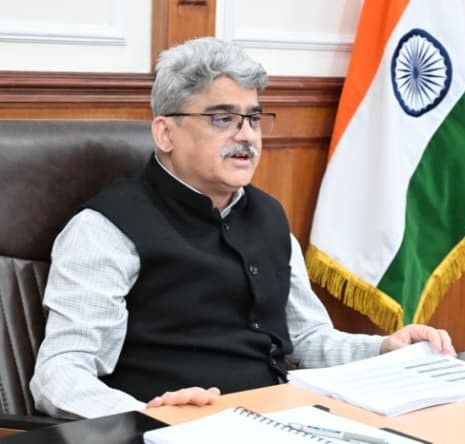
Srinagar: Chief Secretary Atal Dulloo on Wednesday reviewed preparations for the first household-level enumeration to identify multidimensionally poor families across Jammu and Kashmir as part of a proposed initiative to improve targeting of welfare schemes.
Chairing a meeting of the Planning, Development and Monitoring Department (PD&MD), Dulloo said the proposed exercise aims to create a scientifically validated, technology-enabled database to help ensure that government benefits reach the most deserving households, according to an official statement.
He directed Deputy Commissioners to assess manpower requirements in coordination with the Planning Department and asked the department to prepare capacity-building programmes for the personnel who will undertake the survey after completion of the two phases of the Census, including coverage of pastoral populations.
The proposal, presented by Commissioner Secretary, Planning, Development and Monitoring Department, R. Alice Vaz, is based on the National Multidimensional Poverty Index (MPI) framework developed by NITI Aayog in collaboration with the United Nations Development Programme (UNDP), with adaptations for household-level identification in Jammu and Kashmir.
The meeting was informed that the initial phase of the exercise would cover around 2.19 lakh Antyodaya Anna Yojana (AAY) beneficiary households across all 20 districts of the Union Territory.
Officials said the survey will assess households across three dimensions—health, education and standard of living—using 12 indicators, including nutrition, child and adolescent mortality, maternal health, years of schooling, school attendance, cooking fuel, sanitation, drinking water, electricity, housing, household assets and financial inclusion.
According to the proposal, the exercise will use two digital schedules. The first will collect information required to generate a multidimensional poverty score, while the second will gather details on reasons for deprivation and barriers to accessing government schemes for households identified as multidimensionally poor.
The proposed database is expected to support targeted delivery of welfare schemes, improve convergence across departments, strengthen monitoring of Sustainable Development Goals and facilitate evidence-based planning, the statement added.