
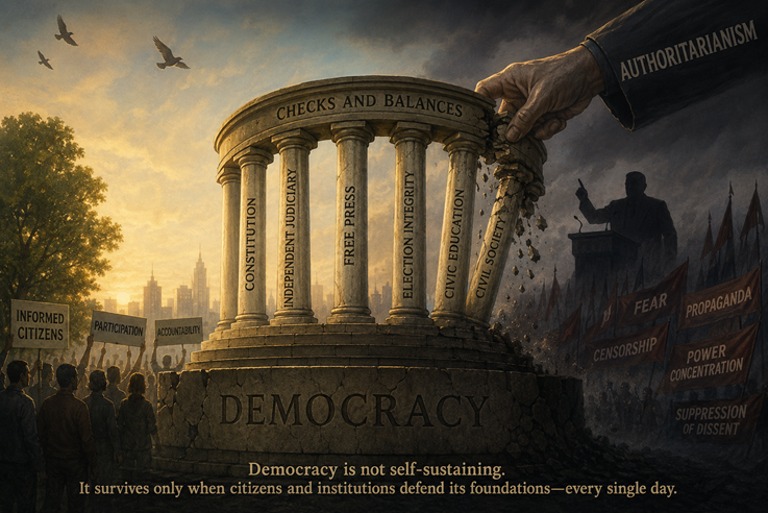
For centuries, humanity has debated a question that remains unresolved: Which system governs better, democracy or authoritarianism?
The answer often depends on whom one asks, where they live, and whether they value freedom more than stability, accountability more than efficiency, or individual rights more than collective order. Yet perhaps the more important question is not which system is superior, but why human societies repeatedly become disappointed with both.
Democracy is frequently presented as the highest achievement of modern civilization. Citizens elect their leaders, governments can be replaced peacefully, and power is distributed among institutions rather than concentrated in one individual. In theory, democracy protects liberty while ensuring accountability.
But does it always?
Democratic societies often celebrate elections as proof of political legitimacy. Yet elections alone do not guarantee competent leadership. Voters can be misinformed, manipulated by propaganda, swayed by emotions, or driven by short-term interests. Political campaigns increasingly resemble marketing exercises where slogans, personalities, and fear often matter more than policy or competence.
Can a system truly claim superiority if it repeatedly rewards popularity over wisdom? If democratic citizens can be influenced by misinformation, money, tribal loyalties, and emotional appeals, is democracy always an expression of informed public will, or can it become a reflection of collective manipulation?
History suggests that democracies are not immune to poor leadership. In fact, some of the most damaging leaders in history first acquired legitimacy through democratic or semi-democratic processes. Citizens willingly handed them power. The danger did not come from the system being overthrown from outside; it emerged from within.
Yet the criticisms of democracy often lead people toward another conclusion: perhaps strong centralized leadership is more effective.
Authoritarian governments can act quickly. They do not spend years debating policy. They can build infrastructure, implement economic reforms, and pursue long-term national objectives without constant political opposition. To citizens frustrated by political paralysis, endless elections, partisan conflict, and bureaucratic inefficiency, authoritarian leadership can appear attractive.
But should efficiency alone determine political legitimacy?
History is filled with authoritarian leaders who delivered stability, economic growth, and national development. It is also filled with authoritarian rulers who led their nations into disaster. The problem is not merely whether an authoritarian leader is competent. The problem is what happens when that leader is not.
If a democracy elects an ineffective government, citizens can eventually remove it. If an authoritarian ruler becomes corrupt, detached from reality, or obsessed with personal power, who removes them? Who questions them? Who corrects their mistakes?
Perhaps authoritarianism succeeds when leaders are wise and fails when they are not. But is it wise to build an entire political system on the hope that those with absolute power will remain wise forever?
Yet democracy faces a similar challenge. Democracies assume that large numbers of people, acting collectively, will make better decisions than a small group of rulers. But what evidence suggests that large populations are always rational, informed, or farsighted? Are crowds less vulnerable to fear, prejudice, nationalism, or emotional manipulation than individual leaders?
Perhaps the uncomfortable truth is that both systems ultimately depend on the quality of human judgment. Democracies trust the wisdom of the many. Authoritarian systems trust the wisdom of the few. Both assumptions have repeatedly succeeded and repeatedly failed.
This raises an even deeper question: Are the weaknesses of political systems actually reflections of human nature itself?
Human beings often seek freedom when they feel oppressed and seek order when they feel insecure. When democracies appear chaotic, people demand stronger leadership. When authoritarian governments become oppressive, people demand greater freedom. Societies seem to oscillate endlessly between these competing desires.
Perhaps this explains why no political system has ever solved humanity’s problems permanently. Every system eventually encounters corruption, incompetence, concentration of power, or public dissatisfaction. Constitutions can be manipulated. Institutions can be weakened. Elections can be influenced. Strong leaders can become tyrants. Even well-intentioned citizens can become indifferent to the freedoms they once demanded.
If that is true, then perhaps the central challenge is not choosing between democracy and authoritarianism. Perhaps it is understanding how to limit power itself.
A society that blindly trusts elected leaders risks democratic decline. A society that blindly trusts strong rulers risks authoritarian abuse. In both cases, excessive faith in individuals can become dangerous.
The strongest protection may not lie in a particular political system but in a culture of skepticism toward power. Independent courts, free media, civic education, transparent institutions, and active citizens are valuable not because they guarantee perfect government, but because they make it more difficult for anyone, whether elected or unelected, to accumulate unchecked authority.
Perhaps the ultimate lesson of history is that power itself is the problem. Whether it emerges through elections, military force, revolutionary movements, or popular acclaim, concentrated power tends to seek its own preservation.
The debate between democracy and authoritarianism therefore remains unresolved. Democracy may offer accountability but often struggles with efficiency. Authoritarianism may offer efficiency but often struggles with accountability. Each system highlights the weaknesses of the other while concealing its own.
The question humanity must confront is not simply which system is better. It is whether any political system can overcome the enduring realities of ambition, fear, self-interest, and the human desire for power.
Until that question is answered, the debate between freedom and authority is likely to continue—not as a contest between political systems, but as a reflection of the contradictions within human nature itself.