

From vital sea lanes and trade routes to disaster response, the Indo-Pacific sits at the center of global security and stability. For the United States, operating across this vast region requires constant readiness, strong coordination, and the ability to respond quickly in a contested environment.
Headquartered at Hickam Air Force Base, Hawaii, Pacific Air Forces (PACAF) is a major command of the U.S. Air Force and the air component of U.S. Indo-Pacific Command (USINDOPACOM) . Its primary focus is to deter aggression and ensure a free and open Indo-Pacific. It pursues this mission through a strategy of “peace through strength,” which relies on credible, combat-ready airpower and strong alliances and partnerships.
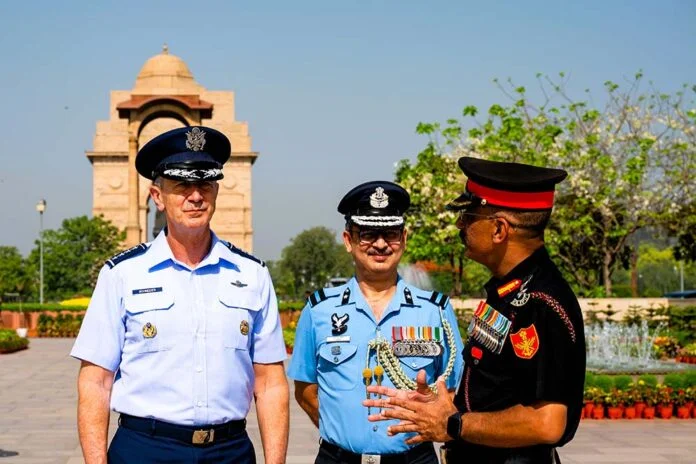
India is an important partner in these efforts, as the United States and India continue to expand cooperation through exercises, planning, and operational coordination. Bilateral defense trade and joint training with India have directly contributed to this growing interoperability.
General Kevin Schneider, commander of PACAF, highlights that “the growth in Indian and U.S. bilateral defense trade has corresponded with growing interoperability,” adding that “the importance of our partnership continues to grow, particularly as we face an increasingly complex and dynamic security environment in the Indo-Pacific.”
Evolving operational priorities
As the Indo-Pacific faces a multifaceted geopolitical environment, strengthening command and control and logistics in contested areas are a priority. To address this, operational postures are adapting through agile combat employment, a concept focused on dispersing forces, improving survivability, and maintaining operational tempo across long distances. This involves pre-positioning materials and operating from a network of smaller, dispersed locations to enable operations at speed and scale.
Engagement with partners like the Indian Air Force directly supports this adaptive posture, focusing on robust partner integration, increased information sharing, and testing interoperability. Exercises are designed to stress, test, and refine warfighting and crisis response concepts with allies and partners so they can operate as a unified force.
The relationship has matured significantly over the years; Schneider points out, “Our ability to work together has evolved from basic coordination to high-end interoperability in complex scenarios.”
This approach to mobility and rapid adaptation was recently tested in the large-scale Resolute Force Pacific (REFORPAC) exercise, which brought together more than 400 aircraft and over 12,000 personnel across 50 locations to demonstrate the ability to operate across the Indo-Pacific at scale.
Similarly, collaborative events with India like exercise Tiger Triumph focus heavily on developing these joint capabilities, specifically tailored for logistics, humanitarian assistance, and disaster relief in austere environments.
Integrating cyber and space
Air operations are increasingly linked with cyber and space capabilities. The United States is working with allies and partners to deepen operational integration through training, exercises, and planning that address emerging challenges in these domains. The goal across all partnerships is to achieve seamless operation. This ambition reflects the broader U.S.-India Major Defense Partnership, which actively includes increased information sharing, regional security cooperation, and deep collaboration in these critical new domains.
Rapid response
Strategic air mobility remains central to supporting both security operations and humanitarian response across the vast distances of the Indo-Pacific. The ability to deploy hundreds of aircraft and thousands of personnel, as proven in recent exercises, is critical to rapid response.
Looking ahead
This approach also reflects the recognition that the network of allies and partners is one of America’s greatest strategic assets, fostering a shared responsibility for regional security.
The Quad (comprised of the United States, India, Japan, and Australia) serves as a key mechanism for such collaboration on critical and emerging technologies, ensuring partners like India are integrated into the evolving operational landscape.
Looking forward, the greatest opportunities lie in continuing to build upon strategic partnerships to promote stability, both bilaterally and through regional groupings like the Quad. Future cooperation is expected to focus on emerging domains, technology, and regional security as tactical and strategic coordination in the Indo-Pacific continues to strengthen.
“The foundation of a free and open Indo-Pacific rests on the strength of our strategic relationships,” said Schneider. “In India, we have a partner whose shared values and approaches ensures our combined resolve to meet regional challenges.”
(This article is published as part of a special arrangement between Kashmir Images and SPAN Magazine, the publication of the U.S. Embassy in India (https://spanmag.state.gov/).


