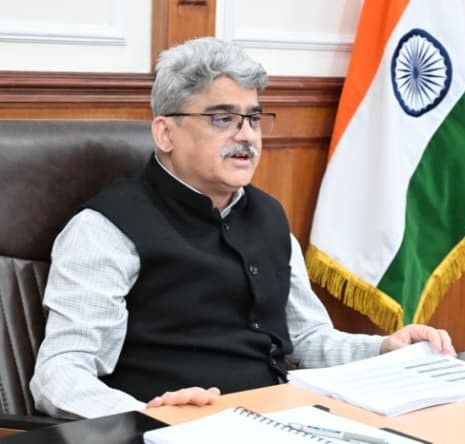
Srinagar: Chief Secretary Atal Dulloo on Sunday chaired a high-level review meeting to assess the performance of the Jammu and Kashmir MSME Health Clinic, a digital initiative aimed at diagnosing, reviving and strengthening micro, small and medium enterprises (MSMEs) across the Union Territory.
The meeting was attended by senior officials including Commissioner Secretary Industries and Commerce, Director Indian Institute of Management Jammu, Executive Director Jammu and Kashmir Entrepreneurship Development Institute, Director Industries Jammu, Director Employment and other concerned officers.
During the review, the Chief Secretary issued a series of strategic directions to enhance the effectiveness of the MSME Health Clinic. He stressed the adoption of advanced AI tools, including Large Language Model (LLM)-based systems, for root cause analysis of stressed industrial units, supported by a robust and secure framework. He also called for training such systems on local datasets and exploring indigenous platforms to improve contextual relevance.
Emphasising evidence-based policymaking, Dulloo directed officials to develop detailed case studies based on field-level diagnostics to guide targeted interventions and rehabilitation strategies. He further underscored the need for continuous capacity building, instructing departments to conduct structured training programmes every two months at the district level.
To ensure institutional convergence, the Chief Secretary called for integrating experts from the Small Business Development Unit (SBDU) under Mission YUVA into the MSME Health Clinic framework. He also stressed involving key stakeholders such as banks, National Bank for Agriculture and Rural Development, and allied departments including agriculture for coordinated support at the grassroots level.
Clarifying institutional roles, he said that Indian Institute of Management Jammu should focus on training and capacity building, while implementation must remain with field-level institutions. He also directed the Industries and Commerce Department to engage with financial institutions such as Jammu and Kashmir Bank and State Bank of India, as well as industry bodies like Federation of Indian Chambers of Commerce and Industry, ASSOCHAM and Confederation of Indian Industry, to strengthen stakeholder participation.
The Chief Secretary further directed that a comprehensive one-day workshop be organised, preferably in July, to gather structured feedback from stakeholders after completion of assessment rounds in both Jammu and Kashmir divisions.
The meeting also reviewed progress on earlier directives, including development of an interactive chatbot, automation of MSME health certificates, expansion of daily interactions and constitution of district-level committees.
Commissioner Secretary Industries and Commerce, Vikramjit Singh, informed that the MSME Health Clinic has been designed as an end-to-end system to evaluate the financial and operational health of enterprises using real-time data sources such as GST filings, banking records, power consumption and EPFO data. Based on this analysis, units are categorised as stable, recoverable or sick, enabling targeted interventions.
He revealed that 13,357 enterprises have been digitally assessed so far, with 86.26 percent classified as stable, 13.36 percent as recoverable, and a small fraction identified as vulnerable to sickness. The initiative focuses on early detection of stress signals and timely support to prevent business failure.
Director Industries & Commerce Jammu, Arun Manhas, informed that a responsive chatbot has already been integrated into the portal, with plans to upgrade it into a fully AI-enabled system. He added that district-level committees have been constituted across 10 districts and will begin large-scale outreach from May 10, with a target of increasing daily interactions from 20 to 200.
Officials further informed that 56 industrial units across multiple districts have been surveyed in detail, covering 29 sectors. Key challenges identified include high input costs, market competition, logistics constraints and working capital issues. Over 60 industrial visits have been conducted so far, with diagnostic reports and rehabilitation plans prepared for several stressed units.
On the certification front, more than 1,000 MSME Health Certificates have already been issued to stable units, with full automation expected by May 10. The system also provides an option for re-evaluation to ensure continuous monitoring.
The meeting also reviewed convergence with Mission YUVA, under which enterprises are being onboarded onto the UDYAM portal and integrated with the MSME Health Clinic platform. API integration is expected to be completed by early June, enabling seamless data exchange and improved ease of doing business across the Union Territory.