There are moments in a nation’s life when history does not merely repeat itself – it deepens. This Wednesday, as the sacred relics of Tathagata Buddha descend upon Ladakh for the first time in India on this scale of public veneration, I find myself reaching not for the language of officialdom, but for something far older: reverence.
For centuries, Ladakh has held the flame. Through brutal winters that freeze rivers solid, through geopolitical pressures that would test the sturdiest of souls, through the isolation of altitude and the remoteness of high passes – the people of Ladakh have kept the Dharma alive with a fidelity that humbles every institution and every government. It is entirely fitting, then, that India’s first historic public exposition of the Tathagata relics does not take place in a climate-controlled museum in a metropolitan city. It takes place here, on the Roof of the World, where faith is the very architecture of daily life.
And consider where these relics come from. They originate from Piprahwa, in Uttar Pradesh – the site historically identified with ancient Kapilavastu, the very birthplace of Siddhartha Gautama. Bringing them to Ladakh is, in the most literal sense possible, a homecoming.
A First That Carries the Weight of Ages
The Sacred Exposition of the Holy Relics of the Tathagata carries an official title that is also a declaration: “Peace in Times of Conflict.” In a world convulsed by war, fracture, and rising hostility, these words are a challenge to the premise that conflict is inevitable, that strength requires aggression, that the only answer to uncertainty is force. The Buddha answered that challenge two and a half millennia ago. We bring his physical presence back to remind a watching world that the answer still holds.
The sacred relics of Gautama Buddha – preserved with the utmost sanctity – are travelling for the first time from their permanent place of keeping to be venerated on Indian soil at this scale. Under Z-category security, aboard a special aircraft, they arrive in Leh on April 29th – and for fifteen days, from the 1st to the 15th of May, beginning on the auspicious occasion of the 2569th Vesak Buddha Purnima, they will be accessible to devotees, monks, scholars, and pilgrims from across the world.
The venues themselves speak volumes. The Mahabodhi International Meditation Centre, the Dharma Centre at the historic Leh Palace, the teaching ground of Jive-Tsal – the same sacred earth where His Holiness the Dalai Lama has delivered his teachings – will host this exposition. And the relics will not remain confined to Leh alone. Between the 11th and 12th of May, they will travel to the remote Zanskar valley, carrying the Buddha’s grace to a community whose Buddhist traditions remain as deep as the gorges of their landscape.
“This is a celebration of India’s soul, her civilisation, and the enduring message she carries for a fractured world.”
The Land That Never Let the Flame Go Out
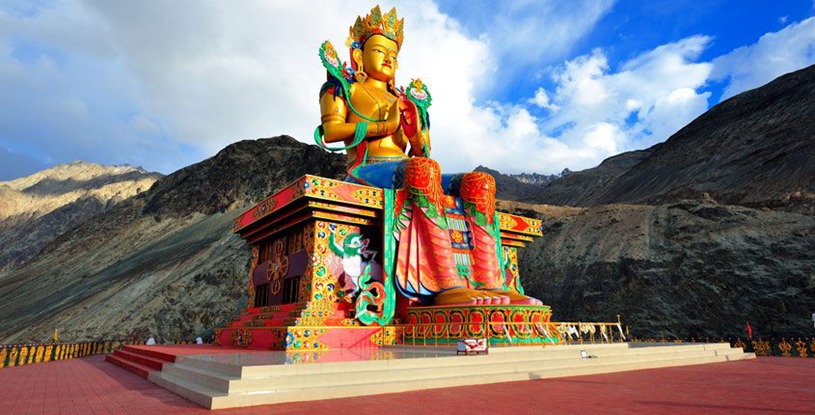
To understand why Ladakh is the right home for this occasion, one must understand what Ladakh is. It is not simply a dramatic landscape of monasteries and mountains, however breathtaking that landscape may be. It is a living university of the Dharma. From the serene heights of Hemis Monastery – whose annual festival draws pilgrims from across the Himalayan world – to the ancient frescos of Alchi, painted in the 10th century and still vivid with devotional genius; from the towering Maitreya Buddha of Diskit that faces the Shyok River with a gaze of infinite compassion, to the layered wisdom of Thiksey, often compared to the great monasteries of Tibet – Ladakh has been, for over a thousand years, one of the most extraordinary repositories of Buddhist philosophy, art, manuscript tradition, and living practice on the planet.
These monasteries, the monks who inhabit them – they are the active transmitters of a tradition that has survived every geopolitical storm the Himalayan region has known. And they have done this work of preservation under conditions that would tax the imagination of most administrators: extreme cold, scarce resources, infrastructural isolation, and a geography that demands courage simply to inhabit.
It is India’s formal acknowledgement of what Ladakh has always been – not a peripheral territory at the edge of the map, but a beating spiritual heart at the centre of the nation’s identity.
A Vision Rooted in Civilisational Depth
Prime Minister Shri Narendra Modi has consistently described Ladakh as a vibrant centre of Buddhist culture and spirituality. He has spoken often of the resilience and patriotism of the Ladakhi people – especially in difficult border conditions – linking their spiritual strength with national resolve and unity. He has made clear that development in Ladakh will go hand in hand with the preservation of its unique culture and environment.
As the Prime Minister has emphasised: Ladakh is not only a land of immense strategic importance, but also a living centre of the Buddha’s teachings. The visit of the holy relics is both a spiritual blessing and a recognition of Ladakh’s centuries-old role in preserving Buddhist heritage, as well as the courage and dedication of its people in serving the nation.
This vision – of a Ladakh that is simultaneously a frontier of national security and a citadel of civilisational wisdom – is the most coherent thing about the place.
What Ladakh Teaches a Fractured World
The exposition is expected to be one of the largest congregations of Buddhist communities India has ever hosted. And in a world increasingly defined by conflict, polarisation, and the politics of suspicion, that congregation carries a message that transcends faith.
The Buddha’s teachings on non-violence, compassion, and inner awakening are not the property of any single community, sect, or lineage. Whether it is the Gelug, Drukpa, Kagyu, or any of the other magnificent traditions that flourish in Ladakh, the essence of the Dharma remains singular: the path of karuṇā, of prajñā, of harmony.
The sacred exposition, arriving just as the region welcomes spring and the snow begins to melt from the high passes, is an invitation to cross every border that divides us: of sect, of nationality, of fear.
“The relics bless the faithful. But they also remind a watching world that the quietest forms of strength have always been the most enduring.”
Our Commitment to This Living Heritage
The Government of India recognises Ladakh as one of the most important living centres of Buddhist culture in the world. We remain committed – not in the language of policy documents alone, but in concrete action – to supporting the preservation of its monasteries, the promotion of Buddhist scholarship, and the safeguarding of its unique cultural traditions. A large-scale Buddhist chanting ceremony involving a significant number of monks is being planned as part of this exposition – one that organisers hope will be entered into the Guinness World Records, a fitting symbol of the scale of devotion this land commands.
The Union Government will continue to work closely with the monastic institutions and the people of Ladakh to ensure that this rich heritage flourishes and reaches the world. The recently launched digital portals for both Ladakh Tourism and the Sacred Exposition itself are steps in that direction
The Ministry of Culture, the Archaeological Survey of India, the International Buddhist Confederation, and the local organisations of Ladakh – the Gonpa Association, the Buddhist Association, the UT Administration under Lieutenant Governor Shri Vinai Kumar Saxena – have worked together with a unity that mirrors the very teaching the relics carry.
A Moment That Belongs to All of Us
As the sacred relics of Tathagata Buddha arrive in Ladakh this Wednesday, something ancient stirs. It is the recognition that some things in the life of a civilisation matter more than the political cycle of any given season. The Buddha’s message of compassion is one such thing. Ladakh’s fidelity to that message is another.
May the blessings of the Buddha bring peace to every home in Ladakh, harmony among all communities, and spiritual awakening to all beings. And may this sacred exposition remind each of us – regardless of faith, regardless of where we stand – that the deepest human aspiration has always been the same: to live without causing suffering, to act with wisdom, and to leave the world a little more at peace than we found it.
Buddham Sharanam Gacchami.
Dhammam Sharanam Gacchami.
Sangham Sharanam Gacchami.
Courtesy PIB, Srinagar
(The Author is the Union Minister for Culture and Tourism, Government of India.)