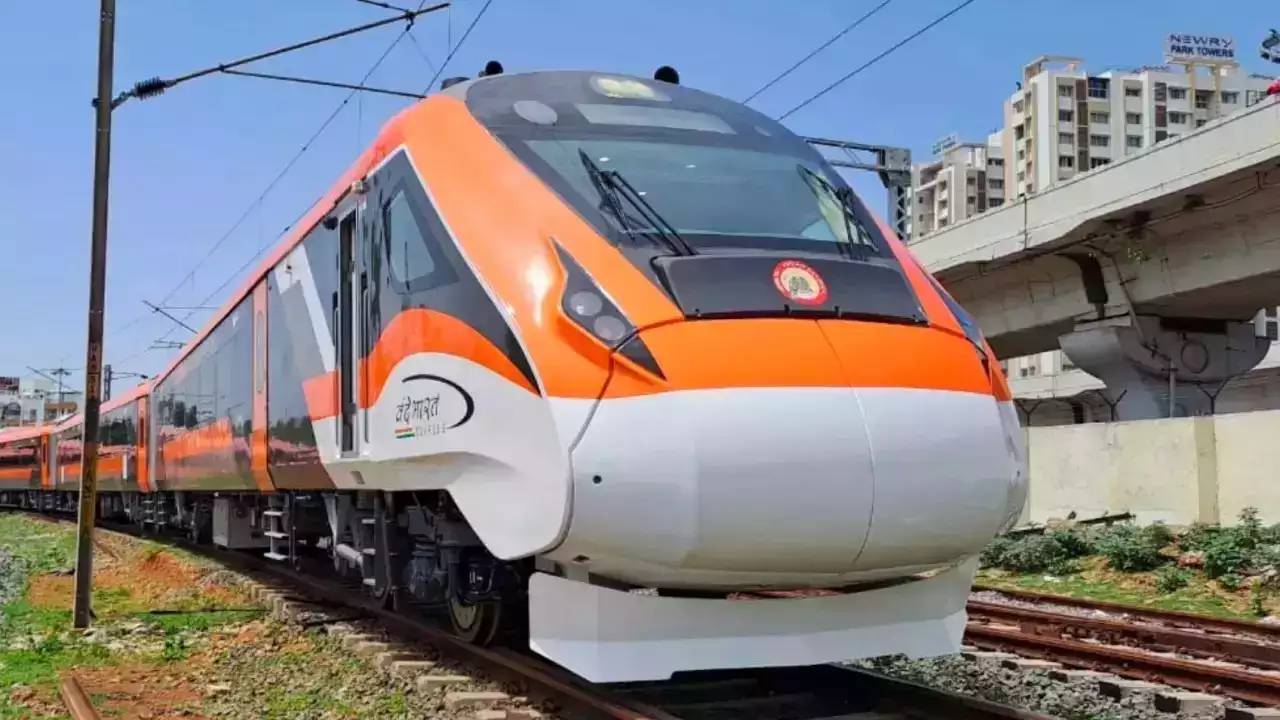
New Delhi: Union Railway Minister Ashwini Vaishnaw will flag off the extended Srinagar–Jammu Tawi Vande Bharat Express from Jammu Tawi railway station on April 30, marking a significant expansion of high-speed rail connectivity in Jammu & Kashmir.
The Vande Bharat service, which until now operated between Srinagar and Shri Mata Vaishno Devi Katra, will be extended to Jammu Tawi, one of the region’s busiest rail hubs, bringing the country’s flagship semi-high-speed train directly to the winter capital of the Union Territory.
During his visit, the minister is also scheduled to inspect two landmark engineering structures on the Udhampur–Srinagar–Baramulla Rail Link (USBRL): the Anji Khad Bridge, India’s first cable-stayed railway bridge, and the Chenab Rail Bridge, the world’s highest railway arch bridge.
Originally launched by Prime Minister Narendra Modi on June 6, 2025, with an 8-coach configuration, the Vande Bharat train on this route has witnessed consistently high demand. In response, the rake has now been expanded to 20 coaches—more than doubling its seating capacity and easing pressure on reservations, particularly during peak pilgrimage and tourist seasons.
The move is expected to significantly reduce waitlists and improve accessibility for passengers, including pilgrims, tourists, traders, and daily commuters.
While the April 30 run will be ceremonial, regular operations of the extended Jammu Tawi–Srinagar Vande Bharat Express will commence from May 2. Two pairs of trains will operate six days a week (with different weekly off days), covering a distance of approximately 266 km.
The first service (Train No. 26401) will depart Jammu Tawi at 6:20 AM and reach Srinagar at 11:10 AM, halting at Katra, Reasi, and Banihal. Its return service (Train No. 26402) will leave Srinagar at 2:00 PM and arrive in Jammu Tawi at 6:50 PM. This pair will not operate on Tuesdays.
The second service (Train No. 26404) will depart Srinagar at 8:00 AM and reach Jammu Tawi by 12:40 PM, stopping at Banihal and Katra. Its return (Train No. 26403) will leave Jammu at 1:20 PM and reach Srinagar at 6:00 PM. This pair will remain off on Wednesdays.
Together, these services offer both morning and afternoon travel options from either end, enhancing flexibility for passengers.
The extension eliminates the need for passengers to change trains at Katra. Travellers arriving at Jammu Tawi from major cities like Delhi or Mumbai can now board a single Vande Bharat train to reach Srinagar without interruption. Similarly, passengers from the Valley will be able to connect directly to the national rail network at Jammu.
For pilgrims, the move simplifies travel to Shri Mata Vaishno Devi and further to Kashmir, especially for those combining the Vaishno Devi pilgrimage with the Amarnath Yatra. Tourists, too, stand to benefit from a faster and more comfortable journey through the Himalayan landscape.
The train is designed to operate in extreme weather conditions, including temperatures as low as minus 20°C, making it a reliable alternative during winter months when the Jammu–Srinagar National Highway often faces disruptions due to snowfall.
Improved rail connectivity is also expected to benefit local businesses. Traders, artisans, and entrepreneurs, particularly those dealing in handicrafts, horticulture, and textiles—will gain from faster and more dependable transport between Jammu and Srinagar.
The Anji Khad Bridge, rising 331 metres above the river valley and supported by 96 high-tensile cables, and the Chenab Rail Bridge, standing 359 metres above the riverbed, are among the most ambitious components of the USBRL project. Their completion has been crucial in enabling uninterrupted rail connectivity to the Kashmir Valley.
The extension marks another milestone in the transformation of rail infrastructure in Jammu & Kashmir. Key developments over the past decade include the commissioning of the Udhampur–Katra section in 2014, the introduction of electric trains in the Valley in 2024, and the establishment of a dedicated Jammu Railway Division in 2025.
The USBRL project, spanning 272 km, with 36 tunnels covering 119 km and 943 bridges, has been built at a cost of ₹43,780 crore and now forms the backbone of rail connectivity in the region.
With the extension of the Vande Bharat to Jammu Tawi, the rail network in J&K takes a major step forward, offering faster, more reliable, and seamless connectivity to millions of passengers.