New Delhi: Union Minister of Commerce and Industry Piyush Goyal on Monday announced a sweeping three-year fee waiver for all intellectual property (IP) registrations related to sports, marking a major policy push to promote innovation in the sector.
The announcement came during the World Intellectual Property Day celebrations in the national capital, held under the theme “IP and Sports: Ready, Set, Innovate!”.
Under the initiative, registrations across categories—including trademarks, copyrights, patents, industrial designs, traditional knowledge, and geographical indications—will be exempt from fees with immediate effect. Describing it as a special drive to strengthen the sports innovation ecosystem, the Minister directed officials to issue a notification without delay. He added that beyond the waiver, the government will also provide facilitation support under existing schemes to assist innovators, students, artisans, and other stakeholders in securing IP rights.
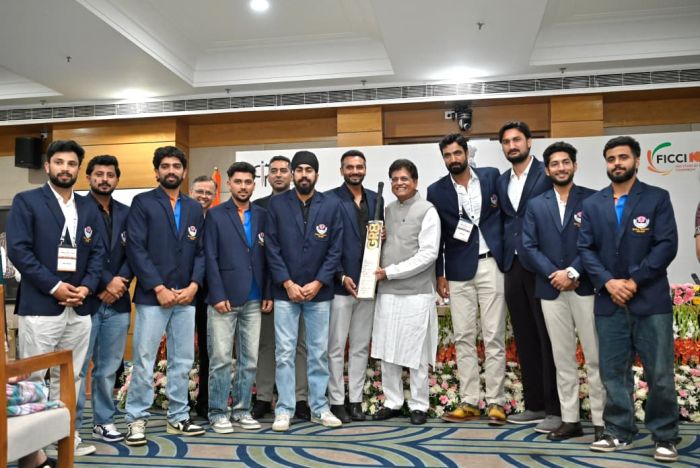
The valedictory session of the programme also saw Piyush Goyal felicitating the Jammu and Kashmir Ranji Trophy team for its historic performance, including a landmark victory after 67 years and a notable win over eight-time champions Karnataka cricket team. The achievement was hailed as a moment of pride and a sign of the region’s growing sporting potential, expected to inspire young athletes across Jammu and Kashmir.
Highlighting the broader context, the Minister said the development reflects sustained government efforts to promote sports and expand opportunities in Jammu and Kashmir through investments in infrastructure, tourism, and industry. He described the team’s success as a signal of renewed confidence, with athletes from the region poised to make their mark at national and international levels.
Emphasising India’s craftsmanship and IP strength, Piyush Goyal pointed to the GI-tagged Kashmir willow cricket bat as a standout example. He noted that it is among the first—and possibly the only—sports-related product from India to receive a Geographical Indication tag, and called for its wider promotion globally while strengthening manufacturing within Jammu and Kashmir.
The Minister also advocated for the development of sports manufacturing clusters in regions such as Jammu and Kashmir and Meerut, identifying their potential to emerge as key hubs for sports goods. He stressed the need to boost domestic production of equipment such as bats, balls, hockey gear, training aids, and gym equipment to strengthen local value chains and indigenous manufacturing.
Focusing on Jammu and Kashmir, he underscored the opportunity to build specialised manufacturing ecosystems that can enhance livelihoods and improve the region’s presence in national and global markets. He also encouraged innovation in sports formats, urging that such ideas be evaluated for IP protection to drive value creation and support long-term sectoral growth.
Calling on innovators and students to act early, the Minister urged stakeholders to convert new ideas into IP assets and seek timely registration, while making use of available government support systems.
Highlighting the economic potential of sports, Piyush Goyal noted the sharp rise in valuations of franchise-based cricket teams over the past 18 years, attributing it to innovation and commercialisation. He also referred to the recently signed India–New Zealand Free Trade Agreement, noting that the two countries are celebrating 100 years of sporting ties.
Reiterating the government’s vision of “innovate, patent, produce and prosper,” he said India’s expanding network of free trade agreements is opening new global opportunities for innovators.
In a related development, the Minister launched the Viksit Bharat Digital Matrix 2026 – Design Hackathon, a six-month initiative organised by the Department for Promotion of Industry and Internal Trade (DPIIT) in collaboration with Indian Institute of Technology Delhi. The hackathon, focused on smart wearables, aims to encourage development of next-generation solutions that enhance everyday living, performance, and holistic wellness.
The initiative seeks to promote the convergence of advanced technology and user-centric design, encouraging participants to create prototypes that are both functionally sophisticated and aesthetically refined. It also aims to ensure that such innovations are protected through patents and design rights, reinforcing India’s push towards an IP-driven innovation ecosystem.
Piyush Goyal further highlighted India’s expanding sporting ambitions, including the inclusion of cricket in the Olympics and the country’s bid to host the 2036 Olympic Games. He called for greater youth participation in global sporting platforms, including from Jammu and Kashmir.
Describing sports as both a driver of physical well-being and a significant economic activity, the Minister pointed to the growing scale of sports viewership and the rapid adoption of new formats in India.
Referring to the upcoming Sports Policy 2025, he outlined efforts to strengthen infrastructure, promote sports at the school level, and ensure equal opportunities nationwide. He also cited earlier initiatives such as the establishment of a sports academy in Ranchi aimed at nurturing talent from tribal communities.
He further urged increased utilisation of Corporate Social Responsibility (CSR) funds for sports development, including the creation of open gym facilities and expansion of infrastructure in remote areas.
Cautioning sportspersons and influencers, the Minister stressed the importance of responsible endorsements, particularly in areas such as nutrition and supplements, to avoid misleading advertising.
The event also featured interactive elements including a sports IP quiz, a workshop on sports advertising and endorsements, and discussions on the “Future of IP & Sports” with participation from international IP offices. A Sports Innovation Arena showcased advancements in sports technology, manufacturing, and esports, underscoring the sector’s evolving landscape.