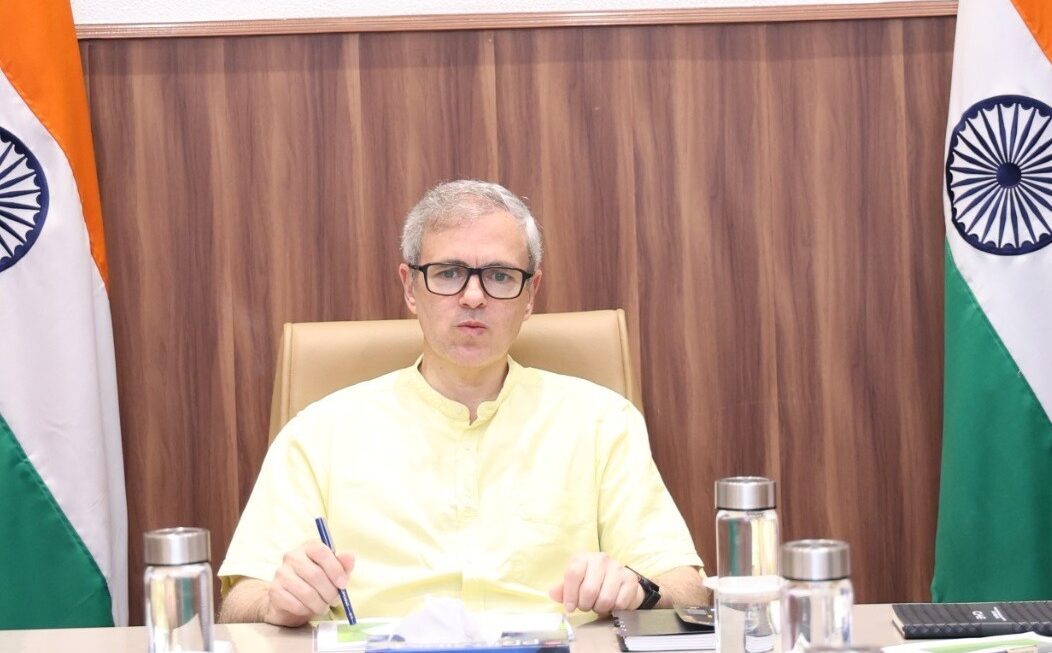
Srinagar: Chief Minister Omar Abdullah has expressed gratitude to Prime Minister Narendra Modi and Union Minister for Road Transport and Highways Nitin Gadkari for their support and approval of the Sudhmahadev–Dranga and Singhpora–Vailoo tunnel projects on NH-244.
As per an official press release, the chief minister said that these vital infrastructure projects will significantly strengthen connectivity, ensure all-weather access, and accelerate economic growth across the Chenab Valley and adjoining regions.
The Government of India has approved the construction of the uni-directional twin-tube Sudhmahadev–Dranga Tunnel (12.85 km, including 2-lane plus paved shoulder approaches) and the twin-tube Singhpora–Vailoo Tunnel (38.61 km, including 2-lane plus paved shoulder approaches) on NH-244 in Jammu & Kashmir, at an estimated total cost of ₹9,779.42 crore.
Recalling his earlier intervention, the chief minister said that in June last year, he had written to the Prime Minister and the Union Minister highlighting delays in the projects and seeking their urgent consideration. He had urged that the projects be taken up under the NH (O) scheme of the Ministry of Road Transport & Highways on priority to ensure their timely completion in line with the broader vision for the development of Jammu & Kashmir and the nation.
In his communication, the chief minister had also expressed concern that while other NH projects on NH-244 were progressing under NHIDCL, delays in these two critical tunnels were impeding the expected socio-economic benefits for the Chenab region and hindering its efforts to overcome economic backwardness, the press release said.
Meanwhile, Abdullah underscored the critical role of the banking sector in strengthening financial inclusion, supporting entrepreneurship, and driving sustainable economic growth in Jammu & Kashmir.
Addressing the Axis Bank Senior Management Confluence in Srinagar, the chief minister noted that the bank, with its network of 54 branches across Jammu and Kashmir, has played a significant role in advancing financial inclusion, an official press release informed.
Reflecting on the region’s economic landscape, the chief minister said that Jammu & Kashmir may be relatively small in terms of geographical size, market scale, and natural resources compared to other states, but it is rich in opportunities. He emphasized that sectors such as MSMEs, tourism, agriculture, and horticulture offer immense potential for growth and investment.
Highlighting the region’s “transformative trajectory”, he said Jammu & Kashmir is “witnessing sustained progress driven by infrastructure development, tourism expansion, agricultural advancement, and a growing entrepreneurial ecosystem”. He reiterated that the banking sector plays a pivotal role in enabling credit access, promoting digital finance, and supporting enterprise growth.
Speaking on tourism, the chief minister described it as a sector close to the collective aspirations of both the government and private stakeholders. He pointed out the need to enhance customer experience at key destinations such as the Gulmarg Gondola, suggesting improvements in queue management, introduction of time-slot based ticketing, and plugging operational gaps. He noted that such areas present opportunities for collaboration between the government and financial institutions like Axis Bank, particularly in deploying technology-driven solutions.
At the same time, he underscored that while tourism is important, agriculture and horticulture remain the largest contributors to Jammu & Kashmir’s GSDP. He called for innovative partnerships with the banking sector to deliver tailored financial solutions, strengthen value chains, and improve market access for farmers and horticulturalists.
The chief minister also highlighted opportunities in urban governance, including municipal services such as collections and disbursements, where banking institutions can play a greater role through efficient and technology-driven systems. He acknowledged that banks operating in Jammu & Kashmir are familiar with the region’s unique challenges and encouraged them to innovate within this context.
Calling for stronger collaboration, he urged the banking sector to expand its role in startup financing, MSMEs, and youth entrepreneurship, and to increase its footprint in underserved regions while supporting key sectors such as handicrafts and tourism through CSR initiatives.
Reaffirming the government’s commitment, the chief minister stated that Jammu & Kashmir is ready to partner with financial institutions to build a resilient, inclusive, and future-ready economy.