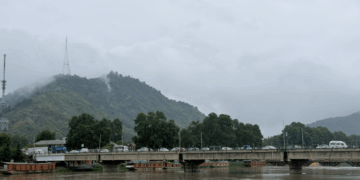

There is a strange contradiction playing out in Kashmir today – so visible, so loud, and yet so rarely questioned. It has been so, say most grandfathers and grandmothers, always like that. The Valley that struggles daily with its own decay suddenly finds its voice when the crisis is thousands of miles away.
Streets fill up, slogans rise, donations flow, and leaders compete in expressions of solidarity. Recent events have shown exactly this – rallies, aid collections, and even disruptions inside the Jammu & Kashmir Assembly over developments in Iran.
Delegations meet foreign envoys, condolences are offered, and emotional alignment is displayed with remarkable urgency. For a moment, Kashmir appears united, mobilized, and deeply conscious.
But then, one uncomfortable question emerges – and refuses to go away. Where is this Kashmir when the crisis is its own?
Because back home, the same Valley is drowning quietly in problems that are neither distant nor abstract. Springs are drying, garbage is piling up, cities are choking, and systems are eroding. Yet, there are no comparable rallies. No mass mobilizations. No emotional outpouring. No urgency. It is as if Kashmir has developed a peculiar instinct – to feel deeply about causes where its voice carries no consequence, and to remain detached from problems where its voice is the only one that matters.
This is not empathy. This is displacement.
And nowhere is this contradiction more sharply visible than in the conduct of its political class. Inside the Assembly, leaders erupt over global conflicts. Proceedings descend into chaos, slogans echo, and positions are taken on international wars. Outside the Assembly, however, the same leaders walk past collapsing infrastructure, polluted water bodies, unplanned urban expansion, and a steadily deteriorating quality of life – with remarkable composure. The outrage is loud, but it is not local.
It is performative.
Because it is easier to speak about Iran than about garbage in one’s own constituency. Easier to condemn a distant war than to confront a failed drainage system. Easier to align with global narratives than to fix local dysfunction.
In Iran, bombs may be falling and people may be suffering – that is real, tragic, and deserving of empathy. But what is equally real is that in Kashmir, decay is not falling from the sky. It is rising from the ground. And it is being ignored.
This selective consciousness reveals something deeper.
Kashmir today is emotionally invested in issues where it has no agency, and indifferent to those where it has full responsibility.
Because responsibility is uncomfortable. It demands ownership. It demands accountability. It demands sustained effort without applause.
Emotion, on the other hand, is easy. It requires only expression. And expression has become Kashmir’s strongest currency.
So, we gather, we speak, we donate, we declare solidarity. But we do not organize ourselves to clean our own lakes. We do not mobilize to save our own springs. We do not disrupt assemblies over our own failing systems. We do not demand accountability for our own collapsing urban spaces.
We have, in effect, outsourced our conscience.
This is precisely why the spectacle becomes almost surreal. A region battling its own environmental, civic, and institutional decline finds the energy to intervene – emotionally, politically, and publicly – in global conflicts. A society that cannot fix its garbage system feels compelled to comment on geopolitical wars. A political class that has no coherent district-level vision finds comfort in taking positions on international diplomacy.
And the tragedy is not that Kashmir cares about the world. The tragedy is that it does not care enough about itself.
Because the problems back home are not waiting. They are intensifying. Water systems are weakening. Waste is accumulating. urban chaos is becoming irreversible. Social fatigue is deepening. These are not distant possibilities – they are immediate trajectories. And unlike global conflicts, these will not be resolved by statements, protests, or symbolic gestures.
They will require work. Relentless, unglamorous, local work. Which is precisely what is missing.
The most bitter truth, then, is not about Iran. It is about Kashmir. It is about a society that has learned to amplify its voice where it carries no consequence – and to suppress it where it could actually make a difference.
It is about a political class that prefers posturing over performance. It is about a people who can mobilize for symbolism, but hesitate to organize for survival.
And if this continues, the consequences will not be ideological. They will be existential. Because while Kashmir cries for Iran, Kashmir itself is quietly collapsing – unheard, unattended, and increasingly, unlivable.
And perhaps the harshest question that future will ask is this: When everything around you was falling apart… why did you choose to speak everywhere – except where it mattered most?