

PIB EXPLAINER:
India is rapidly harnessing Artificial Intelligence (AI) to transform its agriculture sector, signalling a new era of productivity, sustainability, and resilience. Ranked third globally in AI competitiveness by the 2025 Global AI Vibrancy Tool of Stanford University, the country’s steady progress reflects strong digital infrastructure, a vibrant innovation ecosystem, and growing public investment. Agriculture, the backbone of rural livelihoods, is now benefiting from this technological momentum.
The ongoing India-AI Impact Summit 2026 underscores the nation’s commitment to using artificial intelligence for inclusive development. Anchored in the vision of human-centric innovation, the initiative promotes equitable access to AI tools, especially for underserved farming communities. Within this broader framework, agriculture has emerged as a priority sector where data-driven insights are empowering farmers to make smarter and more timely decisions.
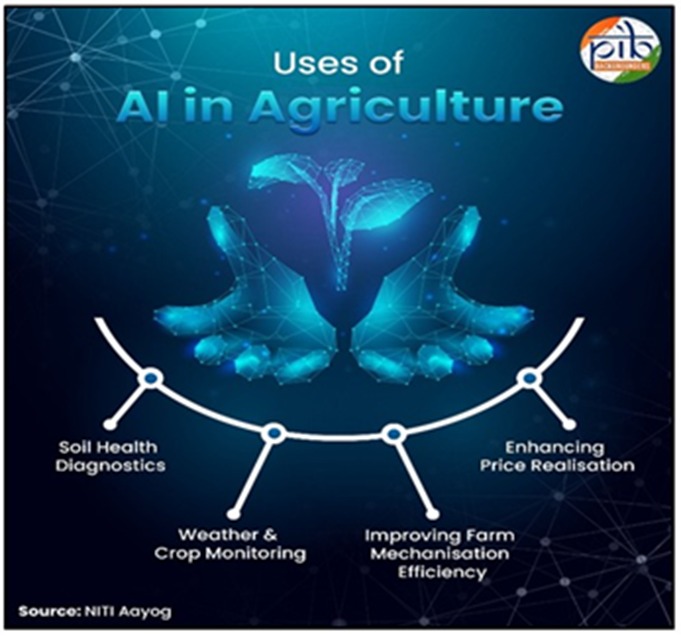
AI-enabled agriculture converts complex datasets into simple, actionable advisories. By analysing satellite imagery, soil parameters, crop patterns, and weather forecasts, intelligent systems help farmers decide what to sow, when to irrigate, and how much input to apply. Early warnings about pest attacks and diseases further reduce production risks, making farming more precise and efficient.
A compelling example of AI’s field-level impact is the experience of Rajaratnam Kanakarajan, who adopted an AI-enabled precision farming system developed by Farm Again, a Tamil Nadu-based startup. Using solar-powered sensors linked to a mobile platform, the system monitors soil moisture, irrigation, and fertiliser use in real time while automating key farm operations. By optimising crop conditions and reducing over-irrigation, the intervention led to a doubling of coconut yields. The model now benefits over 3,500 farmers across more than 4,000 acres in Tamil Nadu. Its affordability—about ₹2.5 lakh compared to nearly ₹25 lakh for imported systems, has accelerated adoption. Environmentally, the solution saves over 4,00,000 cubic metres of water and around 1,75,000 kWh of energy annually while avoiding roughly 20,000 tonnes of CO₂-equivalent emissions, demonstrating scalable, sustainable impact.
Government initiatives are reinforcing this transformation. The Union Budget 2026–27 has proposed Bharat-VISTAAR, a multilingual AI platform integrating AgriStack databases with scientific crop practices to deliver customised advisories. Complementing this, the Kisan e-Mitra chatbot, launched in 2023, has answered more than 93 lakh farmer queries as of December 2025, handling over 8,000 questions daily in 11 regional languages, significantly improving access to scheme-related information.
Risk management capabilities have expanded considerably. The National Pest Surveillance System now supports 66 crops and over 432 pest species, providing real-time advisories to more than 10,000 extension workers. Meanwhile, an AI-based local monsoon onset forecasting pilot for Kharif 2025, implemented with the India Meteorological Department, reached 3.88 crore farmers across 13 states through SMS alerts. Surveys show that 31-52 percent of farmers adjusted sowing schedules and land preparation based on these forecasts, highlighting measurable behavioural change.
India has also created a robust digital foundation for agriculture under the Digital Agriculture Mission. More than 7.63 crore Farmer IDs have been generated through AgriStack, while digital crop surveys have covered over 23.5 crore plots, enabling targeted and data-driven service delivery. AI-powered tools such as YES-TECH, CROPIC, and the PMFBY WhatsApp Chatbot are further modernising crop insurance under the Pradhan Mantri Fasal Bima Yojana by improving yield estimation, damage assessment, and farmer outreach with greater speed and transparency.
AI is simultaneously improving farm economics. Predictive analytics applied to agricultural marketing platforms are strengthening price discovery and reducing distress sales. Support to agri-tech startups under the Rashtriya Krishi Vikas Yojana has catalysed innovation across precision farming, IoT solutions, and supply chain management, helping translate research into field-ready applications.
Looking ahead, advances in agricultural robotics led by the ICAR–Indian Agricultural Research Institute and the policy roadmap outlined in the Future Farming playbook signal a decisive shift toward precision agriculture. Collectively, these initiatives illustrate how India’s human-centric AI strategy is building a resilient, efficient, and inclusive agricultural ecosystem, one that empowers farmers while advancing sustainable rural prosperity.
Courtesy: Press Information Bureau, Srinagar


