Jammu: The Jammu & Kashmir Government on Thursday made a series of policy clarifications in the Legislative Assembly, announcing uniform implementation of Scheduled Tribe (ST-I) reservation across the Union Territory, operationalisation of a real-time fake-news monitoring cell, focus on strengthening existing schools and incentives for employees serving in remote areas.
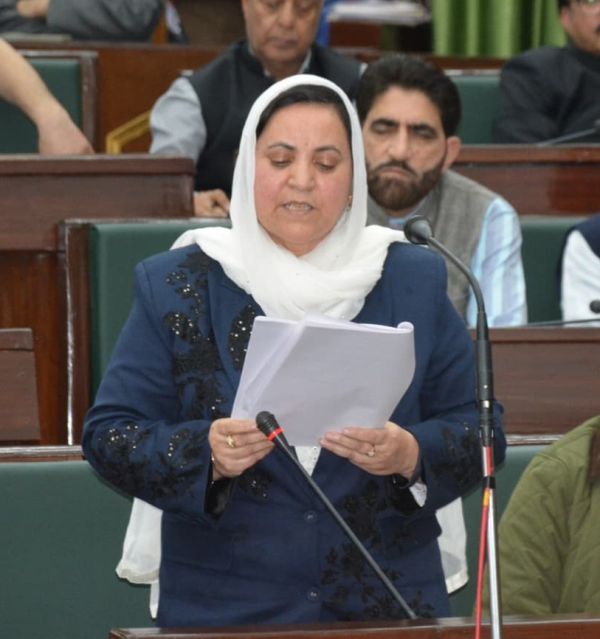
Replying to a question by legislator Dr Narinder Singh Raina, Social Welfare Minister Sakeena Itoo said ST-I reservation has been implemented uniformly across Jammu and Kashmir. She clarified that the ST-II reservation extended to the Pahari ethnic group is based on ethnic, cultural and linguistic identity, not on any regional or area-specific criteria, as reflected in SO-176 of 2024.
The Minister said no separate regional assessment was required since the inclusion is grounded in ethnicity and is consistent with constitutional principles of equality and non-discrimination. Legislators Ajaz Ahmed Jan and Dr. Rameshwar Singh raised supplementary queries.
In another reply, on behalf of Chief Minister Omar Abdullah, the Minister informed the House that a dedicated Media Monitoring Cell (MMC) has been established in the Directorate of Information and Public Relations (DIPR) to track fake and misleading news in real time and issue rebuttals through press releases and official social media platforms.
She said the cell continuously monitors print, electronic and social media platforms and issues fact-check posts whenever misinformation is detected. Between April 1, 2025 and January 31, 2026, DIPR issued 28 rebuttals — 20 through press releases and eight via social media.
All departments, she added, have designated nodal officers with access to a dedicated portal to upload misinformation for timely response. The Minister clarified that regulation of websites, digital platforms and online news channels does not fall within the Information Department’s mandate, and it does not recognise or authorise any private fact-checking unit. She added that a draft New Media Policy-2026 proposing a regulatory framework for print and digital media is under inter-departmental consultation.
She further informed the House that cybersecurity infrastructure across government departments has been strengthened, including security audits of websites hosted at State Data Centre and NIC Mini Data Centre, decommissioning of redundant sites, cyber drills and mandatory training programmes.
On education, the Minister said the government is currently focusing on consolidation of infrastructure and provision of teaching staff in already upgraded schools rather than fresh upgradations. Replying to a question by legislator Dr. Sajjad Shafi, she said school upgradation is a continuous process subject to prescribed norms such as distance, feeding schools and enrolment, and requires financial concurrence from the Finance Department. She added there is no immediate proposal for upgrading schools, though remote areas like Uri would receive priority consideration.
Speaking in her capacity as Health and Medical Education Minister, Itoo also welcomed Chief Minister Omar Abdullah’s Budget 2026-27 announcement granting incentives to employees posted in far-flung areas, saying it would improve public service delivery, especially in health and education sectors.
She informed the House that 480 Medical Officer posts have been referred to the JKPSC for recruitment to address shortages in peripheral areas, while 292 paramedical vacancies have been referred to JKSSB and advertised. Additionally, 802 non-gazetted and sanitation worker posts are under examination for referral.
The Minister said selected doctors will be posted to underserved and border areas, including SDH Tangdar Karnah. She added two doctors appointed in 2024 failed to join duties and their appointments were cancelled. Legislator Nazir Ahmad Khan (Gurezi) raised supplementary questions.