

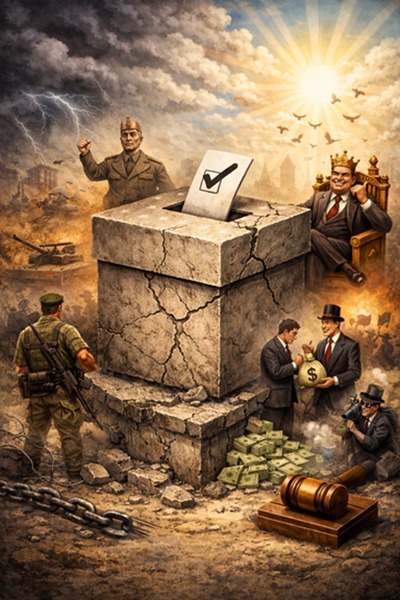
The debate over whether democracy is the best form of government has persisted for centuries. It involves weighing the ideals of popular rule against the practical shortcomings seen in real-world politics. The common consensus is often summed up by Winston Churchill’s famous observation that democracy is “the worst form of government, except for all those other forms that have been tried from time to time.” This wry remark captures both democracy’s flaws and its enduring appeal.
Critics of democracy point to several serious weaknesses. One major concern is voter ignorance and irrationality. In complex modern societies, public policy demands technical knowledge and long-term thinking, yet many voters may lack either the information or the interest needed to make informed choices. This can result in decisions driven more by emotion, slogans, or short-term promises than by sound reasoning.
Another danger is the tyranny of the majority. While majority rule is central to democratic systems, it can also marginalise minority communities, whose rights and interests may be ignored or overridden by the dominant group. Without strong constitutional safeguards, democracy can become a tool for majoritarian oppression rather than collective justice.
Democracy is also often criticised for inefficiency. Extensive debate, consultation, and consensus-building can slow decision-making, making it difficult to respond swiftly in times of crisis or to implement long-term projects that require continuity. Frequent changes in leadership can further contribute to political and economic instability, as successive governments reverse the policies of their predecessors.
In recent times, democracies have shown vulnerability to populism and manipulation. Charismatic leaders can exploit public emotions, media biases, and misinformation to gain power, gradually weakening institutions from within, a process often described as democratic backsliding. Alongside this is the growing influence of money in politics. Costly election campaigns and lobbying by wealthy individuals or interest groups can distort representation, giving the rich a louder voice and undermining political equality.
Ironically, systems designed to ensure accountability can also breed corruption. Complex bureaucracies and opaque processes may allow leaders to prioritize power games and personal gain over public service, while responsibility becomes diffused and hard to enforce.
Yet, despite these criticisms, supporters argue that democracy remains superior to its alternatives. Its greatest strength lies in legitimacy and popular participation. Democracy rests on the principle that people should govern themselves, fostering a sense of ownership, responsibility, and political autonomy among citizens.
Democratic systems also tend to protect fundamental rights and freedoms, freedom of speech, a free press, and the rule of law, which are often curtailed under authoritarian regimes. These liberties not only safeguard individuals but also act as checks on the misuse of power.
Another key advantage is democracy’s ability to correct its own mistakes. Open debate, criticism, and regular elections provide peaceful mechanisms for change. Instead of coups or revolutions, citizens can remove ineffective or unjust governments through the ballot box.
Democracy further offers a framework for accommodating diversity. In plural societies with competing interests and beliefs, it provides a method for negotiation and compromise, helping manage conflicts without resorting to violence. By recognising political equality, democracy also enhances human dignity, granting every citizen, regardless of background, an equal voice in shaping the collective future.
However, history shows that the struggle for power is not limited to any one system. Those who attain authority rarely relinquish it willingly. In many countries, leaders have seized power through coups, claiming to act temporarily to restore order and promising a return to democratic rule, only to entrench themselves indefinitely. Elsewhere, rulers have come to power through free elections with overwhelming majorities, only to amend constitutions, weaken institutions, and declare themselves lifelong leaders or virtual monarchs. Often, such moves are justified by narrow public support while dissent and criticism are suppressed.
These abuses reveal an uncomfortable truth: there is no fundamental distinction between right-wing or left-wing ideologies when it comes to the temptation of power. Any side, once in control, can manipulate systems and undermine freedoms to prolong its rule.
In conclusion, democracy is far from perfect. Its practice is messy, slow, and vulnerable to manipulation, corruption, and public disillusionment. Yet it is precisely because human nature is flawed that democracy remains valuable. Compared to alternatives that concentrate power in the hands of a few, democracy offers checks, balances, and the possibility of peaceful correction. For all its shortcomings, it is still widely regarded as the “best possible” system, not because it guarantees good governance, but because it provides the strongest defence against tyranny and the abuse of absolute power.
Author has over 25 years of experience in leadership roles with major global Semiconductor companies working on AI. Visit LinkedIn to know more about the author: https://www.linkedin.com/in/aijazqaisar/

