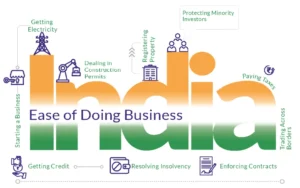
In the early 2010s, doing business in India felt like a hurdle race where the hurdles were raised mid-sprint. Do you know India once ranked an abysmal 184 out of 190 countries just to get a construction permit?
Do you know it took 186 days, over six months of bureaucratic purgatory, not to build anything, not to create jobs, but merely to get permission? This was not accidental. It was the cumulative weight of decades of regulatory excess, inherited controls, and a deep mistrust of enterprise.
Undoing that damage did not happen overnight. It took 11 years of sustained, often unglamorous reform to dismantle what had been layered over generations.
But 2025 stands apart.
This year, India moved from easing business to freeing business. If 1991 was the year of liberalisation, then 2025 is the year of deregulation. If 1991 gave India its “animal spirits,” 2025 has finally given those spirits a cage-free environment.
Breaking the “Dwarf” Cycle
For decades, Indian firms stayed small by design. Not because of weak ambition, but because growth triggered punishment. Hiring the 10th, 20th, or 100th worker often meant crossing invisible regulatory tripwires buried inside nearly 29 central labour laws. Expansion brought scrutiny, inspectors, and legal risk. The rational response was to remain a “dwarf.”
That psychology finally broke in 2025.
The government raised the turnover threshold for “small companies” tenfold to ₹100 crore, decisively removing the incentive to artificially cap growth. At the same time, dozens of overlapping labour statutes were consolidated into four simplified labour codes, replacing uncertainty with clarity.
The message was unmistakable: Scale will no longer be penalised. Growth will no longer be suspect.
Cutting the Compliance Cord
Similarly, for years, India’s manufacturing ambition was constrained not by a lack of skill or scale, but by an overgrown compliance regime. Quality Control Orders (QCOs), originally intended to protect standards, had expanded into a dense web of mandatory certifications covering finished goods as well as critical manufacturing inputs.
The result was paradoxical & detrimental.
Manufacturers were encouraged to “Make in India,” yet forced to import inputs only from QCO-compliant sources, often at higher costs and longer lead times. Exports became costlier, not because Indian firms were inefficient, but because compliance had become embedded in the supply chain itself.
Recognising this distortion, the government undertook a sweeping review of QCOs. Mandatory compliance was removed for 76 product categories, and over 200 additional categories were identified for deregulation. What once took decades of incremental rollback was executed at scale, and at speed. Within a single year, India accelerated a deregulation process that earlier moved in cautious, fragmented steps.
The message was clear: manufacturing should happen in India, not paperwork.
This momentum is being reinforced by the Export Promotion Mission (EPM), a six-year initiative with an outlay of ₹25,060 crore, including ₹20,000 crore in expanded export credit guarantees for MSMEs and first-time exporters.
This deregulation were not just ministry activities but all hands in mission with RBI and SEBI too following suit with significant deregulation.
For years, raising capital meant wading through dense paperwork where the signal got lost in the noise. SEBI’s recent reforms simplify offer documents, cutting through the clutter so investors can focus on what truly matters. Capital markets are finally being designed to reward clarity, not compliance gymnastics.
Meanwhile, the RBI has taken a scalpel to decades of overlapping instructions. By consolidating nearly 9,000 circulars into 238 Master Directions across 11 categories and 30 functional areas, it is turning a sprawling, confusing archive into a single, readable framework. Compliance is now cheaper, faster, and far less ambiguous.
Global Integration: 3 Major FTAs in Just 1 Year
Ease of Doing Business is meaningless if businesses have nowhere to sell. By securing three major Free Trade Agreements (FTAs) with the UK, Oman, and New Zealand in 2025, India effectively lowered the “cost of entry” into global markets.
For instance, the India-Oman CEPA included a specific provision for “Tiered Rules of Origin,” which simplified certification and granted immediate zero-duty access for Indian petroleum products and jewellery. With New Zealand, there is Zero Duty market access on 100% of India’s exports.
The Port “Logjam” vs. Maritime Velocity
In 2013–14, ships spent nearly four days idle at Indian ports. Every stalled vessel was capital frozen, trade delayed, and competitiveness eroded. By 2025, average turnaround time fell to less than one day.
This year, parliament replaced maritime laws dating back to 1908 and 1925 with five modern statutes covering bills of lading, coastal shipping, carriage of goods by sea, merchant shipping, and ports governance.
By replacing colonial-era laws from 1908 and 1925, these reforms have modernized maritime governance, reduced disputes, and lowered logistics costs, positioning India to fully leverage its blue economy with 21st-century standards.
The Quietest but Strongest Proof: Active Companies in India Nearly Double in 2025
In March 2014, India had 9.52 lakh active companies.
By March 2025, that number rose to 18.51 lakh.
This near-doubling did not come from a single incentive or scheme. It came from predictability. From fewer choke points. From rules that stopped punishing success. When businesses multiply quietly, it usually means the system has stopped getting in the way.
Slaying the “Inspector Raj” with Jan Vishwas:
Jan Vishwas mattered, but not as a slogan.
Through Jan Vishwas 1.0 and 2.0, over 200 minor technical offences were decriminalised and hundreds of obsolete provisions removed. The deeper impact was cultural: a paperwork lapse was no longer treated as a criminal act.
More importantly, deregulation did not remain confined to Delhi.
Seven NDA-governed states have already decriminalised over 1,000 provisions, ensuring that reform reaches the point where businesses actually operate, factory floors, warehouses, ports, and district offices.
This is where 2025 truly stands apart.
The Centre did not deregulate alone. It pulled the entire system with it. 2025 will be remembered not for a single reform, but for a shift in governance philosophy.
Ease of Doing Business is no longer an index India chases. It is now a habit the system practises.
(Courtesy: Press Information Bureau)