

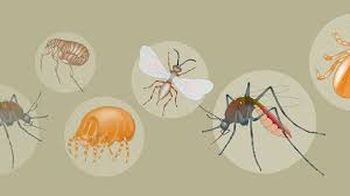
Recently, I attended an educational activity on emerging Vector-borne diseases, organized by American College of Physicians (USA), of which I happen to be a member. Therefore, I place the focus of this article to highlight various aspects regarding the emerging and resurgence of Vector-borne diseases at global level with particular emphasis on our country’s response to such emerging trends.
To begin with, Vector-borne diseases are human illnesses caused by parasites, viruses and bacteria that are transmitted by vectors(living organisms that can transmit infectious pathogens between humans, or from animals to humans).
As per World Health Organization data, vector-borne diseases account for more than 17% of all infectious diseases — causing more than 700,000 deaths annually — from diseases such as malaria, dengue, schistosomiasis, human African trypanosomiasis, leishmaniasis, Chagas disease, yellow fever, Japanese encephalitis, onchocerciasis, chikungunya fever, Zika virus fever, West Nile fever, and, tick-borne encephalitis.
Malaria is a parasitic infection transmitted by Anopheline mosquitoes. As per World Health Organization, it causes an estimated 249 million cases globally, and results in more than 608,000 deaths every year. Most of the deaths occur in children under the age of 5 years.
Dengue is the most prevalent viral infection transmitted by Aedes mosquitoes. As per World Health Organization, more than 3.9 billion people in over 132 countries are at risk of contracting dengue, with an estimated 96 million symptomatic cases and an estimated 40, 000 deaths occurring every year.
While many of these vector-borne diseases are preventable through protective measures and community mobilization, however their distribution is determined by a complex set of demographic, environmental and social factors. Global travel and trade, unplanned urbanization, climate change and silent spread and adaptation of the vectors have all contributed to the spread of vector-borne diseases.
Climate change poses as a biggest environmental threat. It substantially affects pathogens (parasites, viruses and bacteria), vectors, and reservoir hosts, having implications for the transmission of many vector-borne diseases. These trends are expected to continue as the climate continues to get warmer.
The Global Vector Control Response (GVCR), 2017–2030 approved by the World Health Assembly in 2017 — provides strategic guidance to countries and development partners for urgently strengthening vector control as a fundamental approach to preventing disease and responding to outbreaks.
To achieve this, further strengthening of vector control programmes is required, supported by increased technical capacity, improved infrastructure, strengthened monitoring and surveillance systems, and greater community mobilization.
Moreover, implementation of a comprehensive approach to vector control will enable the achievement of disease-specific national and global goals, thereby contributing to the achievement of the Sustainable Development Goals and universal health coverage.
In India, the National Center for Vector Borne Diseases Control (NCVBDC) administers an umbrella programme, namely, National Vector Borne Diseases Control Programme (NVBDCP) for prevention and control of vector borne diseases namely Malaria, Japanese Encephalitis, Dengue, Chikungunya, Kala-azar and Lymphatic Filariasis.
Out of them three diseases namely, Malaria, Lymphatic Filariasis and Kala-azar are targeted for elimination. Malaria, Dengue and JE are outbreak prone and climate sensitive. The States/UTs are responsible for implementation of the programme, whereas NCVBDC provides technical and financial assistance to the States/UTs in the form of cash & commodity, under the overarching umbrella scheme of National Health Mission (NHM).
The epidemiology of these vector borne diseases varies considerably on account of ecology, vector bionomics, economic, socio-cultural and behavioral factors. Generally, the high risk areas for VBDs are rural and tribal areas and urban slums inhabited by the poor, marginalized and vulnerable groups with limited access to quality health care, communication and other basic amenities in those focal areas.
A crucial element in reducing the burden of vector-borne diseases is behavioural change. Moreover, access to safe water and sanitation is a very important factor in disease control and elimination.
Personal prophylactic measures are important like — use of mosquito repellent creams, liquids, coils, mats etc.; wearing of full sleeve shirts and full pants with socks; use of bed-nets for sleeping infants and young children during day time to prevent mosquito bite.
Moreover, environmental management and source reduction methods; biological control; chemical control; health education and awareness in the community — are crucial in controlling vector borne diseases.
drtasadukitoo@gmail.com


