

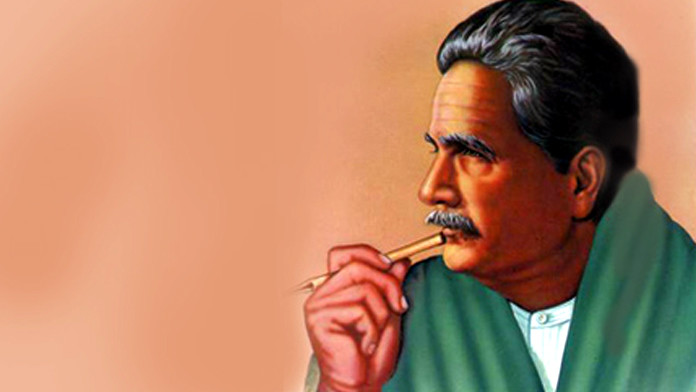
Iqbal was a great philosopher, poet, and visionary whose thoughts were far ahead of his time. His poem “Sāre Jahān se Achchā, Hindustān Hamārā” continues to be sung with fervour and love across India.
Muhammad Iqbal was born on 9 November 1877 in Sialkot, then part of undivided India (now in Punjab, Pakistan), into a Kashmiri family. He proudly acknowledged his Kashmiri heritage in his writings. Historical accounts state that Iqbal’s grandfather was Kanhaya Lal, and his father, Rattan Lal, converted to Islam, adopting the name Nur Muhammad. Nur Muhammad married Imam Bibi, who passed away in 1914 in Sialkot.
At the age of four, Iqbal was admitted to a mosque to learn the Qur’an. He studied Arabic under Syed Mir Hassan. In 1893, he completed his matriculation from Scotch Mission College, Sialkot. Four years later, in 1897, he graduated with a B.A. in Philosophy, English Literature, and Arabic from Government College University, Lahore. He earned his M.A. in 1899 from the same institution and joined as a junior professor there.
In 1905, Iqbal travelled to England for higher studies. Influenced by thinkers like Friedrich Nietzsche, Henri Bergson, and the mystic Rumi, he obtained a Bachelor of Arts degree from Trinity College, University of Cambridge, in 1906. In 1907, he moved to Germany to pursue a PhD, completing it in 1908 at Ludwig Maximilian University of Munich. His doctoral thesis was titled “The Development of Metaphysics in Persia.”
Upon returning to India in 1908, Iqbal became associated with the All India Muslim League. In November 1926, he contested the Punjab Legislative Assembly elections from Lahore and won. In 1930, as the President of the Muslim League, he delivered his famous Allahabad Address, outlining his vision for a separate homeland for Muslims.
Iqbal first rose to prominence in 1899 when he recited Nala-e-Yateem. In 1904, he published Tarāna-e-Hind, better known by its opening line, “Sāre Jahān se Achchā, Hindustān Hamārā.” His 1915 work, Asrār-e-Khudī, explored the concept of khudi.
Iqbal’s Concept of Khudi
Contrary to liberalism’s idea of possessive individualism—which sees the individual as the centre of the universe—Iqbal’s khudi is the discovery of the higher self. For him, the human mind can transcend physical dimensions and connect with God, who is the highest form of Being. To realise the self, one must pass through three layers:
- Physical existence (self)
- Relational existence (others)
- Universal existence (God)
Upon achieving this higher state, a person becomes the insān-e-kāmil—a selfless individual dedicated to humanity and the welfare of others. Iqbal envisioned building an egalitarian society through the moral and spiritual strength of religion.
Personal Reflections on Khudi
The contribution of Sir Muhammad Iqbal to Urdu literature is immeasurable. Even today, on 15 August, many events begin with “Sāre Jahān se Achchā, Hindustān Hamārā, Hum Bulbulain Hain Iski, Ye Gulistān Hamārā.”
As teenagers, my friends and I often asked each other: “What is khudi?” To find answers, we turned to Iqbal’s books. His kalaam was difficult for us to grasp then, but as we matured, we began to understand. We came across profound verses like:
– Yeh ho to banta hai Musalmaan
Nigāh buland, sukhan dilnawāz, jān pursūz
– Johar-e-zindagī hai ishq,
Johar-e-ishq hai khudi
– Nazar nahī to meray halqay-e-sukhan mein na baith,
Ke nuqta hai khudi, hai misaal tegh-e-aseel
In these lines, Iqbal reminds us that khudi is not arrogance but a divine spark—love as the essence of life, and selfhood as the essence of love.
In 1933, after returning from travels to Spain and Afghanistan, Iqbal developed a throat illness that plagued him until his death on 21 April 1938. His ideas and poetry, however, continue to inspire generations in South Asia and beyond.
sajad_08phd12@nitsri.ac.in


