Collage, a dynamic and versatile medium, thrives on the interplay of disparate elements—newspaper clippings, photographs, fabric, and found objects—united to create a cohesive visual narrative. At the heart of its origins are Pablo Picasso and Georges Braque, whose groundbreaking work in the early 20th century laid the foundation for collage as a revolutionary artistic practice.
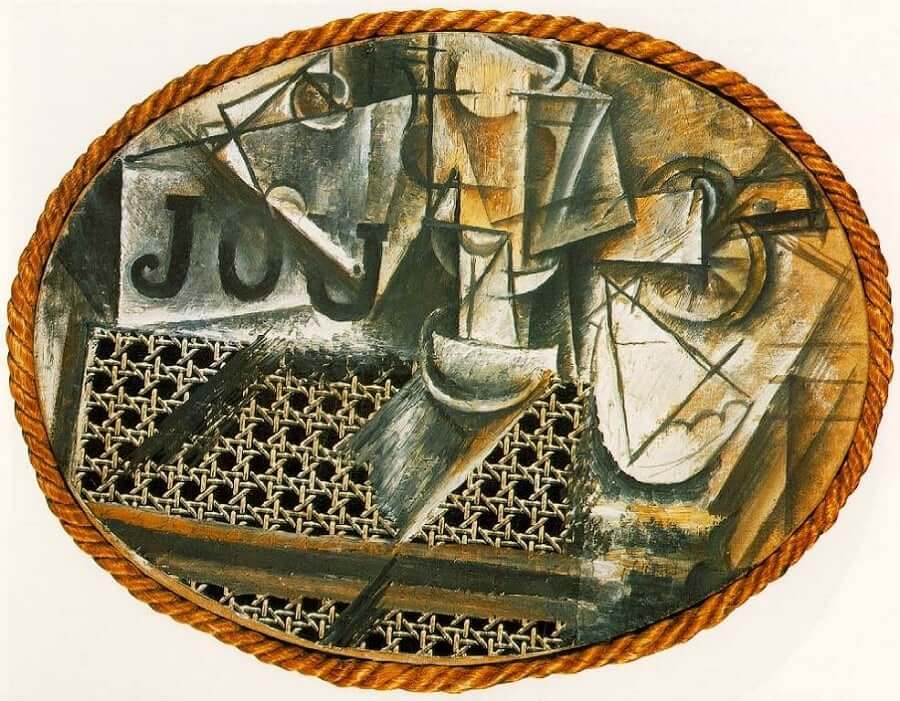
Picasso and Braque, the pioneers of Cubism, introduced collage as a way to challenge traditional notions of art and representation. Around 1912, they began incorporating everyday materials like newspaper clippings, sheet music, and wallpaper into their paintings. Picasso’s Still Life with Chair Caning (1912) is often cited as one of the first examples of collage in fine art. By gluing a piece of oilcloth printed with a chair caning pattern onto the canvas and framing it with rope, Picasso blurred the line between reality and illusion, forcing viewers to question the nature of representation.
Braque, equally instrumental in the development of collage, introduced elements like wood-grained paper and faux marble textures into his works. His used papier collé (pasted paper) to create a layered, fragmented composition that disrupted traditional perspective. Together, Picasso and Braque transformed collage into a tool for deconstructing reality, breaking objects into geometric shapes and reassembling them in ways that emphasized multiple viewpoints.
Their experiments with collage were not merely aesthetic but philosophical. By incorporating mundane, mass-produced materials into their art, they challenged the elitism of traditional fine art, democratizing the creative process. This radical approach influenced countless artists and movements, from Dada and Surrealism to Pop Art and beyond.
The Dada movement of the 1910s–1920s further revolutionized collage, using it as a tool for political and cultural critique. Artists like Hannah Höch and Kurt Schwitters employed photomontage to satirize societal norms, exposing contradictions in gender roles, nationalism, and consumer culture. Surrealists such as Max Ernst embraced collage to explore the subconscious, creating dreamlike, irrational compositions that defied logic.
In the mid-20th century, collage found new life in Pop Art. Artists like Richard Hamilton and Robert Rauschenberg incorporated advertising imagery and consumer products to critique postwar consumerism and mass media. By the late 20th century, postmodernists like Barbara Kruger and Romare Bearden used collage to deconstruct narratives of identity, history, and power. Bearden’s vibrant depictions of African American life, for instance, layered paint with magazine cutouts to celebrate cultural resilience.
Collage techniques range from traditional analog methods—cutting, tearing, and layering materials like paper and fabric—to digital tools like Photoshop, which allow for surreal or hyper-real compositions. The choice of materials often carries symbolic weight, with weathered newspaper evoking nostalgia or glossy advertisements critiquing consumer excess.
Today, collage thrives in both physical and digital realms. Social media platforms like Instagram have democratized the form, while NFTs (non-fungible tokens) have introduced collage into the blockchain art market. Its accessibility makes it a favorite in art therapy and education, fostering creativity and emotional expression.
Collage endures because it mirrors the fragmented, multilayered nature of contemporary life. By transforming ordinary materials into extraordinary visions, it invites viewers to find meaning in juxtaposition and chaos. Whether through a punk zine, a gallery installation, or a digital NFT, collage continues to prove that art is not about the medium’s purity but the boldness of the artist’s vision. Picasso and Braque’s pioneering spirit lives on in every cut, paste, and layered fragment, reminding us that art is as much about breaking boundaries as it is about creating them.