• About us
  • Contact us
  • Our team
  • Terms of Service
Friday, April 17, 2026
Kashmir Images - Latest News Update
Epaper
  • TOP NEWS
  • CITY & TOWNS
  • LOCAL
  • BUSINESS
  • NATION
  • WORLD
  • SPORTS
  • OPINION
    • EDITORIAL
    • ON HERITAGE
    • CREATIVE BEATS
    • INTERALIA
    • WIDE ANGLE
    • OTHER VIEW
    • ART SPACE
  • Photo Gallery
  • CARTOON
  • EPAPER
No Result
View All Result
Kashmir Images - Latest News Update
No Result
View All Result
Home OPINION

One Nation, One Election: More Benefits, Less Drawbacks

Dr.Shiben Krishen Raina by Dr.Shiben Krishen Raina
December 20, 2024
in OPINION
A A
0
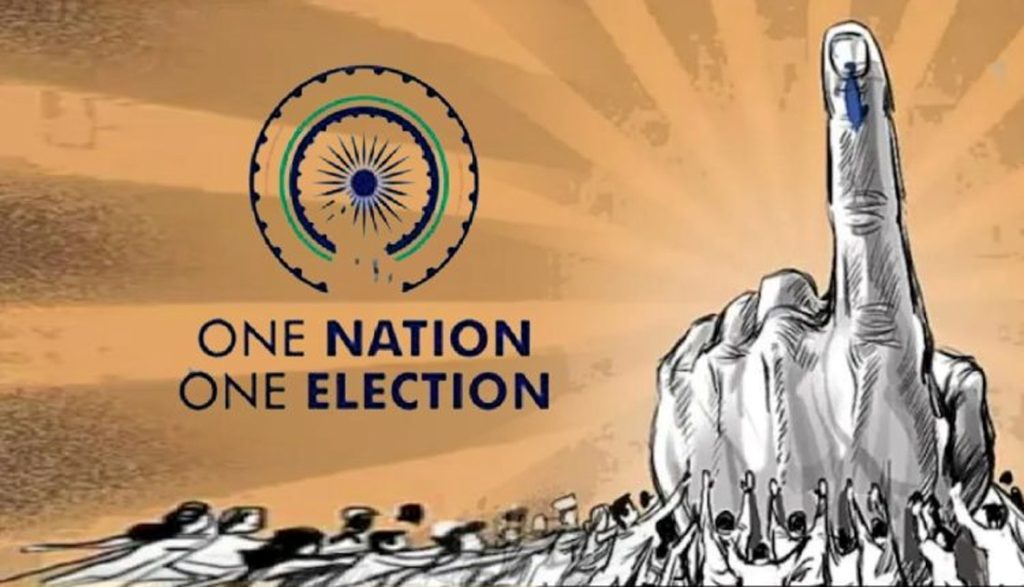
Cabinet accepts ‘one nation, one election’ recommendation
FacebookTwitterWhatsapp

The concept of ‘One Nation, One Election’ has become a topic of discussion these days. This idea is linked to the issue of conducting simultaneous elections for the Lok Sabha and all state legislative assemblies in the country. This means that elections for the Lok Sabha and all state assemblies will be held simultaneously, and voting will also be done at the same time. Broadly speaking, ‘simultaneous elections’, which can be understood as “One Nation, One Election,” means conducting elections for state assemblies, Lok Sabha, and local bodies (municipalities and panchayats) together across the country.

In India, from 1951-52 to 1967, state assembly and Lok Sabha elections were held simultaneously. But this cycle broke, and currently, elections are held every year and sometimes at different times in the same year. This leads to problems such as massive increase in government expenditure, long-term deployment of security forces and election officials, hindrance in development work (due to implementation of Model Code of Conduct), etc. Therefore, the Law Commission of India, in its 170th report “Reform of Election Laws,” suggested that the government should make arrangements to conduct Lok Sabha and all state assembly elections simultaneously.

More News

Is Indian Academic Research Worth the Cost?

The Time Is Now: Why Women’s Reservation Will Transform Indian Democracy  

Securing the Digital Lifelines of Global Connectivity

Load More

The first step would be to conduct state assembly and Lok Sabha elections simultaneously. The second step would be to hold panchayat and municipal elections along with state assembly and Lok Sabha elections. Under this, panchayat and municipal elections will be held within 100 days of state assembly and Lok Sabha elections. To implement this process, at least half of the states would need to agree.

It would not be inappropriate to consider some difficulties that may arise from this process:

Mid-term Election Problem: It is unclear how this system would work if a government loses majority or is dissolved.

Challenge for Regional Parties: Regional parties may not be able to prominently raise local issues and might appear weak compared to national parties. Need for Constitutional Amendment: Several changes in the constitution and legal framework will be required to implement this.

Impact on Local Issues: National issues dominating regional elections could affect state-level decisions.

Resource Limitations: Regional parties have limited resources, which might make them appear weak compared to large national parties.

Overall, the concept of One Nation, One Election could be an important step towards making the democratic process in India smoother and stronger. However, before implementing it, it is necessary to resolve many constitutional, legal, and administrative issues.

The writer is former Fellow, IIAS, Shimla(HP)

Previous Post

Tangmarg mourns loss of ambulance driver Muhammad Sabir Khan

Next Post

J&K Athletes continue to shine at National Competitions

Dr.Shiben Krishen Raina

Dr.Shiben Krishen Raina

Related Posts

Is Indian Academic Research Worth the Cost?

INDIA bloc leaders sound poll bugle at Patna rally
April 17, 2026

Somewhere in a university laboratory, a young doctoral scholar is bent over a spectrometer at midnight, measuring isotopic ratios in...

Read moreDetails

The Time Is Now: Why Women’s Reservation Will Transform Indian Democracy  

Regional-bilateral significance of Nepal PM Dahal’s India visit
April 16, 2026

While taking my first oath as a Minister of State, I looked around the packed room and made a count....

Read moreDetails

Securing the Digital Lifelines of Global Connectivity

Securing the Digital Lifelines of Global Connectivity
April 15, 2026

Beneath the vast waters of the Indo-Pacific lies a largely unseen but indispensable network powering the modern world. Subsea cables, often overlooked in...

Read moreDetails

Baramulla: Transitioning from Historical Gateway to Sustainable Urban Hub

Regional-bilateral significance of Nepal PM Dahal’s India visit
April 14, 2026

Nuzzled along the Jhelum River, Baramulla has long been known as the “Gateway to Kashmir.” At the moment, it is...

Read moreDetails

Why Kashmir’s Ghanta Ghar Defeats Its Tourism Pitch

April 13, 2026

The announcement of the Kashmir Travel Mart 2026 has been received with the usual optimism. Stakeholders will gather, presentations will...

Read moreDetails

Collateral Damage: The Unseen Cost of War

Collateral Damage: The Unseen Cost of War
April 12, 2026

For a long time, wars have been justified with the argument that collateral damage is unavoidable. Military strategists and political...

Read moreDetails
Next Post

J&K Athletes continue to shine at National Competitions

  • About us
  • Contact us
  • Our team
  • Terms of Service
E-Mailus: kashmirimages123@gmail.com

© 2025 Kashmir Images - Designed by GITS.

No Result
View All Result
  • TOP NEWS
  • CITY & TOWNS
  • LOCAL
  • BUSINESS
  • NATION
  • WORLD
  • SPORTS
  • OPINION
    • EDITORIAL
    • ON HERITAGE
    • CREATIVE BEATS
    • INTERALIA
    • WIDE ANGLE
    • OTHER VIEW
    • ART SPACE
  • Photo Gallery
  • CARTOON
  • EPAPER

© 2025 Kashmir Images - Designed by GITS.