

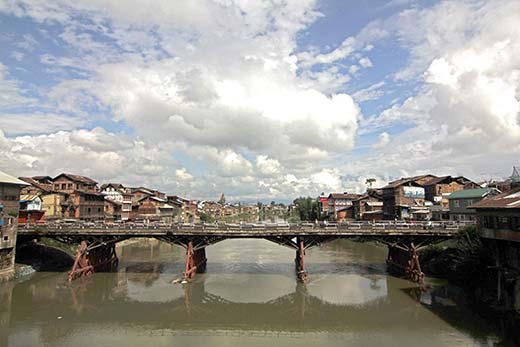
In the heart of Srinagar, nestled near the picturesque Habba Kadal Bridge, stood a small shop that held a special place in the memories of many. This was the area where Peetambar Paanwala, affectionately known as “Peetkak, owned a shop.” His humble establishment was more than just a paan-shop. It was a gathering place, a source of entertainment, and a window into the changing times of Kashmir. I am talking of the mid-Fifties when I was just a school-going boy.
Peetkak’s shop was strategically located in what was then considered the bustling center of Srinagar: Habba-Kadal. Habbakadal, a locality in Srinagar, holds a special place in the hearts of many. It is home to a significant population of Kashmiri Pandits adding to the city’s unique character. I remember Habbakadal’s bustling square, always beaming with activity and people.
From there, four roads branched out, leading to different neighborhoods: Fateh Kadal, Babapora, Kral Khod (Ganpatyar), and Purshyar (Kani Kadal). Those days most people preferred to walk, and bicycles and Tangas (horse-drawn carriages), too, were a common sight. I have the proud privilege of being a native resident of Purshyar, Habbakadal.
Amidst the bustling sight of Habba-Kadal and around, Peetkak’s shop wore a busy look. In the front were three renowned bookstores, Kapoor Brothers, Ali Muhammad and Sons and Omkar Brothers, adding an intellectual flavor to the neighborhood. Just next door, a quieter presence could be found in the form of Zinda Paanwala, another betel leaf seller who lived in the same lane where I lived.
Peetkak himself was a character larger than life. Tall and sturdy, he possessed an imposing figure behind his modest counter. His face was captivating, exuding a charm that drew people to his shop. Perhaps his most striking feature was the prominent round vermilion Tilak adorning his forehead, a symbol of his faith and identity. But it wasn’t just his appearance that made Peetkak memorable, his voice carried authority and could be heard far and wide, while his quick wit and audacious nature had made him a local celebrity of the entire area.
In an era when owning a radio was a luxury few could afford, Peetkak’s shop served as a point of social meetings. Students would gather around, drawn by the allure of Radio Ceylon’s Geetmala, a popular music program that brought the latest hits to their eager ears. Cricket enthusiasts found solace here too, huddling close to catch the excitement of match commentaries. In this way, Peetkak’s small shop became a place where shared experiences created lasting bonds.
Despite the seemingly idyllic setting, all was not peaceful in the Kashmir valley. Peetkak often voiced his frustration about the frequent disruptions to daily life. His words paint a vivid picture of a region in turmoil: “What kind of place are we living in?” he would lament, listing off a number of disturbances – “Daily curfews, protests, demonstrations, strikes, lathi-charges, shutdowns.” His advice to me is still fresh in my memory : “Leave this place, or else you’ll end up selling paan/betel leaves like me for the rest of your life. Nothing is left here for young talented boys like you.”
Nearly seven decades have gone by and suddenly today the memory of this colorful character resurfaced in my mind, prompting questions about Peetkak’s fate and his current whereabouts.
The story of Peetambar Paanwala offers more than just a nostalgic glimpse into Srinagar’s past. It serves as a miniature of a society in transition, caught between tradition and modernity, peace and conflict. Through the lens of this small paan shop and its charismatic owner, we see the complex landscape of life in Kashmir – the simple joys of shared entertainment, the bonds of community, and the undercurrent of unrest that came to define the region later. At this point of time, Peetkak’s words of warning seem almost prophetic, highlighting the challenges faced by a generation coming of age in uncertain times. As we reflect on this chapter of history, we’re also reminded of the profound ways in which our environments and experiences shape our lives, often in ways we can’t fully appreciate until years later.
Writer is former Fellow, IIAS,Shimla(H.P). Currently in Bengaluru (Karnataka). skraina123@gmail.com


