

• About us
  • Contact us
  • Our team
  • Terms of Service
Tuesday, June 16, 2026
Kashmir Images - Latest News Update
Epaper
  • TOP NEWS
  • CITY & TOWNS
  • LOCAL
  • BUSINESS
  • NATION
  • WORLD
  • SPORTS
  • OPINION
    • EDITORIAL
    • ON HERITAGE
    • CREATIVE BEATS
    • INTERALIA
    • WIDE ANGLE
    • OTHER VIEW
    • ART SPACE
  • Photo Gallery
  • CARTOON
  • EPAPER
No Result
View All Result
Kashmir Images - Latest News Update
No Result
View All Result
Home OTHER VIEW

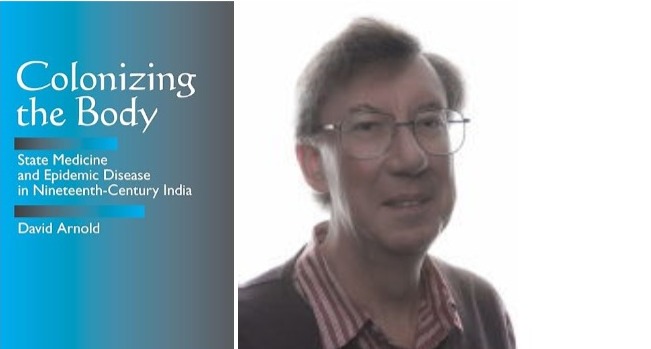
‘Colonizing the Body: State Medicine and Epidemic Disease in Nineteenth Century India by David Arnold’  

KI News by KI News
June 4, 2024
in OTHER VIEW
A A
0
‘Colonizing the Body: State Medicine and Epidemic Disease in Nineteenth Century India by David Arnold’  
FacebookTwitterWhatsapp

By: Hilal Ahmad Tantray

 ‘Colonizing the Body: State Medicine and Epidemic Disease in Nineteenth Century’ India is a seminal historical study by David Arnold that scrutinizes the intertwined relationship between medical science, colonialism, and public health during the 19th century in British India. 

More News

FTAs building a new trade architecture for Viksit Bharat

From Data to Delivery: How ICMR Is Rewiring India’s Health Research for a Healthier Tomorrow

India’s Era of Cultural Renaissance: Reclaiming Our Civilizational Glory

Load More

Arnold asserts that the British colonial rulers introduced modern medicine as a strategy to reinforce their control over the Indian populace. This book delves into how colonial officials, medical professionals, and missionaries utilized medicine to assert power over Indian cultures and bodies, often encountering local resistance.

Despite a comprehensive investigation of colonial policy in the book’s introduction, Arnold’s arguments occasionally overlook critical details. For instance, his claim that dissection was not practiced in Ayurveda contradicts the historical evidence that dissection and inspection of the human body were indeed integral to Indian medical practice.

Arnold’s study makes a substantial contribution to understanding the interaction between imperial objectives and medical knowledge in a colonial context. However, his framework for examining the body as a colonized entity is not entirely robust. After the cessation of colonial support for Indian medicine in 1835, interest was revived in 1837 with native classes at the Calcutta Medical College, becoming formal schools by the 1880s. While the dominance of Western medicine is explored, a deeper analysis of how it became ingrained in Indian society would have been beneficial.

The book discusses the colonial ‘learning’ from Indian medicine, highlighting the significant role of local medications. Indian doctors, who served as practical medical knowledge teachers in dispensaries and hospitals, continued to enrich the Western pharmacopeia with essential drugs. Arnold could have strengthened his arguments by mentioning the Native Medical Institution, which symbolized the early coexistence of Indian and Western medical practices.

In the second chapter, Arnold provides a useful discussion on the establishment of colonial enclaves such as the army and jails, where Western medical policies justified the monopoly of occidental medicine. He details public health facilities and the Indian Medical Services as extensions of colonial policies. The chapter also addresses the crisis of military health, reforming army health, and exploring the relationship between army and civilian health, focusing on the disparity between European and Indian soldiers’ health.

Arnold investigates the impact of epidemic diseases like smallpox, cholera, and plague on Indian society, and the colonial medical response to these crises. Smallpox was deeply ingrained in Indian culture, with the goddess Sitala worshipped for protection. The colonial response to cholera was relatively muted, while the severe measures during the plague outbreaks of the late 19th century sparked fierce public resistance. The pandemic of 1896–1897 saw extraordinary actions such as compulsory postmortems and forced hospitalizations, which led to widespread alienation from Western medicine.

The final chapter provides an informative account of Western hegemony in India, although some points would have been better placed earlier in the book. This chapter also discusses the role of women physicians in expanding Western influence in colonial India.

Overall, Colonizing the Body offers a critical examination of how Western medicine served as a colonizing force in British India. Arnold’s detailed and insightful analysis makes this book a valuable resource for those interested in the history of colonialism, public health, and medicine in British India.

The reviewer is a Doctoral Fellow at Jamia Millia Islamia, New Delhi,

hilalmohiuddin614@gmail.com


Previous Post

NOTA creates record in MP’s Indore seat

Next Post

India’s journey towards ‘Environmental Resilience’

KI News

KI News

Kashmir Images is an English language daily newspaper published from Srinagar (J&K), India. The newspaper is one of the largest circulated English dailies of Kashmir and its hard copies reach every nook and corner of Kashmir Valley besides Jammu and Ladakh region.

Related Posts

FTAs building a new trade architecture for Viksit Bharat

Regional-bilateral significance of Nepal PM Dahal’s India visit
June 16, 2026

Achieving the vision of a 'Viksit Bharat' requires sustaining a high rate of economic growth over the next two decades....

Read moreDetails

From Data to Delivery: How ICMR Is Rewiring India’s Health Research for a Healthier Tomorrow

Regional-bilateral significance of Nepal PM Dahal’s India visit
June 15, 2026

A century of quiet revolution, a decade of urgent reform, and a roadmap to Viksit Bharat 2047 As the nation...

Read moreDetails

India’s Era of Cultural Renaissance: Reclaiming Our Civilizational Glory

Regional-bilateral significance of Nepal PM Dahal’s India visit
June 15, 2026

As India scales new heights across diverse sectors-from economic robustness and national security to cutting-edge science and infrastructure-the path to...

Read moreDetails

Traditional Education vs Gen Z:  Can Yesterday’s Classrooms Prepare Tomorrow’s Minds?

Regional-bilateral significance of Nepal PM Dahal’s India visit
June 14, 2026

For generations higher education was regarded as the most reliable pathway to success. In Kashmir, securing admission to the University...

Read moreDetails

An Icon of Tribal Awakening, Patriotism, and Social Change

An Icon of Tribal Awakening, Patriotism, and Social Change
June 14, 2026

The history of Jammu and Kashmir is incomplete without remembering the individuals who dedicated their lives to social reform, national unity, and...

Read moreDetails

The Predicament of Binti Hawa

Regional-bilateral significance of Nepal PM Dahal’s India visit
June 13, 2026

The recent tragedy at Galwanpora Budgam has shaken us to the core, and our minds are yet to find their...

Read moreDetails
Next Post
INDIA bloc leaders sound poll bugle at Patna rally

India's journey towards ‘Environmental Resilience’

  • About us
  • Contact us
  • Our team
  • Terms of Service
E-Mailus: kashmirimages123@gmail.com

© 2025 Kashmir Images - Designed by GITS.

No Result
View All Result
  • TOP NEWS
  • CITY & TOWNS
  • LOCAL
  • BUSINESS
  • NATION
  • WORLD
  • SPORTS
  • OPINION
    • EDITORIAL
    • ON HERITAGE
    • CREATIVE BEATS
    • INTERALIA
    • WIDE ANGLE
    • OTHER VIEW
    • ART SPACE
  • Photo Gallery
  • CARTOON
  • EPAPER

© 2025 Kashmir Images - Designed by GITS.