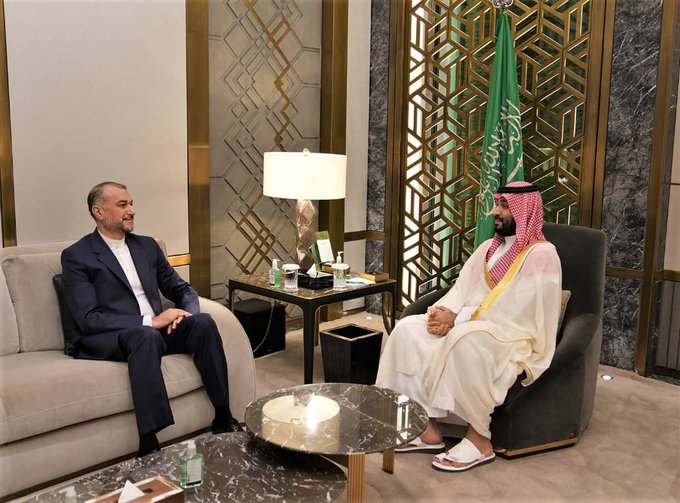
Saudi Arabia’s Crown Prince Mohammed bin Salman (MbS) met Iran’s Foreign Minister Hossein Amir Abdollahian, last week on 18th August, Riyadh. The meeting was the first in a series of high-level talks since both countries reconciled in March this year, after years of bitter rivalry that destabilised the region, in a peace deal brokered by China.
Saudi Arabia broke ties with Iran in 2016 after protesters attacked its embassy in Tehran in retaliation for Riyadh’s execution of a prominent Shiite cleric, Nimr Al Nimr.
Rivalry between Iran’s revolutionary, Shi’ite Muslim leaders and Saudi Arabia’s Sunni ruling family dominated the Middle Eastern regional politics for years as they competed for influence in Iraq, Syria, Lebanon, Yemen and Bahrain.
After the meeting, Iran’s semi-official news agency Tasnim reported Abdollahian as saying the de facto Saudi ruler had accepted his invitation to visit Tehran. This shows how MbS has pushed to reorient the Saudi foreign policy in recent years amid signs of troubles in its historically close relationship with the United States.
Earlier, the Saudi Foreign Minister Prince Faisal visited Tehran in June and said he hoped Iranian President EbrahimRaisi would visit the kingdom at the “appropriate time”.
Apparently, after years of rivalry, and with some of the main regional arenas for their competition more stable than in previous years, both sides have reason to change tack.
Iran’s Supreme Leader Ayatollah Ali Khamenei wants to end political and economic isolation imposed by the United States and saw new relations with Saudi Arabia as a way to do so, Iranian officials have been quoted as saying.
Saudi Arabia had meanwhile lost confidence in the U.S. commitment to shared regional security concerns and wanted to bolster ties with China, which has also retained good relations with Iran. This month it succeeded in getting China to attend a diplomatic meeting on Ukraine that Beijing had earlier avoided.
Iran also hopes that the Houthis in Yemen will be legitimised by the new relationship and that Iran’s role in Iraq, Syria and Lebanon will grow. Iran also hopes to undermine the U.S. and Israel, through this reconciliation. These strategies are stated openly in Iran where officials boast about the decline of U.S. influence in the region.
However, Iran may not be the only one getting what it wants. Saudi Arabia also has an agenda and to achieve it, it has sought to reorient its policies in the region.
In addition Riyadh’s independent policy now includes outreach to China and Russia and also an attempt to broker more deals in the region and abroad. This comes with increasing reports about positive development in potential Israel-Saudi ties.
Iran’s attempts at inroads in Riyadh are not only for Tehran’s benefit. Saudi Arabia also has seen how balancing ties with Iran and other countries can increase its clout in the West; this was the method that Qatar and Turkey have used in the past. Therefore, managing expectations is important for Iran and Saudi Arabia, both.
Meanwhile, Kuwait’s Foreign Minister Sheikh Salem Abdullah Al-Jaber Al-Sabah praised the Iranian visit, according to Arab News.
Kuwait has taken a very prudent view of things in the region over the last decades, watching tensions between Riyadh and Tehran, from the periphery. Kuwait also is more hostile to Israel than the UAE and Saudia. Therefore Kuwait views the reconciliation as a huge potential benefit for the Gulf.
However, we cannot ignore Israel’s view on the latest developments. In a report published by Jerusalem Post, the newspaper opined that Iran-Saudi reconciliation could only go so far. There are many different issues in the region and Iran’s role in numerous countries continues to destabilise those countries. Iran also seeks to incite others against Israel and create tensions in the West Bank by using groups like Palestinian Islamic Jihad.
Iran’s hope is to use this road to erode Saudi Arabia’s room for manoeuvre relating to a potential deal with Israel. Riyadh is aware of all these machinations and therefore it is keeping expectations modest in terms of the incremental reconciliation with Tehran. Meanwhile, it also understands that cutting off ties with U.S. in one go may affect its defence preparedness.
Meanwhile, Talal Al Otaibi, an aide to the Saudi defence minister, met with Aziz Nasirzadeh, the deputy chief of staff of Iran’s armed forces, during the sidelines of the 11th Moscow Conference on International Security, last week, according to a post by the Saudi defence ministry on the social media platform X. During the meetings, the officials reviewed bilateral relations in the defence and security fields, as well as ways to improve them, the ministry said. This shows that MbS is adopting prudential approach for the future and not putting all eggs in one basket, instead he is trying to spread the spectrum by easing relations with old rivals and break the U.S. hegemony in the region, by engaging with Russia and China, along side.
This meeting between top defence officials creates an impression that things may move at a fast pace in the near future between the two old regional rivals, but they will be more in tune rather than opposing one another, and the main casualty in this might be the waning of the American influence in the region.