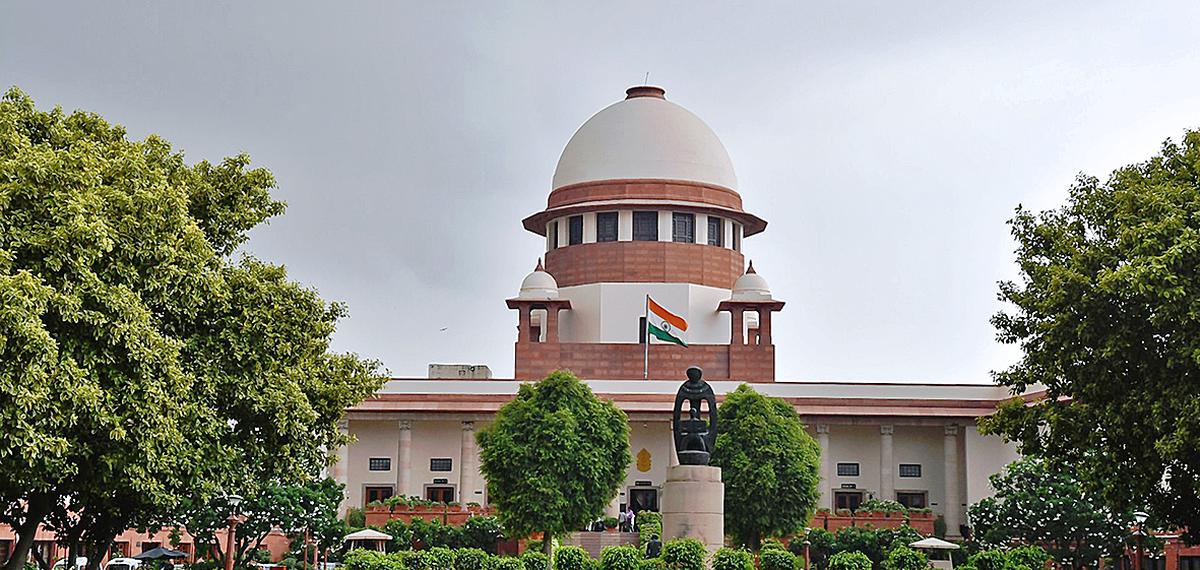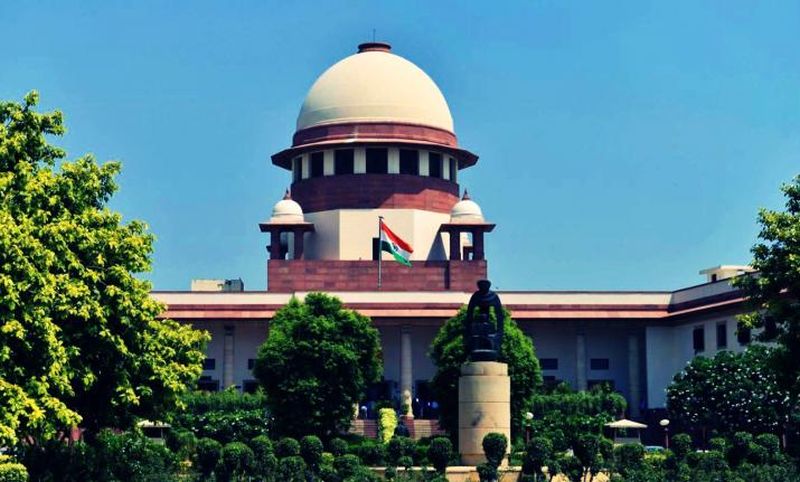
New Delhi: The Supreme Court said on Monday Article 142(1) of the Constitution, which gives “wide and capacious power” to the apex court to do complete justice should be exercised in a legitimate manner and with caution, as its verdict ends the litigation between parties.
Article 142 of the Constitution deals with the enforcement of decrees and orders of the apex court to do “complete justice” in any matter pending before it. As per Article 142(1), a decree passed or an order made by the apex court is executable throughout the territory of India.
A five-judge Constitution bench headed by Justice S K Kaul said the exercise of power and discretion under Article 142(1) is valid and as per the Constitution, as long as ‘complete justice’ required by the ‘cause or matter’ is achieved without violating fundamental principles of general or specific public policy.
“Given the expansive amplitude of power under Article 142(1) of the Constitution of India, the exercise of power must be legitimate, and clamours for caution, mindful of the danger that arises from adopting an individualistic approach as to the exercise of the Constitutional power,” said the bench, which also comprised Justices Sanjiv Khanna, A S Oka, Vikram Nath and J K Maheshwari.
The bench made these observations in its verdict which held the apex court has the discretion to dissolve a marriage on the ground of “irretrievable breakdown” in exercise of its plenary power under Article 142 (1) of the Constitution and can grant divorce by mutual consent while dispensing with the 6-month waiting period mandated under the Hindu Marriage Act, 1955.
Dealing with Article 142 (1), the top court said this provision, apparently unique as it does not have any counterpart in most of the major written Constitutions of the world, has its origin in and is inspired from the age-old concepts of justice, equity and good conscience.
“Article 142(1) of the Constitution of India, which gives wide and capacious power to the Supreme Court to do ‘complete justice’ in any ‘cause or matter’ is significant, as the judgment delivered by this court ends the litigation between the parties,” it said.
The top court said this power, like all powers under the Constitution, must be contained and regulated, as it has been held that relief based on equity should not disregard the substantive mandate of law based on underlying fundamental general and specific issues of public policy.
“Restraint and deference are facets of the Rule of Law, and when it comes to the separation of the role and functions of the legislature, the executive and the judiciary, the exercise of power by this court to do ‘complete justice’, being for a ‘cause or matter’, does not interfere with and encroach on the legislature’s power and function to legislate,” it said.
The bench said when the top court exercises jurisdiction conferred by Article 142(1) to do ‘complete justice’ in a ‘cause or matter’, it acts within the four corners of the Constitution.
“The power specifically bestowed by the Constitution of India on the apex court of the country is with a purpose, and should be considered as integral to the decision in a ‘cause or matter’. To do ‘complete justice’ is the utmost consideration and guiding spirit of Article 142(1) of the Constitution of India,” it said.
It noted that where the CPC (Code of Civil Procedure) and the CrPC (Code of Criminal Procedure) are silent, the civil court or the high court respectively, can pass orders in the interest of the public, for the simple reason that no legislation is capable of contemplating all possible circumstances that may arise in future litigation and consequently provide a procedure for them.
It said the constitutional power conferred by Article 142(1) on the apex court is not a replication of the inherent power vested with the civil court under the CPC, and the high court under the CrPC.
“Given the aforesaid background and judgments of this court, the plenary and conscientious power conferred on this court under Article 142(1) of the Constitution of India, seemingly unhindered, is tempered or bounded by restraint, which must be exercised based on fundamental considerations of general and specific public policy,” it said.
The bench said fundamental general conditions of public policy refer to the fundamental rights, secularism, federalism and other basic features of the Constitution and specific public policy should be understood as some express pre-eminent prohibition in any substantive law, and not stipulations and requirements to a particular statutory scheme.
Referring to another judgement of the apex court, it said exercise of power under Article 142(1) being curative in nature, the top court would not ordinarily pass an order ignoring or disregarding a statutory provision governing the subject, except to balance the equities between conflicting claims of the litigating parties by ironing out creases in a ‘cause or matter’ before it.
“In this sense, this court is not a forum of restricted jurisdiction when it decides and settles the dispute in a ‘cause or matter’. While this court cannot supplant the substantive law by building a new edifice where none existed earlier, or by ignoring express substantive statutory law provisions, it is a problem-solver in the nebulous areas,” it said.
“This is the reason why the power under Article 142(1) of the Constitution of India is undefined and uncatalogued, so as to ensure elasticity to mould relief to suit a given situation. The fact that the power is conferred only on this court is an assurance that it will be used with due restraint and circumspection,” it noted.