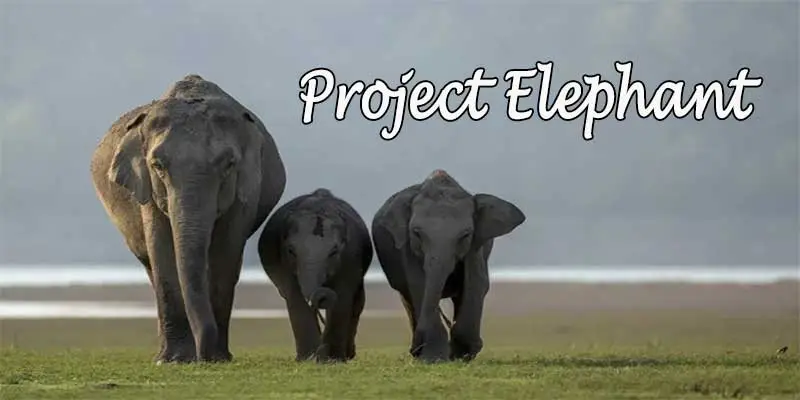

It is increasingly evident that biodiversity conservation is one of the best strategies to combat climate change. Nevertheless, biodiversity conservation is a complex endeavor as biological communities are intricately linked with their environment. To circumvent the challenge, approaches focused on conservation of select keystone and umbrella species can help. Conservation of the globally endangered Asian elephant (Elephas maximus) in India is a case in point.
The association between elephants and people in India is deep, and unparalleled in the world. In India, elephants are revered as a sign of prosperity. They are cultural icons and part of our religion, art, literature and folklore. Indian epics are full of references to elephants. It is even believed Mahabharata was written by Lord Ganesha with one of his broken tusks.
Since the dawn of India’s independence in 1947, elephant population trend has been relatively stable unlike other range countries. India has strong legislations such as the Wildlife (Protection) Act, 1972 that accord highest legal protection to elephants regardless of whether they are in the wild or in human care. The Forest (Conservation) Act, 1980, protects elephant habitats from loss and degradation. In the last 9 years, under Prime Minister Narendra Modi, India has built a robust institutional mechanism, backed by strong political will and leadership, to conserve elephants.
Collectively, elephants are found in about 5% of the total landmass of India. Elephants’ current range include Protected Areas and other forms of multiple-use forests. They also use human-dominated areas to move between forest patches.
Ivory poaching, which remains the foremost challenge for conservation of African elephants, is under control in India. This, however, was not the case in the 1970s and 1980s when we lost several tuskers to poaching fueled by the rapacious international illegal ivory market. The killings posed a serious threat to elephant conservation, and necessitated a mission-mode to revitalise conservation with active coordination between the States and the Centre. This recognition led to the launch of the ambitious Project Elephant in 1992, in line with Project Tiger that managed to bring tigers back from the brink of population collapse.
Project Elephant is a centrally sponsored scheme to provide technical and financial support for elephant conservation and welfare. Elephant Reserves are the fundamental management unit under Project Elephant. As on date, there are 33 Elephant Reserves spread over 80,778 km2 across India. The year 2022 marked 30 years of Project Elephant in India.
Project Elephant has ramped up initiatives for elephant conservation. Two new Elephant Reserves have been created during the last two years in strategically important locations. The Terai Elephant Reserve notified in the Dudhwa and surrounding landscapes of Uttar Pradesh aims to address long-standing issues facing management of transboundary elephants between India and Nepal. The Agasthiyarmalai Elephant Reserve in southern Western Ghats mountains of Tamil Nadu would provide a thrust towards restoring connectivity between Periyar and Agasthiyarmalai landscapes.
Recognizing the importance of corridors to conserve elephants and minimize human-elephant conflicts., Project Elephant has been carrying out the task of ground-validating known elephant corridors across India. Significantly, some critical elephant corridors like Chilla–Motichur in Uttarakhand, Tirunelli-Kudarakote corridor in Kerala and a few others have been successfully restored. In a first, an important corridor in Odisha was notified as a conservation reserve under the provisions of the Wildlife (Protection) Act, 1972.
The Railways and the MoEFCC have been meeting frequently to address the issue of train-related elephant collisions. Both the Ministries are working in tandem with the State Forest Departments and research Institutions to solve the problem.
The most significant challenge towards elephant conservation in India emerges in the form of human-elephant conflict. The government acknowledges the problem and stands with the people to minimise conflicts. Novel initiatives like the Pradhan Mantri Fasal Bima Yojana are now extended to wildlife-related crop losses so that timely compensation can be paid to affected farmers. Efforts are on improve the response time towards conflict and timely ex gratia disbursal.
As India is fast developing and economically progressing, the need of the hour is to retain the nature-culture ties. Our mythology, art, religion and heritage emphasize on the virtues of oneness with nature. To take the elephant conservation message to the masses, MoEFCC and the Assam Forest Department will be celebrating Gaj Utsav marking 30 years of Project Elephant in India.
Gaj Utsav will be a platform to collectively pledge our commitment to conservation of this magnificent species.
The write is Minister, Environment Forest & Climate Change, Government of India
Courtesy PIB, Srinagar