By: M Ahmad
A republic is a “state in which power rests with the people or their representatives; specifically, a state without a monarchy” and also a “government, or system of government, of such a state.” The word republic comes from the Latin term res publica, which literally means “public thing”, “public matter”, or “public affair” and was used to refer to the state as a whole.India, as a sovereign state is a supreme power and no internal groups or the external authority could undermine the authority of the Indian government.
As a sovereign state, India is free from any kind or form of foreign interference in its domestic affairs. India as a democratic country has a system of government in which the people have the power to participate in decision-making. In a democratic system everyone is to be treated equally and to be involved in making decisions.
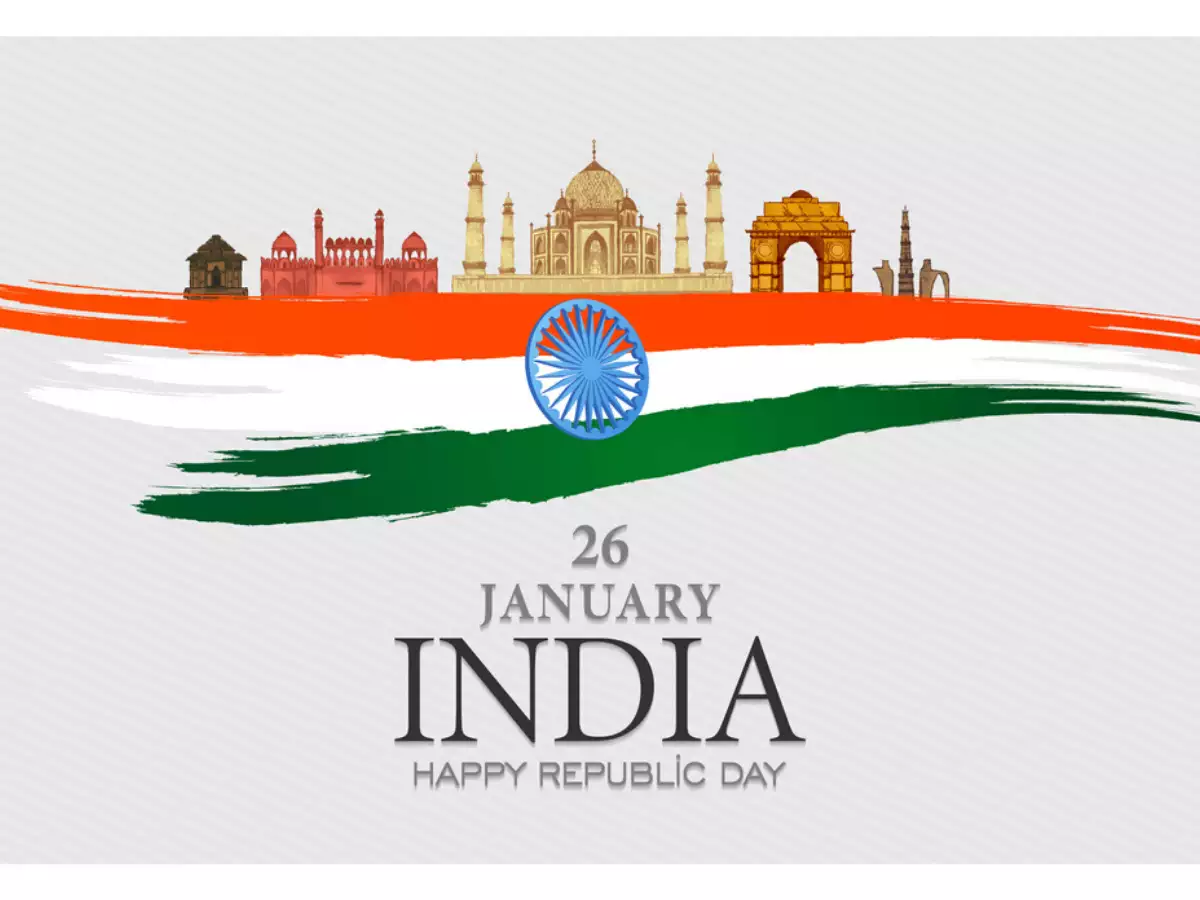
Though India became a free nation on August 15, 1947, it declared itself a Sovereign, Democratic and Republic state with the adoption of the Constitution on January 26, 1950. The Constitution gave the citizens of India the power to choose their own government and paved the way for democracy. A salute of 21 guns and the unfurling of the Indian National Flag by Dr. Rajendra Prasad heralded the historic birth of the Indian Republic on that day. Thereafter 26th of January was decreed a national holiday and was recognised as the Republic Day of India.
Dr.Rajendra Prasad took oath as the first President of India at the Durbar Hall in Government House and this was followed by the Presidential drive along a five-mile route to the Irwin Stadium, where he unfurled the National Flag. Republic Day is a public holiday in India where the country marks and celebrates the date on which the Constitution of India came into effect on 26 January 1950. This replaced the Government of India Act 1935 as the governing document of India, thus turning the nation into a republic separate from British Raj. The constitution was adopted by the Indian Constituent Assembly on 26 November 1949 and came into effect on 26 January 1950. 26 January was chosen as the date for Republic Day as it was on that day in 1930 when the Declaration of Indian Independence was proclaimed by the Indian National Congress.
India obtained its independence on 15 August 1947 as a constitutional monarchy with George VI as head of state and the Earl Mountbatten as governor-general. The country, though, did not yet have a permanent constitution; instead its laws were based on the modified colonial Government of India Act 1935. On 29 August 1947, a resolution was moved for the appointment of Drafting Committee, which was appointed to draft a permanent constitution, with Dr B R Ambedkar as chairman. While India’s Independence Day celebrates its freedom from British Rule, the Republic Day celebrates the coming into force of its constitution.
A draft constitution was prepared by the committee and submitted to the Constituent Assembly on 4 November 1947. The Assembly met for 166 days in public sessions spanning two years, 11 months, and 18 days before adopting the Constitution. The 308 members of the Assembly signed two handwritten copies of the document (one in Hindi and one in English) on 24 January 1950, after much deliberation and some changes. Two days later which was on 26 January 1950, it came into effect throughout the whole nation. On that day, Dr. Rajendra Prasad’s began his first term of office as President of the Indian Union. The Constituent Assembly became the Parliament of India under the transitional provisions of the new Constitution. On the eve of Republic Day, the President addresses the nation.
It is to be noted that January 26 had a great significance in India’s struggle for Swaraj. The Congress Session at Lahore on December 29, 1929, had passed a resolution declaring Purna Swaraj (Complete Independence) as India’s goal. It was also decided that the 26th of January should be observed all over India as Purna Swaraj Day. The complete Independence Day was for the first time celebrated on January 26th, 1930. It continued to be so observed until 1947. On achieving Independence, August 15 became our Independence Day. Since 1950, Republic Day in India is celebrated on 26 January. It signifies the right spirit of Independent and individual India.
The important symbols of the festival include the exhibition of military equipment, the national flag and military equipment. On this day, flag hoisting ceremonies and parades by armed forces are held at Rajpath, New Delhi. India will celebrate its 74th Republic Day on January 26 this year. Twenty-three tableaux– 17 from States and Union Territories, and six from various Ministries and Departments will roll down the Kartavya Path during RD Parade, depicting the nation’s cultural heritage, economic as well as social progress and strong internal and external security. The biggest drone Show in India will light up the evening sky over the Raisina hills, weaving myriad forms of national figures through smooth synchronisation, comprising of 3,500 indigenous drones.
As we all know every year, the organisation of the parade on 26th January is done at Rajpath situated in New Delhi, but Rajpath was not the organizing centre for the parade from 1950 to 1954. During these years, the 26th January parade was held at Irwin Stadium (now National Stadium), Kingsway, Red Fort, and Ramleela Maidan respectively. Rajpath became the permanent venue for the parade of 26th January in AD 1955. Rajpath was known by the name ‘Kingsway’ at that time, now known as Kartavyapath. Every year, the Prime Minister/ President/ or the ruler of any nation is invited as a guest for the 26th January parade.
The first parade was held on 26th January 1950, President of Indonesia Dr. Sukarno was invited as a guest. However, in 1955 when the first parade was held at Rajpath, the Governor-General of Pakistan Malik Ghulam Mohammad was invited. For rehearsal for the parade of 26th January, each group covers the distance of 12 Kilometres but on the day of 26th January, they cover the distance of 9 Kilometres only. Judges are seated all through the way of the parade, and judge every participating group based on 200 parameters, and based on this judgment, the “best marching group” title is awarded. Each army personnel who participates in the event of parade has to pass through 4 levels of investigation.
Besides this, their arms are thoroughly checked to ensure that their arms are not loaded with live bullets. The most fascinating part of the event is the “flypast”. Responsibility for “flypast” lies on the Western Airforce Command, which involves the participation of around 41 Aircraft. The aircraft involved in the parade take off from different centers of the Airforce and reach the Rajpath at a fixed time. There are various other countries in the world who celebrate their Republic Day like India they include-Italy,Turkey, Egypt, Nepal, Kenya, Republika Srpska, Pakistan, Hungary, Guyana, Iran, Gambia, Lithuania, Azerbaijan.
According to information obtained through RTI, an expenditure of about 320 crore rupees was incurred in the parade event held in the 2014 parade. In 2001, this expenditure was about 145 crores. In this manner, the expenditure made on the 26th January parade has increased by 54.51% from 2001 to 2014. From over one lakh seats at the Republic Day (RD) parade, this year the seats have been reduced to around 45,000 due to the reorganisation of seating arrangement and a massive cut in invitations allotted to Very Important Persons (VIP) and officials, while the entire process has been made online. During the parade, a 120-member Egyptian Armed Forces contingent will march on Kartavya Path as the Chief Guest this year Egypt’s President Abdel Fattah El Sisi. In another move to include more women in the Republic Day parade to achieve gender equality in the mega celebration, authorities decided to include female personnel, for the first time, in BSF’s camel contingent on January 26, 2023.
Even if I died in the service of the nation, I would be proud of it. Every drop of my blood will contribute to the growth of this nation and to make it strong and dynamic-Indira Gandhi
If India is not secular, then India is not India at all. We believe in equal respect for all faiths. Ours is a multi-religious country, a multi-lingual country; we have many different modes of worship. We believe in peaceful and harmonious co-existence- Atal Bihari Vajpayee
(M Ahmad is a regular writer for this newspaper and can be reached at specialachivers78@gmail.com)