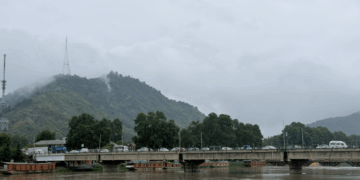
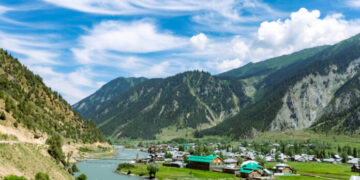
It may surprise many that the Himalayan black bear, also called the Moon bear or Asiatic black bear, holds responsibility for helping the forest ecosystem grow. Popularly and locally known as ‘Maali’ of forests, the black bear has a deep rooted significance in the wildlife community. The duty of cultivating, maintaining and protecting the Himalayan forests lies on the black bear. The role it plays is important in facilitating habitats of various flora and fauna. To further understand what a black bear does to protect its own, we took a stroll through Dachigam National Park and interacted with the forest guards and officials who know better.
Importance
The Himalayan black bear is an omnivore i.e. it eats both plants and small animals. Relying mostly on an acorn diet before and after hibernation, it also consumes fruits, berries, and other plant species found in the jungle. However, it excretes about 85% of the food material consumed, scattering undigested seeds all over the forest floor. These seeds semi-scathed and enveloped in organic matter germinate wherever the black bear passes out its faeces thus, forming new life all over the area. Without any human interference, the black bear gathers up new Himalayas.
Apart from this, when the bear searches for food, finding that lower branches have been depleted of food resources, it forages for fruits and berries up towards the top of trees. As such, it breaks off branches that are too fragile to hold its weight. Though it may seem the bear is destroying the forest, factually it is quite the opposite. Because in doing so, the bear creates a pathway for penetration of sunlight towards the lower growth, such as herbs, shrubs, or smaller vegetation that form a very important part of the whole forest ecosystem. The secondary growth that flourishes, as a result, supports many a flora and fauna.
Cleaning Up
We all know the significance of scavengers in our world. These animals or plants eat up the dead organic remains that would potentially harm our biosphere if not taken care of in a proper way. The Himalayan black bear also acts as a scavenger, eating diseased animals so that continuity is maintained. One of the reasons the black bear does this is because of its strong immune system. It also searches under fallen, partially decomposed logs for grubs, insects, and other biota. When the log is overturned, the side not yet decomposed faces the ground for being acted upon decomposers, thus enriching forest soil with nutrients. It is the black bear which gives up its life to protect our own. Thoroughly misunderstood, it nevertheless continues to protect the forest, cleans it up, and preserves the natural balance. This is what a black bear’s life is all about.
Relation with Humans
Conflicts with the local human population are often seen along the periphery of forests where black bears reside. Construction and development of urban jungles and horticulture farms lead to such interactions. What people don’t realize is that encroaching upon the forest land where a variety of species already exist and thrive will lead to involvement with the same. And improvised farms and orchards which are laden with fresh fruits are a welcome treat for those animals that are dislocated from their habitat, thus making human population susceptible to violence. Most of the time a black bear attacks because it is afraid or has cubs. Just as humans defend themselves, so do the bears too. But increasing proximity to their habitat will mean more conflicts, and more deaths on both sides. Although hostile interactions with the Himalayan black bear have been greatly reduced now when compared to a decade or two ago, yet awareness of sustainable living amongst masses is less. In order to protect wildlife, one has to provide them a breathing space. Unruly encroachments often result in such unsavoury situations.
The Himalayan black bear is a unique species, protecting and preserving the ecosystem as it has been designed to do. But affecting their population, breeding patterns and lifestyle is the untoward attitude of human population. This 250 kg mass of fur and a bit of terror is a friend to our forests, which eventually support us. Therefore, we should learn more about these creatures and devoutly protect them as our own.