By: Bishwadeep Moitra
“My interest is not in the capture of power, but in the control of power by the people”-Jayaprakash Narayan, 1977
In independent India, people’s verdict ‘to overthrow or substitute by another governed’ – definition of a revolution – has happened nine out of 16 times since the first general elections in 1952. The first 30 years since independence, Indian electorate voted back the incumbent government, whereas, elsewhere in the world, during this period revolutions were quite in vogue: France got its Fifth Republic, China its Cultural Revolution and the marquee revolutionary of all, Che Guevera was already on T-shirts. It was not until 1977 that the Indian people rose up to overthrow a regime.
On March 3, 1977, thousands of people gathered at the Ramlila grounds in Delhi to the call of opposition leaders just released from prison. It was a reflection of the nation’s anger and a defiance of the jackboots of the Emergency. Two years earlier, the venue had seen tumultuous crowds cheer Jayaprakash Narayan as he warned Indira Gandhi by evoking Ramdhari Singh ‘Dinkar’: Singhasan khali karo ki janta aati hai.
The silent majority of India, in a revolution-like verdict given a fortnight after the Ramlila ground rally in 1977, uprooted a dictator misguided into snatching liberty away from the citizens. Interestingly, unlike in the other countries where revolutions brought about new forms of governance, we, the people of India, in 1977 restored the constitution our founding fathers bequeathed on us.
A threat similar to 1977 stares back at us. Will the present generation of Indians, far more educated in numbers, reasonably more resourceful than before and wiser from the benefit of hindsight, rise up again eight months from now to reclaim liberty?
Indian democracy, despite its many imperfections, is regarded as functioning due to its people’s right to elect or reject its ruler. The electorate un-seated a 413-parliamentarians strong Rajiv Gandhi government in 1989 over bribery charges to bring V.P. Singh’s minority government to power. Like a repeat script of the Janata experiment of 1977, Singh’s government collapsed mid-term.
Forced into a premature election by inept politicians, the 1991 electorate was perhaps the most listless one; voter turnout being among the least in any general election held so far. No political leader in 1991 had the charisma or an issue that could invigorate the voter. Rajiv Gandhi’s assassination midway during the polls resulted in swing votes that helped the Congress form a minority government headed by a prime minister who had already announced retirement from politics before the elections were held.
P.V. Narasimha Rao’s scam-a-day Congress-led minority government turned out to be epochal in changing the economic and political course of India. Public discourse shifted from India being a social welfare state to a state that is obsessed with camouflaging its criminal poverty by GDP numbers. ‘Poor’ became a cuss word. The hero in Bollywood, unlike his predecessor of belled-economy India, was no longer the coolie oppressed by the mill-owner; instead, he was the lovable rich bloke. We began to feel rich on finding some of our men and women in the dollar-millionaire lists. Net worth became our only focus even as voices of human suffering poked our growth-story like steel nibs. The state gradually abdicated its responsibility of the service to its people in private charge where only bottom lines mattered. Trade unionism died. Our new ‘saviours’, the wealth-creators of India, themselves became richer by selling our natural resources back to us. People revolted in our hinterland for being robbed of what belonged to them, and we marked them as Naxals. The Indian middle-class reached 250-million strong during the halcyon days of Vajpayee-Manmohan Singh. But our dream run hit the global economic iceberg in 2008.
The general elections held in the nine years between 1995 to 2004 and the 2009 election were electoral contests between political groupings almost indistinguishable from each other in their intent on charting India’s destiny. The political significance of these elections lies in the emergence of stable political groupings that could govern India ably.
In 2011, a poor imitator of Mahatma Gandhi, who drew tall patriotic merit for taking a bullet in his skull while in the service of the Indian Army as a truck driver during the 1965 war, proxyed an assault for the Hindu Right on the UPA government. Anna Hazare’s demand for a legislation to punish the corrupt at Jantar Mantar found resonance with a public enraged by a series of financial scams of the UPA II government. Baba Ramdev, another saffron totem, set jitters in the government with his own rally, demanding to bring back Indian money deposited in Swiss banks.
Looking back, the anti-corruption agitation, when it started in April 2011, seemed apolitical, bearing the attributes of a genuine people’s movement. But the agitation’s real orchestrators, the RSS, had masterfully used the agitation in preparing the grounds for a Narendra Modi to launch himself as the BJP’s presidential-like prime ministerial candidate in 2013.
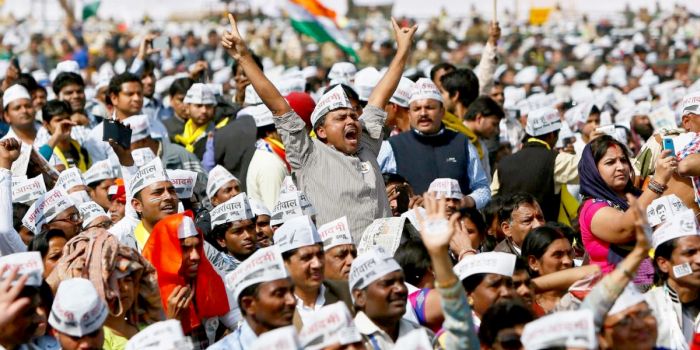
It is now beyond doubt that the projection of people’s anger against corruption during the Hazare-Ramdev shows were disproportionate to its purport. Television media equated RSS-backed rallies in Delhi and elsewhere to the Tahrir Square-like people’s uprisings. Images of big protesting crowds, whether in Cairo, Tunis or Delhi evoke profound romanticism in its citizenry that can rattle any regime. Pranab Mukherjee, the number two in the UPA II government, admitted his nervousness to a group of editors before leaving to meet Ramdev at Delhi’s IGI airport at the height of the agitation. “I will have to talk with him in Hindi, which I don’t understand much.” [He took along Kapil Sibal, then the HRD minister, as his translator.]
The 2019 elections bear similarities to the elections of 1977. The people of India in 2019, like in 1977, will have to valiantly fight back to reclaim what was lost once before: liberty. ‘Hindu Rashtra’ is no longer a hidden agenda. The mask of a moderate BJP slipped a long time ago; the cremation rituals of that symbol has been performed as well. Since Modi cannot count many bridges he could build and his ‘Vikas’ remains the boy who still wets his pyjama in his dreams, the BJP’s Brahmastra is in spreading the bogey of Muslims coming to rule over Hindus again if power goes out of Modi’s hands. The dressing up of a tethering economy, a schizophrenic notion of India’s place in the world, a faux nationalism – these are all a bid to gloss over a script that now beckons canned applause for an encore in 2019. The BJP’s chaalisa for the next bidding is unmistakably Hum paanch, humare pachchis (‘We five, ours 25’) and Shamshan-kabristan – Modi’s tried and tested clarion calls.
Eight months before the general election, there is a strong current of dissent blowing in the country that gathers momentum each day. Streets have begun to get filled again by protestors fighting injustice. Intellectuals – Modi’s bête-noire – have kept the heat on the regime’s excessive agenda. Even pranayam is failing to hold the chest at 56 inches!
The fight to save India from becoming a country for Hindi, Hindu and Hindustan is a fight similar to the one our mothers and fathers had fought against the Emergency. Can the million raging mutinies of today be harnessed into one J.P.-like movement before 2019? Or will we reject an India based on the ideals Nehru and Ambedkar as drivel and embrace fascism?
Bishwadeep Moitra is a senior journalist. He was among the founding member of the Outlook magazine and the author of the illustrated book, Brigitte Singh: The Printress of Mughal Garden.
Courtesy www.thewire.in