By: Zakia Soman
The article ‘Inside Ahmedabad’s Juhapura: What It’s Like for Muslims to Live in a Ghetto’, September 12, by Christopher Jaffrelot and Sharik Laliwala on life in the Muslim ghetto invoked much emotion and memories for me. How did the serene and cosmopolitan neighbourhood of my childhood turn into the much maligned ghetto? Why did it get labelled as “mini Pakistan” in the 1990s? How can one reconcile the existence of such a ghetto with the Gujarat model? My life and the lives of many others have been deeply impacted by these developments.
Juhapura can offer many valuable insights to those interested in studying the politics of religious divide and how it adversely impacts the lives of ordinary citizens.
I was five or six-years-old when my parents moved to Juhapura in 1970. They bought a small tenement in a brand new colony called Sham-e-Burhan. Apart from the affordability of the home, my parents zeroed in on Juhapura as it was a mixed locality. There were Gulistan and Bostan housing colonies as there were Rang Avdhoot, Sardar Smriti and Gandhi Smriti. There were a good number of college teachers who were residents here and my father felt particularly at home. The present F.D. School (Falah-e-Darein School) is housed in a building which was originally Prakash College for Education. My mother got her B.Ed degree from Prakash College. Eid and Diwali were fun occasions for us, with hectic exchanges of visits and greetings.
Communal riots have been a regular feature of Gujarat. With every riot, scores of Muslim families get displaced and are forced to move to a “safe” neighbourhood. Juhapura inched closer to being a Muslim ghetto with each passing communal riot. The city of Ahmedabad witnessed a devastating communal riot in 1969 where over 5,000 lives were lost. As always, Muslims were the worst affected community and several moved to Juhapura seeking safety.
There was a devastating flood in the Sabarmati river in 1970 which resulted in the huge displacement of people living in slum dwellings by the river. The government relocated affected families from economically weaker sections at Sanklitnagar Rehabilitation Colony in Juhapura. It remained a mixed locality with Hindus and Muslims living side by side through the 1970s and till mid-’80s. The growing incidence of communal riots around various rath yatras earlier, followed by the Ram Janmabhoomi movement sealed the fate of Juhapura as a Muslim ghetto. The middle class Hindu residents had already moved out to other parts of the city. Now even those living in Sanklitnagar began moving out after selling their homes to Muslims. Several displaced Muslim families from across the state moved here post the violence of 2002.
During the communal riots following the demolition of Babri masjid in 1992, Juhapura was referred to as ‘mini Pakistan’. It became a theatre of the absurd when a lot of my fellow Ahmedabadis including friends bought into rumours that Juhapura posed a threat to the city and the entire state. That there were rocket launchpads in Juhapura coordinated by the Pakistan army which were ready to target western Ahmedabad. Citizens in Hindu localities would hold vigils through the night as they anticipated truckloads of armed Juhapura Muslims coming to attack them. No prizes for guessing who was behind all this.
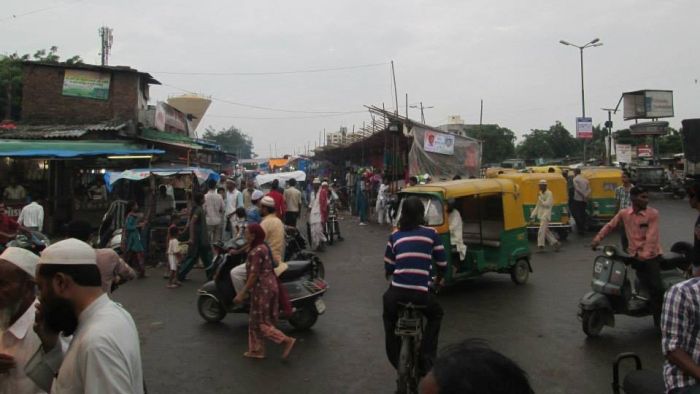
For over two decades following 1992, Juhapura has been subjected to a sort of demonisation, official social boycott and state apathy – with no roads, no water, no garbage disposal, no government schools, no health centres. What is worse, until about eight to nine years ago, there was no post office, no branch of any nationalised bank, no state transport bus service in Juhapura, in spite of it housing a population of over five lakh. What is more, in the heart of Juhapura stood the building that housed the headquarters of riot control police with armoured vehicles. But there has never been a riot in Juhapura.
Just as every dark cloud has a silver lining, Juhapura too has begun to change in the last few years as narrated by the authors. Of course, civic amenities remain far from satisfactory compared with every other locality of the city. There have been several initiatives taken by the citizens to build bridges with the larger society.
Juhapura remains a study in how the politics of religious hate and division is furthered by pushing a community literally to the walls. In a polarised social and political climate there is no place for a Muslim citizen in the city. The only alternative is the ghetto.
Courtesy www.thewire.in