SUPPOSE Antony had a TV channel at his disposal and Brutus didn’t. Would that change the course of history? Difficult to say, but experience shows that TV is overrated for its prowess, more so in a democracy. People win elections without the support of TV and they lose them despite all the help they get from the media barons.
In other words, TV and assorted media innovations are largely a middle-class worry, the subject of drawing room conversation. Yes, one can sell talismans and spurious cures or false promises on TV in a fly-by-night swindle, and it can have a brief use for authoritarian regimes. But even in that realm, a monopoly on the popular medium of information (and disinformation) has seldom prevented the fall of unpopular regimes.
Indira Gandhi put on Bobby, a popular movie of its time, on state TV to distract people heading to Delhi’s Ramlila Grounds to join the opposition’s election rally in 1977. But they went anyway and changed history, without TV. The Soviet Union collapsed despite its formidable propaganda machinery. Satellite connectivity cannot help capitalism from its pervasive crisis.
The anti-Vietnam war movement succeeded against the monopoly of Johnson and Nixon on propaganda. What mattered was Daniel Ellsberg’s revelation of state perfidy in Vietnam. He showed that a person of conscience could be found in the deepest recesses of any deep state. Julian Assange and Edward Snowden are only following in his footsteps.
On a dreary morning in October 2014, historian and public intellectual RomilaThapar delivered a lecture on the waning questioning spirit in India. Prime Minister Narendra Modi had just pocketed Maharashtra and Haryana after his own impressive victory in May that year. In her exhortation, Thapar described Buddha and Socrates as the early prototypes of modern public intellectuals, which Ellsberg was in his own place and time. Public intellectuals are routinely jailed, poisoned or denounced as enemies of the state.
Thapar offered the example of Roman orator Cicero, of the first century BC, who exposed the corruption of some of the Roman governors, and “claimed the right to question whatever he thought needed to be questioned, and used his legal brilliance to do so”.
Distinct from philosophers, the public intellectual emerged as a recognisable category in the 19th century. It began with the Dreyfus Affair. A Jewish captain in the French army, Dreyfus was imprisoned and falsely charged with leaking secrets to the Germans. Those opposing this action argued that the general staff of the army, in league with the politicians, had unfairly targeted Dreyfus. This accusation, written by Emile Zola, carried the support of a large number of writers, artists and academics, all of whom jointly came to be called ‘intellectuals’. Eventually, Dreyfus was declared innocent and reinstated.
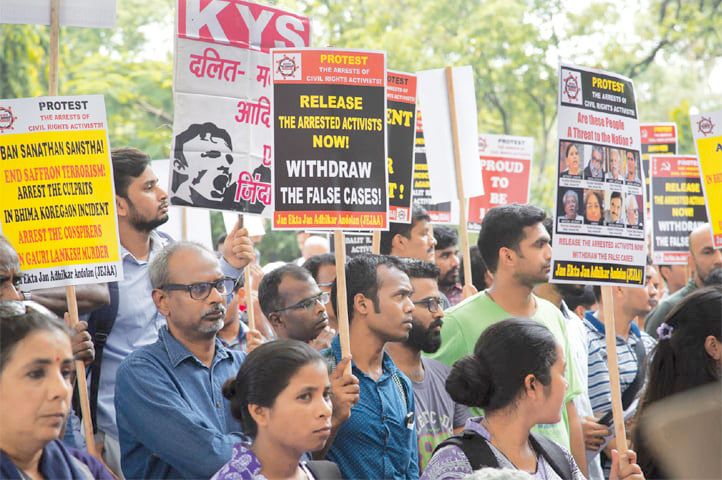
The octogenarian professor was in the news last week, petitioning the Supreme Court to prevent the arrest and harassment of public-minded individuals. Happily, the court appeared to agree with her worry that right to dissent, if denied in a democracy, could belie the purposes of democracy. On Thursday, the court will take up her petition signed also by four other leading academics on behalf of five public figures. They are wanted by police in BJP-ruled Maharashtra as supporters or accomplices of a banned Maoist group.
Five others, including lawyers and writers, were arrested in June over similar charges. One charge pertained to a plot they were allegedly involved in to assassinate Prime Minster Modi. All accused have described the charges as ridiculous and concocted.
Many blame TV and the internet for facilitating communalism in India and Donald Trump in America. This overlooks the horrors of Partition, when the technology didn’t exist. Rumours and prejudice don’t require technological support. TV didn’t drive the Ku Klux Klan. America’s racial divide will not heal even if right-wing TV channels were to be taken off the air. Things could perhaps improve when people accept their follies, but that’s not a discussion to pursue here.
In India, Mayawati, JigneshMewani, Lalu Yadav and Mamata Banerjee come to mind, among others, who can and do win elections by simply being connected with the ground as trees are, with little or no technological prop. In fact, they win while being abused by biased channels. The left once held sway in this realm, despite sustained attacks from the largely business-owned media. Right-wing propaganda, the staple fare of private and state-run TV in India, does not significantly affect the dogged determination of those rooted to the ground reality in any significant way.
After all, fascism preceded Goebbels and its pull and attraction didn’t die with him. India’s RashtriyaSwayamsevakSangh, for example, began with fulsome praise of fascism. The group was banned twice, the first time after Mahatma Gandhi’s murder and then after the demolition of the Babri Masjid. The men and women jailed or kept under house arrest are vocal critics of the fascist threat to Indian democracy.
Which explains why the Modi government is terrified of public intellectuals. Public-minded men and women who don’t have any recourse to putting their critical point of view on any TV channel or newspaper are deemed a threat to a government that has all the levers of power in its hands. That’s how powerful an idea can be.
Faiz may have had the public intellectual’s quandary in mind when he wrote: “Mata’elauh-o-qalamchhingaae’n to kyaghamhai/ Ki khun-e- dilmeindubo li hai’nungliya’nmainey.” (Does it matter they have stolen away my paper and my quill/ With fingers dipped in the inkwell of my heart, the bloody truth will be shriller than shrill.)
Justice D.Y. Chandrachud’s response to Thapar’s petition described dissent as the safety valve of democracy. “If you muzzle democracy, the pressure cooker will burst.” Should it come to such a pass, TV channels could be the last to know.
Courtesy Dawn