By: Anand Sahay
The RSS-BJP had long desired to be in government in Jammu and Kashmir, India’s only Muslim-majority state, in order to try out its brand of politics there. Well, it seems it has badly messed up the opportunity it got.
With anger welling up across Kashmir — and across the political spectrum in the Valley — on the issue of Article 35A of the Constitution, we should prepare for stormy disturbances ahead in addition to the military-related troubles that already exist.
It is evident that the BJP’s mishandling of Kashmir, and casual disregard of public sentiment in the Valley, has set the country back since it is pretty much an axiom that when India takes a political hit in Kashmir, it is Pakistan that gains and its proxies are afforded a wider field of operation and manoeuvre.
So sorry has been the spectacle — and so conspicuous the BJP’s failure — that, in order to escape responsibility as a partner in the J&K government, the Centre toppled the PDP-BJP government in which the BJP was a more than vigorous ally, and Central rule was imposed. This is an extraordinary happening, and is by any yardstick a screaming acknowledgment of political inadequacy.
Before the next Lok Sabha poll, there does not appear to be much chance of retrieval. The RSS’ espousal of the case to remove Article 35A of the Constitution, through which is defined the identity of the Kashmiri people in relation to the rest of India, is causing turmoil in the minds of ordinary men and women in the Valley.
This dangerous advocacy — taken to the Supreme Court by a NGO with RSS leanings — has unleashed demons in the minds of the people of J&K, indeed even in “Hindu” Jammu, where a BJP MLA spoke out against his party.
If terrorist events and extremist violence combined with military action initiated to check this trend, and the ensuing civilian casualties as well as instances of civilian challenge to the uniformed forces, have dominated the headlines since July 2016 (after the death of an extremist faction leader in an encounter), for the first time in many years a Valley-wide mobilisation is building up on the question of Article 35A even as these lines appear.
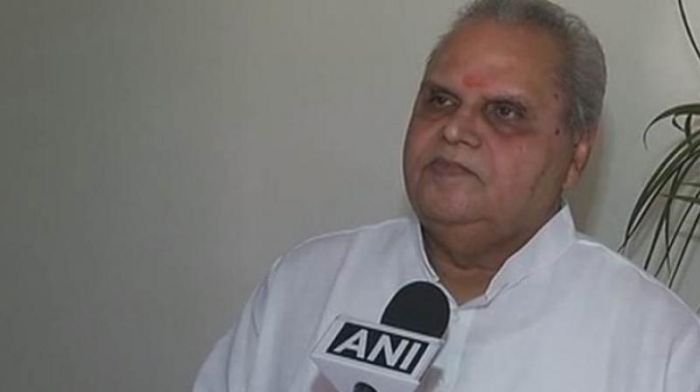
Every Kashmiri is getting involved, and there are no exceptions. This ought to be the real worry. For the newly-inducted governor, Satya Pal Malik, this development could mark a most unpropitious beginning to an innings for which he appears to have no previous preparation.
His predecessor N.N. Vohra, a retired civil servant of distinction, was held in esteem across the Valley. The sudden announcement of his replacement last week caused dismay although it had been known for some time that he didn’t wish to stay. The popular perception was that Mr Vohra tried to be fair to the people within the range of the powers he had, and was not a yes man.
His substitution with a BJP politician, who has flitted across the political spectrum, is giving rise to fears in Kashmir that unpalatable political measures could be on the cards. The replacement of a governor during Governor’s Rule is itself unusual and gives rise to a sense of dissonance at the top. It is in this unwholesome atmosphere that Mr Malik has been ushered in.
The scale and intensity of terrorist violence seen in the past two years or so was reminiscent of the Pakistan-triggered militancy of the late 1980s and the early ’90s. It did admit of a firm response on the part of the armed forces, alongside efforts to calm the populace. On the whole, it is principally the impressionable youth who were getting sucked into this violence.
However, the latest development surrounding the RSS-BJP’s attempt to have Article 35A of the Constitution struck down as unconstitutional is escalating the problem manifold. It is bringing about a concord among all sections of politics and public opinion in Kashmir, not just the sections of the youth — and their numbers are said to be rising — being attracted to militancy.
The separatists and the mainline parties have come together as one. The anger building up now is not just against the Narendra Modi government in Delhi. It is also turning out to be against India for contemplating to renege — as the Valley sees it — on an understanding reached with Kashmir and its people. The first act of any responsible authority should be to remove any misunderstanding on this score.
Article 35A lays down that only permanent residents of J&K (known as “state subjects” under the Maharaja’s rule) shall own immoveable property in the state, or get government jobs or scholarships. This was the situation prevailing before Maharaja Hari Singh “acceded” to India against his will in very difficult circumstances (rather than “merged” his domains with India) in October 1947, and has been accepted in toto in the Indian Constitution through Article 35A.
This provision lays down further that only the J&K legislature shall be competent to determine who a permanent resident is. It is also important to note that it is through Article 35A that permanent residents of J&K become citizens of India.
The RSS-inspired NGO, which is in the Supreme Court petitioning for its removal, has argued on a pseudo-technical basis that this article was not incorporated into the Constitution through the due process of amendment, but was incorporated through a presidential order in 1954 as per powers conferred on the President of India by Article 370 (i) (d) of the Constitution.
Given forceful precedents, it is a mystery why the Supreme Court has not dismissed the petition as being not maintainable since it is amply clear that Article 35A is a sub-set of Article 370, which accords special status to J&K in light of the dangerous circumstances prevailing in the state at the time of accession, and directly flows from it.
The power of the President under Article 370 (i) (d) to modify a provision of the Constitution for the purposes of application to J&K (since it was in a special category) has been challenged earlier. A Constitution Bench of the Supreme Court rejected it in Puranlal Lakhanpal vs President of India (judgment of March 30, 1961).
Further, in Delhi Laws Act (SCR 747), the Supreme Court put it sharply. The issue was the same. The court rejected the petition “with costs”, finding “no force in it”. It also noted that this was “apart from the question whether the petitioner has any fundamental right to maintain his petition under Article 32”.
It is hoped the Supreme Court will not just be judicial but also judicious and hand down mischievous elements lessons in avoiding gamesmanship when the integrity of the country is at stake.
Courtesy The Asian Age