
By: Radha Kumar
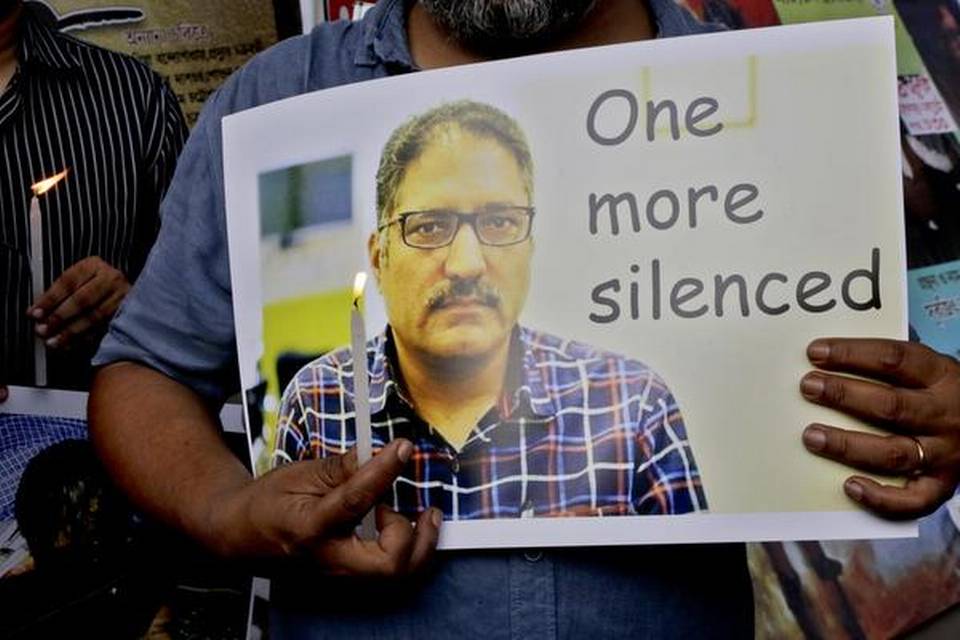
The tragic and shocking assassination of Shujaat Bukhari came as yet another reminder of how conflict brutalises. Shujaat joins a line of martyrs who were assaulted because they sought a negotiated end to violence — Abdul Ghani Lone who called for an end to cross border militancy and Fazal Haq Qureshi who engaged with the Indian government to find an honourable solution to the Kashmir conflict. Fazal Haq escaped with his life. Shujaat alas did not. His last days were spent in underlining the grave situation in the Valley, where youth alienation was at a peak. The government’s unfortunate decision to end the Ramzan ceasefire will only add to this nihilistic despair, as Shujaat would warn were he alive.
Building bridges
Shujaat fought for a policy that would return Kashmiri youth to the peacemaking fold. He was a passionate Kashmiri nationalist who brought the Kashmiri language back to the Valley’s literary and educational establishments. He sought to build bridges with Jammu and Ladakh as well as across the Line of Control, with New Delhi as well as Islamabad. He never indulged in abuse or even expressions of rage — an extraordinary feat given the terrible suffering of his people at the hands of both the Indian and Pakistani governments, not to mention Pakistan-based terror groups like the Lashkar-e-Taiba and Jaish-e-Mohammed. He was a man of great discipline and clear sight when it came to the interests of Kashmiris.
I first met Shujaat when he was a reporter at The Hindu, but my closest association with him came when I was appointed one of the Indian government’s Group of Interlocutors for Jammu and Kashmir in 2010. Shujaat was sceptical, as were most Kashmiris — so many interlocutors had come and gone, he said, but the government never took the next step, of moving towards a political solution. We might help assuage rage at the deaths of 120 youth during the summer uprising of 2010, he added, but what after that? Could we get the government to engage in a results-oriented political dialogue with the ‘azaadi’ groups and Pakistan? Was there any hope of resurrecting the peace process of 2004-07?
Despite his scepticism, Shujaat helped us. Like the rest of the Kashmiri media, his paper was hostile to our mission when we started. Yet, as they saw that we were sincere — though our superiors in government may not be — they rallied to our cause. When we visited the Srinagar jail and met with the militants held there, he called to commiserate with me on the trolling we received by the Bharatiya Janata Party (BJP) and the national media. It was after this that he assigned one of his most seasoned journalists to cover our work, and it was partly due to the reporting in Rising Kashmir, and Greater Kashmir too, that the tide of public opinion in the Valley slowly turned in our favour.
In the one year that we worked as interlocutors, we must have met Shujaat a few dozen times. Our meetings were never as friends — though we were indeed friends — but always professional. He refused to lunch or dine with us, but he did offer us advice. It was because of his prodding, along with Fayaz Ahmad Kaloo’s, that the Home Ministry lifted its ban on government advertisements in his and other papers, albeit briefly. It was also because of his prodding that we were able to get hundreds of stone throwers released. Most rare of all, his was one of the few Valley papers that gave as much coverage to our work in Jammu and Ladakh as in the Valley. And when my colleagues wanted to focus on Jammu and Kashmir alone, excluding the Pakistan-held parts of the former princely state, it was Shujaat who gave me the courage to stand firm and include those regions in our final report.
Ironically, it was our attempt to push the boundaries of interlocution to include human rights, demilitarisation and talks with ‘azaadi’ groups, including their armed wings, that won us Shujaat’s support. I say ironically because it was these very efforts that led to our loss of support in both Delhi and the government and made us less effective than we might have been. But Shujaat, like so many other Kashmiris, welcomed us as individuals. He did not believe the government would act politically, but he believed that the more inclusive we were the better it would be for everyone. He was a man who saw both the short and the long run.
Unfinished business
Our mission ended, as he had predicted, without the government engaging in next steps. But he remained a friend. We did not work together again but were constantly in touch on Kashmir. Our last conversation was about my forthcoming book. He was writing his own book, he told me. Do it fast, I said, because then I can quote from it. The paper came first, he replied, there was time for his book. Alas there was not, but the chapters he did write should be published soon.
As I conclude this memorial, I have only one hope. Let the Indian and Pakistani governments, and the ‘azaadi’ groups — all of whom have condemned Shujaat’s assassination — restore the ceasefire and restart political talks for an end to the conflict. This was what Shujaat worked for. As his senseless killing shows, time is fast running out for the Valley.
Radha Kumar is a writer and political analyst. She was one of the three interlocutors for J&K appointed by the Central government in 2010.
Courtesy The Hindu