In Pakistan, Pathan youth are at the heart of a mass movement questioning state policies. Their methods hold a lesson for Kashmir’s young.
Amidst the iniquitous engineering Pakistan’s political structures are increasingly exposed to, there is emerging the promise of a rights movement premised on the legitimacy of its demands and the relevance of its message, claiming space and accountability within a constricted political landscape. While framed within the context of Pashtun identity and experience, the questions it is raising, the discourse it is steering and the redress it is pleading all find pertinence within a larger national consciousness. Within the backdrop of its ethno-regional grievances, the movement is trying to re-define the broader relationship between the Pakistani state and its citizens, the nature and character of its contract and the role, responsibilities and conduct of its various institutions and their power elite. Originating within the central theatre of Pakistan’s “war on terror”, the movement questions the rationale of state policies and their collateral fallout, while also calling out the decision-making processes that arrive at such policies.
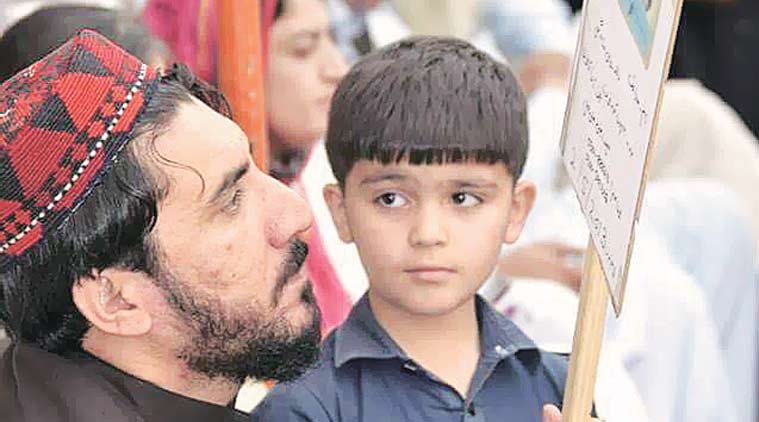
Spearheaded by a dynamic twenty-something tribesman, Manzoor Pashteen, the Pashtun Tahafuz Movement (PTM) gestated within the conflict sociology that developed as a result of the war-like situation ravaging the north-western tribal areas of Pakistan, adjacent to its border with Afghanistan. Caught in the crossfire between militants and the military, life for the proud tribesmen was reduced to being a suspect, terrorised and disenfranchised collective. The emotional trauma as a result of internal displacement further added to their despair as years later, on their return to their homes they were met with razed remains and the strife that attended endeavours to rebuild their lives. A cycle of discrimination, bloodletting and ignominy followed. The pent-up alienation finally found a vent in the campaign for “Justice for Naqeeb Ullah Mehsud”, an aspiring model from the tribal region based in Karachi, killed in a police encounter on fabricated charges of terrorism.
What started as a 10-day sit-in in Islamabad in February soon snowballed into a widespread movement drawing thousands of people, especially Pashtuns, from far and wide. The movement responded by reinventing itself and rolled out a four-point charter of demands in quick succession. The demands in a crux underlined the major issues challenging the region: The establishment of a judicial commission to look into the “extra-judicial” killings of Pashtuns; presenting the “missing” persons in a court of law and release of the innocent; the clearance of landmines from the FATA region and the bringing to justice of Rao Anwar — the police officer responsible for the murder of Mehsud. Evincing conciliation, the government arrived at a swift resolution of key issues such as the abolition of the Watan card (ID card), reduction of checkposts, ending restrictions on political gatherings and re-opening of trade routes with Afghanistan. However, the missing persons issue remained a major sticking point and proved an obstinate impediment to further progress. As official communication broke down, the PTM vowed to take its cause across various cities to pursue support and justice, creatively building a debate around the 14th Amendment of the Constitution of Pakistan — invoking the “Inviolability of dignity of man”.
The appeal of the movement lies not only in the vigour of its demands or the magnitude of its trauma, but more importantly in the non-violent methods of protest it embraces and the humanising strategies it employs. This has garnered not only domestic grass roots support but also international media spotlight. As the catchy anthem “Da Sanga Azaadi da” (what sort of freedom is this) blazes in the backdrop, among a sea of white and black flags, the former denoting peace and the latter their grief, speaker after speaker enthral the audience with the simplicity of their narratives and conviction of their cause.
The movement would, however, do well to scale down the tirade against the army — a sentiment in post-terrorism Pakistan, the broader national mood does not have much appetite for. As the movement continues to go from strength to strength despite the media gag and various forms of containment, major parties in an election year are all too willing to woo it, ranging from words of support to offers of assistance and more critically the ruling party’s accelerated passage through parliament of the much-delayed mainstreaming of the FATA region by the 31st Amendment to the Constitution of Pakistan, just before its tenure expired. From a rag-tag assembly of “misguided” youngsters, the movement has evolved into a force to reckon with.
Living in Kashmir, one can’t help but draw parallels and reflect upon the vortex of violence it has steadily been engulfed in with no end-game in sight, devouring its young and best alike. Beyond the path of violent self-destruction, the youth need to take a cue, step back and devise more imaginative and engaging means of registering their dissent. There needs to be an urgent mechanism to check the socio-economic haemorrhaging of the society. They need to venture beyond the prescribed self-inflicting, rhetorical tactics and acquire smarter and more widely accepted means of getting their message across. On the other end, there need to be willing listeners.
The announcement of a ceasefire on the eve of Ramzaan by New Delhi, is a step in the right direction, conjuring a throwback to the Ramzaan ceasefire of 2000. The ceasefire during the Atal Bihari Vajpayee government eventually proved a precursor to a more structured and almost deliverable peace process. Thucydides, in the History of the Peloponnesian Wars underscored over 2,000 years ago the thesis “killing insurgents does not end rebellions”.
Conflicts come with costs for all, their resolution brings dividends to each.
The writer is an academic who divides her time between Srinagar, New Delhi and Islamabad
Courtesy The Indian Express