By: Hafsa Kanjwal & Mohamad Junaid
On May 18, the New York Times published an editorial entitled “A long shot in Kashmir”. The editorial completely misrepresents the nature of the Kashmir issue and reinforces the false notion of it being a “territorial dispute” between India and Pakistan.
In addition, it raises the bogey of “Islamism” to further undermine genuine mass aspirations for self-determination and freedom from India among Kashmiris. As scholars of Kashmir, we believe it is important to provide correctives to these misconceptions.
One of the primary misfortunes of the Kashmiri people has been that their struggle for self-determination continues to be framed simply as an interstate conflict, with much more importance given to Indian and Pakistani nationalist narratives on Kashmir than Kashmiri viewpoints.
For the issue to be resolved, the international community, and the media, need to move beyond these statist perspectives and foreground Kashmiri perspectives and agency. Kashmiris are not only the main victims of the conflict in the region but remain the key drivers of the long-standing self-determination movement.
As recent scholarship on Kashmir has showcased, we need to move beyond the framing of the conflict as only beginning in 1947. Despite popular perceptions in the West and elsewhere, the region was far from internally politically passive while India and Pakistan fought three wars to control it.
Instead, we need to look into Kashmiri political aspirations in the late colonial period. In 1931, Kashmiris launched their first mass agitation against the Dogras, a Hindu monarchy that ruled over the Muslim-majority region. While this historic movement became embroiled in the politics of British India’s partition in 1947, as the region was split between India and Pakistan, the Kashmiri aspiration to determine their own future not only continued but intensified.
Indeed, focusing primarily on India and Pakistan, the New York Times editorial makes no reference to why Kashmiris are protesting and why they have continued to demand their political rights.
Simplistic references to “Islamist insurgency”, and its sponsorship by Pakistan, play easily into Indian conspiracy theories that dehumanise Kashmiris and deny them any political agency and ability to rule themselves. These theories do not explain the existence of a decades-old Kashmiri self-determination movement before the 1990s, nor do they cover the entire gamut of Kashmiri opinions on the matter.
Furthermore, while Pakistan remains a party to the dispute, its role since 9/11, and especially since 2008, has been minimal. The large crowds demanding freedom in Kashmir are not instigated by Pakistan; this is an indigenous resurgence.
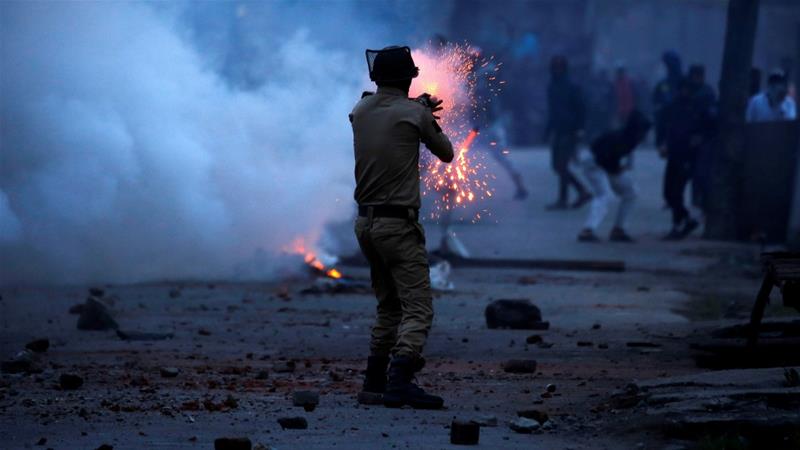
The editorial does not highlight the intense repression and political surveillance that Kashmiris are subject to on a daily basis. The “Islamist insurgency” is only one facet of the Kashmiri response to the occupation and is itself a result of Indian repression and curbing of dissent.
Indeed, presenting Kashmir’s historical struggle for self-determination as an “Islamist insurgency” helps India present itself as a victim of terrorism rather than as a perpetrator of state violence.
As new scholarship, as well as Kashmiri intellectuals on the ground, has made clear, Kashmiris are demanding an end to the Indian military occupation of their land and the right to determine their own future. Self-determination was promised to them by the government of India itself at the time of Partition and recognised by the international community in several UN Security Council resolutions, including UNSC Resolution 47 (1948).
Shockingly, there is no mention of the fact that Kashmir remains the largest militarily occupied territory in the world. Over 700,000 Indian soldiers forcefully control and surveil a population of eight million.
There is also no mention in the editorial of the emergency laws, like Armed Forces Special Powers Act, that give overarching powers to the Indian military to kill and arrest individuals and destroy personal property. Tens of thousands of Kashmiris have been killed, thousands remain in jails, and thousands more have been forcibly disappeared. As the New York Times itself reported two years ago, Indian soldiers had fully or partially blinded hundreds of Kashmiri youth, who had demonstrated the Indian state’s highly disproportionate response to protests.
It should be known by now that the intractability of the conflict is not a result of Kashmiri resistance to the occupation; rather, it is the result of the occupation itself.
It is in this larger context that the editorial extolling India’s ostensible “ceasefire” comes as a shock. The ceasefire simply is supposed to put a temporary halt to military operations against armed rebels, but it does nothing to ease the extraordinary burden of the occupation on the daily lives of Kashmiris.
The repression against political dissent, and everyday threats to the safety and security of Kashmiri lives, continues. The Indian government has refused to acknowledge the basic demands of Kashmiris, including demilitarisation of public spaces, the release of political prisoners, or bringing violators of human rights to justice.
Most fundamentally, Indian leaders refuse to recognise the right to self-determination of Kashmiris. Instead, Indian nationalist parties use the Kashmiri issue to rouse nationalist sentiment in India and to gain electoral advantage.
The overwhelming sentiment in Kashmir has been that there should be peace between India and Pakistan. Any effort on the two sides towards dialogue is welcomed.
But despite the long history of interstate and Track II dialogues, Kashmiris are painfully aware that often such efforts yield little relief from the military occupation in Kashmir. It is time to move beyond seeing the solution to the Kashmiri question as a factor of India-Pakistan dialogue and instead recognise the primacy of Kashmiris in solving it.
Courtesy Aljazeera