By: Azim Zahir
It has been 10 years since the Maldivians shook off a three-decade-long dictatorship and chose to walk down the path of democracy. In October 2008, long-term Maldivian leader Maumoon Abdul Gayoom left power peacefully, after a popular opposition movement challenged his power and forced him to hold the Maldives’ first multiparty presidential vote.
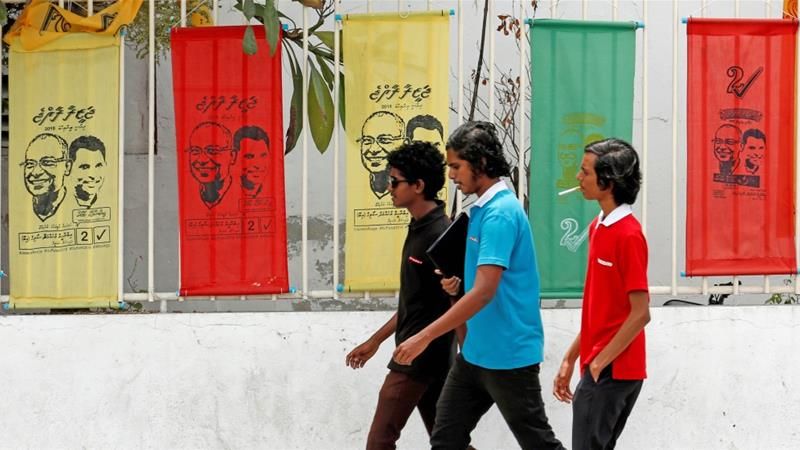
Over the past 10 years, the country has held regular multiparty elections and in just a few days, on September 23, Maldivians will head to the polls to choose their president for the third time since 2008. The incumbent Abdulla Yameen is running against long-term legislator Ibrahim Mohamed Solih, endorsed by a coalition of opposition parties.
In any young democracy, an election would be celebrated as an expression of democratic life, but in the Maldives today, the upcoming vote is just another indication of the death of its democracy.
There is currently little hope that the flawed electoral process and the vote on September 23 will change the current tendencies towards an authoritarian relapse in Maldivian politics.
A short democratic moment
When popular protests erupted in September 2003, following the brutal killing of an inmate in Maldivian prison, hopes for meaningful change in the country ran high. A coalition of opposition parties, led by Mohamed Nasheed from Maldivian Democratic Party (MDP) rode the wave of public discontent and managed to force Gayoom to open up the political system and hold free elections.
In 2008, Nasheed, backed by a coalition of parties, defeated Gayoom in a runoff and became the Maldives’ first freely elected president. Two years later, the international watchdog Freedom House listed the country as an electoral democracy for the first time in its history.
But that newly acquired “status” did not translate into practises on the ground. The Maldivian political class did not give up their predatory behaviour and unprincipled politics.
The new political parties, their leaders, parliamentarians, the judges, and those who pump money into politics did not fully embrace democracy.
Nasheed himself made authoritarian moves, including arresting officials and opposition politicians to deal with mounting political and economic challenges.
Instead of trying to make the democratic transition work despite disagreements, the opposition sought to end Nasheed’s government by any means. He was forced to resign in February 2012 after sections of the police and the military mutinied and backed the demand of the opposition for his resignation.
Then in 2013, Gayoom’s Progressive Party of the Maldives (PPM) nominated his half-brother, Yameen, to run against Nasheed in the presidential race. It then entered into a coalition with the Jumhooree Party and Islamist Adalat Party, both of which backed the MDP against Gayoom back in 2008.
This alliance helped Yameenhe win the vote with 51 percent.
Descent into a new despotism
Soon after he took power, Yameen, too, veered off the democratic path. He gradually took control of various institutions, hollowed them out and made them subservient to his political agenda, all the while talking about democracy, rule of law, and development.
The judiciary has been one of the main targets of Yameen’s authoritarian assault on state institutions. Soon after he took power, he used his party’s legislative majority to change the law regulating the composition of the country’s top court.
Using these amendments, the president managed to remove the chief justice and lower court judge, both of whom were known for their relative independence. This effectively made the judiciary dependent on the executive branch.
In the following years, all major political rivals to Yameen were imprisoned on various charges, including former President Nasheed, his own half-brother – Gayoom, his own vice president – Ahmed Adeeb, Adalat Party leader Imran Abdullah, and the country’s richest man, Gasim Ibrahim.
Similarly, when his despotic adventurism estranged his coalition partners and the president lost their legislative majority, the courts and the elections body stripped 12 opposition MPs of their seats.
And when, in a surprising turn of events, in February this year, the top court ruled to free all opposition leaders, the security apparatus arrested the chief justice and lower court judge.
A month later, parliament changed the law again and paved way for the removal of the two judges. Yameen thereby regained control over the court.
His type of despotism, of course, still leaves pockets of space for political and civic activism. Parties still function; there is still part of the media that can be critical; there is some freedom of expression, especially on the internet; and there is a sense of a vibrant public sphere.
However, the effect of ever-changing laws and hijacked institutions is that even those freedoms can be taken away whenever Mr Yameen wants. This type of regime is what Australian political thinker John Keane calls “new despotism”: governments, “backed by democratic rhetoric and election victories, massively expand their executive powers by means of economic nepotism, media controls, strangled judiciaries, dragnet surveillance and armed crackdowns on their opponents”.
Elections without hope for democracy
It is amid such political circumstances that Maldivians will be voting on September 23. There are already signs that the electoral process is flawed. Several candidates were not allowed to contest the election because of politically motivated prison sentences.
The independence of the election commission and the Supreme Court are also in doubt. Elections have been postponed before several times and the results of the 2013 vote annulled.
And even if the election is free and fair on September 23, what is on offer are two bad options: Yameen and the promise of deepening authoritarianism; or Solih and the prospect of an unstable government of warring factions.
Solih is backed by Nasheed’s MDP and its unholy alliance with Jumhooree Party and Islamist Adalat Party (which went against him in 2012) and with his former rival, Gayoom, who was pushed out of the PPM.
This coalition is currently held together by their common enemy – Yameen. If they win and Solih comes to power, there is no guarantee that they will stick together. In fact, the recent past shows that these political parties are quick to abandon their alliances whenever their narrow self-interest is in danger.
If, unlike his predecessors, Solih tries to stick to democratic processes and negotiations to resolve political disagreements, he would find it difficult to do so in the face of a predatory political culture and widespread corruption which have eroded any serious commitment to democratic norms and principled politics.
In other words, whether Yameen or the opposition wins this election, there is little hope the country would be put back on the democratic track.
Courtesy Aljazeera