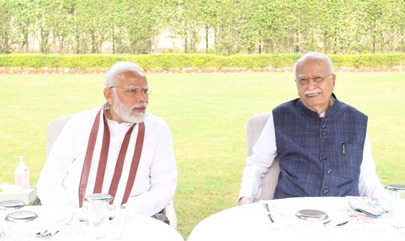
Shri Lal Krishna Advani Ji enters the hundredth year of his life today, 8th November. This year, his birthday fittingly coincides with Diwali, a festival associated with Prabhu Shri Ram and the Diya at a time when we are marking 75 years since the inception of the Jana Sangh, 125th Jayanti of Dr. Syama Prasad Mookerjee and recently celebrated a hundred years of the RSS.
There are very few people whose lives have touched so many different chapters of modern India. Advani Ji was born on 8th November 1927, on Dev Deepawali. As a youngster in 1947, he experienced the pain of leaving behind his familiar world in Sindh. He rebuilt his life from scratch without bitterness. This trait of being able to build from scratch, against all odds, has stayed with him throughout. It was seen while he was strengthening the Jana Sangh and later building the BJP. His tenures as BJP President saw the Congress falling sharply from 400 to below 200 in 1989 and the BJP becoming the single largest party for the first time in 1996. Advani Ji nurtured generations of Karyakartas and gave the Party a clear foundation rooted in the principle of Nation First.
Two qualities always set Advani Ji apart as a leader. First, his ideological clarity and intellectual sharpness. This was reflected in his speeches and writings. The Jana Sangh and BJP resolutions he authored remain worth reading even today, while his interviews were consistently incisive and precise. Second, the manner in which he exposed the pseudo-secularism propounded by a large section of the Indian polity for many years.
Advani Ji took up every responsibility with immense diligence. As an RSS Pracharak, Advani Ji first worked in different parts of Rajasthan. From there, he went to the national capital, where he started working closely with Atal Ji. History shows that it is rare for two towering political leaders to work together for several decades, cooperating with each other without becoming competitors. Advani Ji and Atal Ji set a remarkable example. Together, they changed the course of Indian politics.
The Delhi that Advani Ji came to was coming to terms with the horrors of Partition. He immersed himself in making the Jana Sangh stronger. In 1967, Advani Ji became the Chairman of the Delhi Metropolitan Council, where he worked alongside the late Vijay Kumar Malhotra Ji (who became Chief Executive Councillor).
In 1970, Advani Ji’s Parliamentary innings began. His interventions have won appreciation across the political spectrum. He made a mark as an MP and later, as Leader of Opposition in both houses and from the treasury benches too. Despite parliamentary commitments, he frequently travelled across India meeting people.
I vividly recall the 1991 Lok Sabha elections. It was decided that Advani Ji would contest the Lok Sabha elections from two seats, one of which was Gandhinagar. He had an old link with Gujarat. His father had settled in Kutch after Partition. Advani Ji had also served as a Rajya Sabha MP from Gujarat. So, it was a homecoming of sorts. Being involved in the BJP organisation, I had the honour of helping prepare his papers and assisting him throughout the campaign. The people of Gandhinagar sent him to Parliament time and again. As a voter of Gandhinagar, I also had the honour of voting for Advani Ji on numerous occasions. The care and attention he devoted to his constituency is something to learn from.
The Emergency was a watershed moment in Advani Ji’s life. He was at the forefront of saving democracy and protecting the Constitution. His experiences found their way into his book, ‘A Prisoner’s Scrap-Book.’ One part of that book, titled ‘A Tale of Two Emergencies’, beautifully explained the striking similarities between the events in India starting June 1975 and those in Nazi Germany in 1933.
Advani Ji was a fiery Opposition leader but an equally excellent administrator. When the Janata Government came to office in 1977, Advani Ji became Minister for Information and Broadcasting. It is widely accepted that his work in this department was extremely impactful. As Deputy Prime Minister and one of India’s longest-serving Home Ministers, he was instrumental in strengthening India’s security apparatus. His work in improving the lives of our security forces is remembered with great fondness. His unequivocal stand against terrorism ensured India got a tough anti-terror law.
Of course, an iconic moment in Advani Ji’s life was the Somnath to Ayodhya Rath Yatra. It changed the course of Indian society for the better. I consider it a privilege that I got the opportunity to be involved in this Yatra from the ideation stage to execution. Being present at Somnath when the Yatra began was particularly special. A Yatra can be very demanding, requiring long hours, constant travel, physical endurance and an ability to remain focused despite fatigue. Advani Ji embodied this endurance.
I also have memories of the saddening moments of Advani Ji’s arrest in Bihar. Then, in Gujarat, the BJP withdrew support from the Chimanbhai Patel Government. With this, a simple message was given, that when it comes to our ideology and the Ram Temple, there will never be any compromise. Many of our senior leaders and Karyakartas took an oath that, come what may, a Ram Temple will be built. And, years later, with the blessings of the people of India, a grand Mandir for Prabhu Shri Ram became a reality in Ayodhya.
There is so much more of Advani Ji that is outstanding. His simplicity, for example. After the Navnirman Movement, Advani Ji had come to Junagadh and stayed for a month as an ordinary Karyakarta, preparing the Party for the Assembly elections in which Congress was rejected. He has always shown what probity in public life is about. He is a voracious reader. Those who have spent time with him know how carefully he goes through newspapers. He is a big fan of cinema and theatre, and has been an enthusiastic film critic. His sense of history and the need to preserve it is visible in his book, ‘My Country My Life.’
Advani Ji always remained in touch with Sindhi culture. Another effort he undertook was the popularisation of Sindhu Darshan Puja near Leh. I myself had been to one Puja with Advani Ji and George Fernandes Ji.
Any account of Advani Ji’s remarkable journey would be incomplete without mentioning Kamla Advani Ji. She was a constant source of strength and support throughout his public life.
Growing up in Karachi, Advani Ji could hardly have imagined the path his life would take. In an expression of gratitude, the people of India conferred upon him the Bharat Ratna in 2024. As Advani Ji enters the hundredth year of his life, I pray that he be blessed with good health and that he continues to inspire us all as he has always done.
Courtesy PIB, Srinagar
Shri Narendra Modi is the Hon’ble Prime Minister of India.