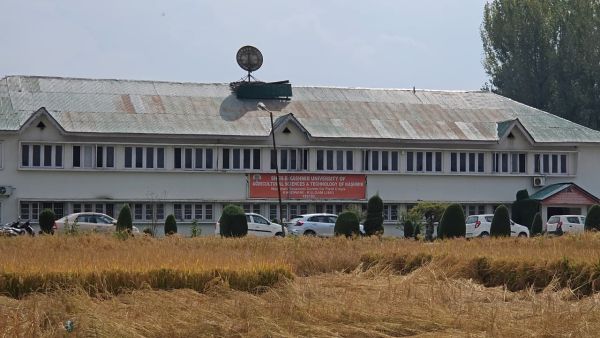
KULGAM: The Mountain Research Centre for Field Crops (MRCFC) of Sher-e-Kashmir University of Agricultural Sciences and Technology of Kashmir (SKUAST-K) at Khudwani is working to revive traditional rice varieties and develop improved seeds aimed at boosting production and increasing farmers’ income.
The centre has revived traditional varieties such as Mushkbudji and Zag, which had nearly disappeared from cultivation in parts of the Valley. Scientists are also working to improve their disease resistance while retaining their original characteristics.
Dr Ghazala, a plant breeder at MRCFC Khudwani, said the centre had incorporated specific genes into traditional varieties to make them genetically resistant to diseases. The research also covers the development of improved varieties of rice, wheat and oilseeds suited to the needs of farmers across Kashmir.
Highlighting the performance of Shalimar Rice-4, popularly known as the “Ten-Ton” variety, Dr Ghazala said improved varieties, combined with appropriate farming practices, could substantially increase rice yields.
She said farmers earlier harvested around one quintal of rice per kanal under traditional cultivation practices, while production could reach four to five quintals per kanal under suitable conditions with improved varieties and proper crop management.
The centre develops rice varieties suited to different agro-climatic conditions and altitudes across Kashmir, as varieties that perform well in lower areas may not be equally suitable for higher-altitude belts.
Farooq Ahmad, a professor at MRCFC, said the centre focused on developing rice varieties that combine higher yields with better grain quality. SKUAST-K has released 10 varieties under the Shalimar Rice series, from Shalimar Rice-1 to Shalimar Rice-10, for different agro-climatic zones of the Valley.
He said Shalimar Rice-5 was in demand in higher-altitude areas, while Shalimar Rice-6 had been developed for the Mushk Budji belt. The university has also developed finer-grain varieties, including Shalimar Rice S-1, to meet consumer preferences.
Another variety, Shalimar Sugandh, also known as Kashur Basmut, released in 2021, has attracted market interest. Ahmad said it offered farmers an opportunity to earn better returns, citing a price premium of around ₹100 per kilogram.
He also referred to Shalimar Rice-4, released in 2025, which has a reported yield potential of around 17 quintals per hectare.
Ahmad stressed that improved seeds alone were not sufficient to achieve higher production, adding that timely fertiliser application, adherence to recommended doses and better crop management were equally important.
The centre also organises training programmes for farmers and field-level officials under the Holistic Agriculture Development Programme (HADP), focusing on improved cultivation practices and the adoption of new varieties.
Apart from rice, MRCFC Khudwani is conducting research on brown sarson, an important winter crop in Kashmir, with an emphasis on developing improved varieties.
The centre’s research combines the revival of traditional rice varieties with efforts to improve productivity, grain quality and disease resistance, with the broader aim of preserving Kashmir’s agricultural heritage while improving farm incomes.