JAMMU: The Bharatiya Janata Party (BJP) on Tuesday said a resolution adopted at its Jammu and Kashmir State Executive Meeting highlighted changes in infrastructure, healthcare, welfare delivery and security following the abrogation of Article 370 in August 2019.
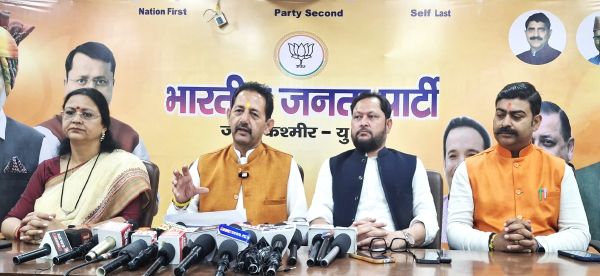
Addressing a press conference at the party headquarters in Trikuta Nagar, BJP general secretaries Baldev Singh Billawaria, Sanjita Dogra and Gopal Mahajan, accompanied by media in-charge Dr Pardeep Mahotra, said party workers would take the resolution to people across the Union Territory.
Billawaria said the resolution, adopted under the presidentship of BJP J&K president and Rajya Sabha MP Sat Sharma, called for equitable development across all 20 districts. He linked the abrogation of Article 370 to the vision of Maharaja Hari Singh, the Praja Parishad Movement led by Prem Nath Dogra and the sacrifice of Syama Prasad Mookerjee.
The resolution referred to the 90-member Jammu and Kashmir Legislative Assembly, with 43 seats in Jammu and 47 in Kashmir, including nine seats reserved for Scheduled Tribes—six in Jammu and three in Kashmir. It also cited transparent recruitment and balanced regional development as key priorities.
On security, Billawaria cited the identification of 7,656 Rohingya and 504 Bangladeshi nationals allegedly residing illegally in J&K. He said 150 Bangladeshi nationals had initially been deported and 117 cases registered against networks allegedly involved in providing fraudulent documents, including 101 cases in Jammu and 16 in Kashmir.
Highlighting infrastructure and institutional development, he referred to IIT Jammu, IIM Jammu, IIMC Jammu, AIIMS Vijaypur, progress on AIIMS Awantipora and seven new government medical colleges in Kathua, Rajouri, Doda, Baramulla, Anantnag, Udhampur and Handwara.
He also cited the Syama Prasad Mookerjee Tunnel, Banihal-Qazigund Tunnel, Z-Morh and Zojila tunnels, more than 20,000 kilometres of roads constructed under the Pradhan Mantri Gram Sadak Yojana (PMGSY), and Rs 4,224 crore sanctioned under PMGSY-IV. The Delhi-Amritsar-Katra Expressway and Chenab Rail Bridge were also mentioned among major connectivity projects.
On welfare delivery, Billawaria cited 88.26 lakh Ayushman cards, tap-water connections to 15,66,716 rural households, free ration for 98.52 lakh beneficiaries, more than 3.23 lakh rural houses and 35,961 urban houses. He also referred to 46,133 rooftop solar installations.
Under Mission YUVA, he said, 1.59 lakh young people had registered, 1,00,407 applications had been received, Rs 1,826 crore had been disbursed across 32,665 bank accounts and more than 13,597 youth-led enterprises were active.
Dogra said the resolution also highlighted the extension of rights to Valmikis, West Pakistan refugees and Gorkhas, nearly 30,000 elected grassroots representatives, provisions for women, Kashmiri migrants and displaced persons from Pakistan-occupied Jammu and Kashmir, and 33 per cent reservation for women.
She also cited figures claiming an 83 per cent decline in terror incidents, a 96 per cent drop in local youth recruitment into terrorism and the absence of organised stone-pelting. The resolution further referred to more than Rs 18,000 crore in active industrial investments and 2.35 crore tourist visits in a single year.
Mahajan called for the effective implementation of welfare schemes and inclusive development, urging party workers to take the resolution to the grassroots. He said the BJP remained committed to a secure and prosperous Jammu and Kashmir under the principle of “Sabka Saath, Sabka Vikas.”