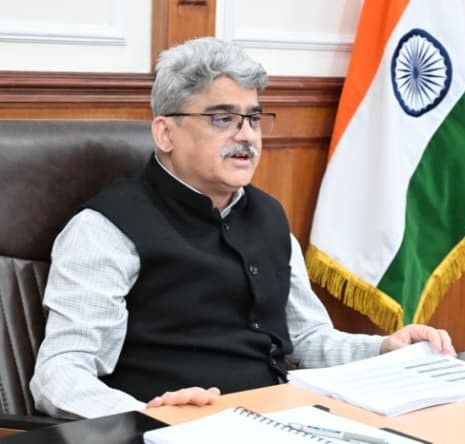
SRINAGAR: Chief Secretary Atal Dulloo on Tuesday reviewed the revised Jammu and Kashmir State Action Plan on Climate Change (SAPCC 2.0) and directed departments to incorporate clear, time-bound actions, outcomes and milestones up to 2030 for effective implementation.
The revised plan, prepared by the Department of Forest, Ecology and Environment, aims to strengthen climate resilience in the Union Territory and align J&K’s climate response with India’s Nationally Determined Contributions (NDCs), the Paris Agreement and emerging regional climate challenges.
During the meeting, Dulloo emphasised that the action plan should translate into measurable interventions with clearly defined responsibilities, timelines and outcomes. He called for greater inter-departmental coordination and integration of climate-related measures with existing government schemes to maximise resources and avoid duplication.
The meeting was attended by senior officials, including Administrative Secretaries of key departments, the Principal Chief Conservator of Forests and representatives of the Ministry of Environment, Forest and Climate Change (MoEF&CC).
Presenting the revised plan, Commissioner Secretary, Forest, Ecology and Environment, Sheetal Nanda, outlined climate projections indicating that average temperatures in Jammu and Kashmir could rise by around 1.5 degrees Celsius between 2021 and 2050 under a moderate-emission scenario. The assessment also projects an increase in annual precipitation of about 5 per cent under moderate emissions and up to 15 per cent under a high-emission scenario, accompanied by shorter winters and more intense rainfall events.
Officials said the climate vulnerability assessment evaluated 42 indicators across the agriculture, water, health and forest sectors to identify district-specific risks and guide targeted interventions.
The revised SAPCC proposes 55 emission-mitigation measures with an estimated reduction potential of 2.6 million tonnes of carbon dioxide equivalent by 2030. These include expansion of solar energy projects, including floating solar plants, greater use of small hydropower and wind energy, strengthening of power infrastructure, reduction of transmission losses, promotion of electric mobility and deployment of Intelligent Traffic Management Systems.
The plan also outlines 100 adaptation measures across key sectors and disaster risk reduction. Proposed interventions include expansion of micro-irrigation, universal household tap-water coverage, rainwater harvesting, strengthening healthcare infrastructure in underserved areas, restoration of degraded forest catchments and slope-protection works in vulnerable locations.
Officials informed the meeting that the implementation framework envisages a Governing Council headed by the Chief Minister and an Executive Council chaired by the Chief Secretary to oversee implementation and inter-departmental coordination. Progress is proposed to be monitored quarterly through a digital dashboard using department-specific key performance indicators.
Dulloo directed that the revised framework clearly specify responsibilities, timelines and measurable outcomes while ensuring that interventions are tailored to Jammu and Kashmir’s ecological, geographical and socio-economic conditions.
The revised SAPCC 2.0 will be placed before the State Level Steering Committee for approval before being submitted to the National Level Steering Committee under the Ministry of Environment, Forest and Climate Change for implementation.