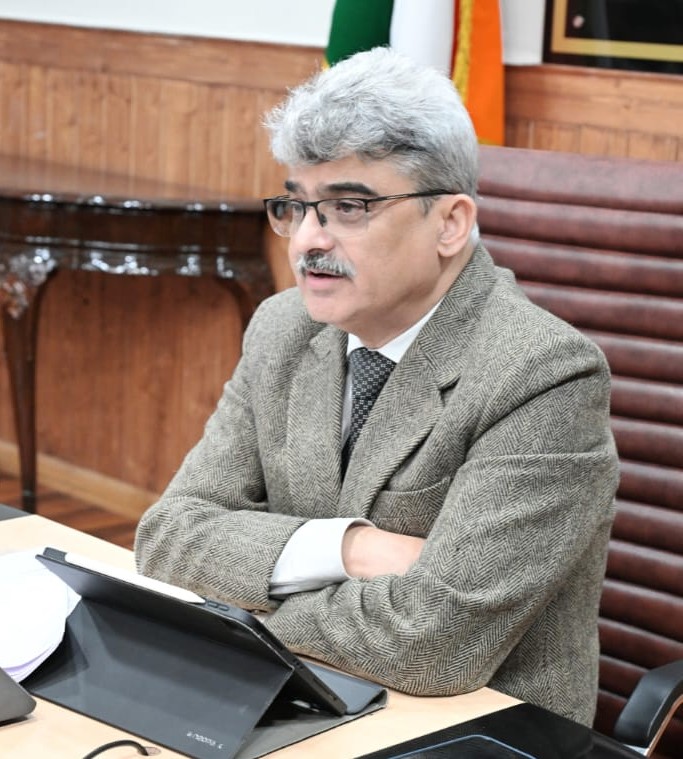
SRINAGAR: Chief Secretary Atal Dulloo on Monday directed departments and road-owning agencies to accelerate corrective measures at accident-prone locations and work towards developing zero-casualty corridors across Jammu and Kashmir.
Chairing a high-level review of the Road Safety Action Plan, Dulloo stressed the need for time-bound rectification of identified black spots and hazardous stretches, and asked District Road Safety Committees to meet every month to monitor accident trends and address infrastructure deficiencies.
According to officials, road fatalities in Jammu and Kashmir have declined from 1,090 in 2024 to 756 up to mid-September 2026. The number of road accidents has also reduced from 5,808 in 2024 to 4,222 during the current period.
The meeting was informed that 367 accident black spots have been identified across the Union Territory, of which 165 have been audited by central agencies and 68 have already been rectified.
Officials said a road safety audit of 1,433 roads has been completed and ₹11.60 crore released to 15 districts for immediate corrective measures under the Road Safety Fund.
The Chief Secretary also reviewed trauma care infrastructure and emergency response mechanisms. A UT-wide audit of 15 Level-III Trauma Centres—eight in Jammu division and seven in Kashmir division—has been completed, and a plan has been prepared to upgrade the facilities with additional manpower and equipment.
The meeting was informed that 906 road accident victims have received cashless treatment under the PM-RAHAT and Rah-Veer schemes.
On traffic enforcement, officials reported that 10.39 lakh e-challans have been issued during the current year as part of a shift towards technology-based enforcement. A proposal has also been prepared to extend Intelligent Traffic Management Systems (ITMS) to rural areas through the installation of 2,144 digital devices across 25 critical corridors and 195 junctions.
Four Traffic Control Units are currently operational in Srinagar, Jammu, Ramban and Udhampur, while additional sites are being developed.
The meeting was further informed that infrastructure at the Institute of Driver Training and Research (IDTR), Kot Bhalwal in Jammu, has been completed and operations are expected to begin next month in partnership with Maruti Suzuki India Limited. The institute will offer a 45-day commercial driving training programme.
Officials also reported a 116 per cent increase in road safety awareness campaigns during 2026, with 4,509 campaigns conducted so far.
The review noted the implementation of measures such as the “No Helmet, No Fuel” directive for two-wheeler riders, the introduction of Automated Testing Stations in Jammu and Samba for vehicle fitness testing, and plans for setting up Registered Vehicle Scrapping Facilities to remove end-of-life vehicles from roads.
The meeting was attended by senior officials from the Transport, Home, Public Works and Health departments, as well as representatives of the Border Roads Organisation, National Highways Authority of India and National Highways and Infrastructure Development Corporation Limited.