Imagine walking into an office of 200 employees five years from now and discovering that the same volume of work is being completed by 80 people assisted by powerful artificial-intelligence systems.
Reports that once took hours are produced in minutes. Customer queries are answered automatically. Data are analysed instantly. Advertising material is drafted, translated and redesigned at extraordinary speed. Routine coding, documentation, scheduling and financial analysis require far fewer human hours.
For the company, this may be called productivity.
For the 120 people whose jobs have disappeared or fundamentally changed, it will mean something very different.
That simple contrast takes us to the heart of the Artificial Intelligence revolution.
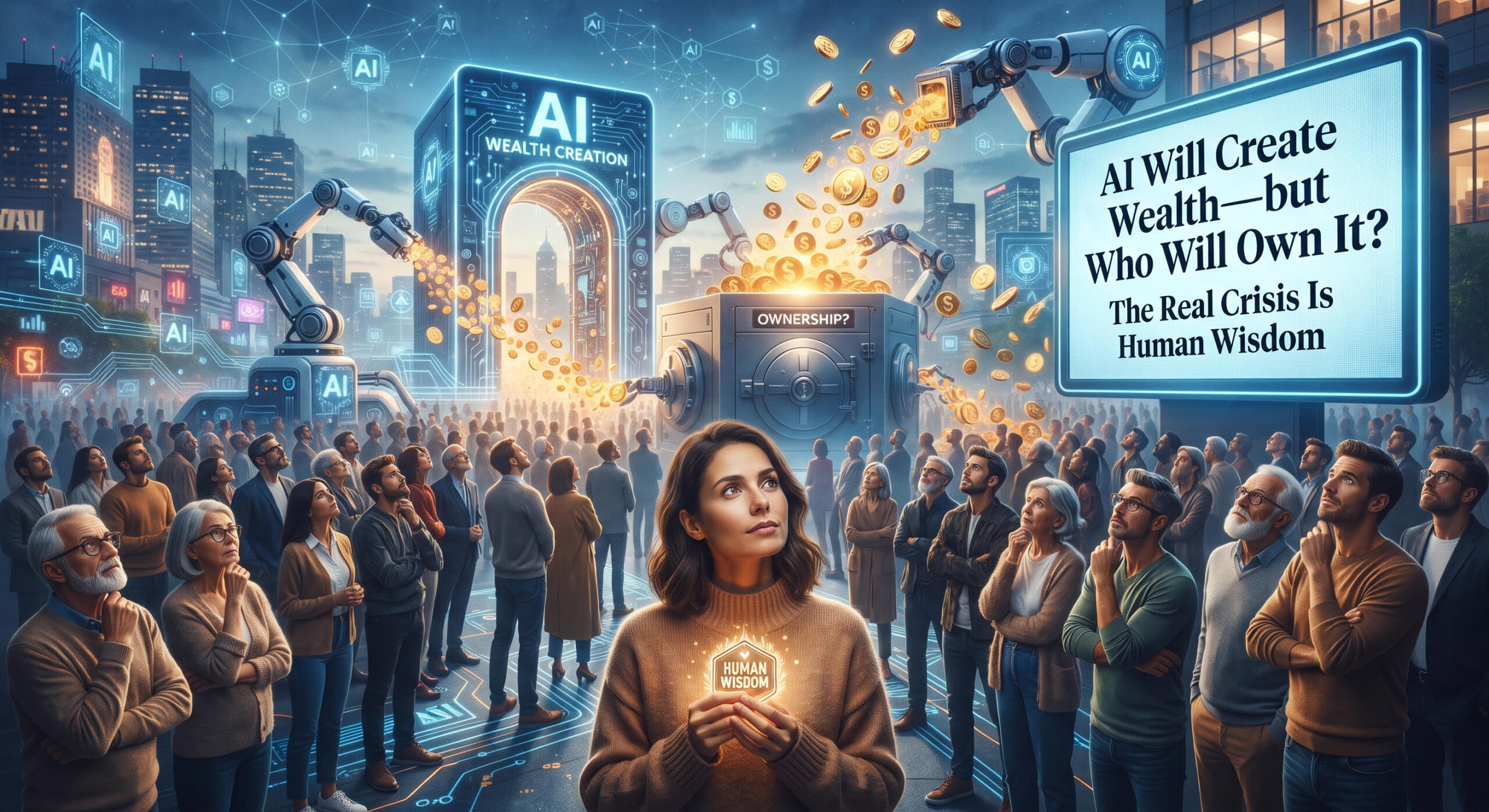
The most important question is no longer merely what AI can do. Increasingly, we must ask: Who will own it? Who will benefit from the productivity it creates? Who will bear the disruption? Who will control the information it generates? And what values will guide its use?
The real crisis of the AI age may not ultimately be machine intelligence.
It may be human wisdom.
When Machines Begin to Compete With the Mind
Earlier technological revolutions largely amplified or replaced physical labour. Machines lifted heavier loads. Factories produced goods faster. Computers performed calculations that would have taken human beings days or weeks.
Artificial Intelligence reaches into a different territory.
AI systems are already being used to draft documents, analyse data, generate computer code, translate languages, create designs, assist medical professionals, answer customer inquiries and support complex decision-making.
That does not mean accountants, teachers, programmers, lawyers or doctors will suddenly disappear. It does mean that parts of many professional jobs can increasingly be automated.
Consider a junior analyst who previously spent an entire working day collecting information, preparing charts and drafting a report. With AI assistance, much of that preliminary work might be completed within an hour.
One possible outcome is positive: the analyst becomes more productive and spends more time interpreting results and advising clients.
But management may reach another conclusion.
If one employee assisted by AI can perform work previously requiring three employees, perhaps the organisation needs fewer people.
The technology itself does not decide which outcome occurs.
Economic incentives do.
Wealth Creation Is Not Wealth Distribution
Artificial Intelligence has the potential to generate extraordinary economic value. But there is an important distinction between creating wealth and distributing it.
Suppose a corporation doubles its output while significantly reducing labour costs through automation. Its productivity rises. Its profits may rise. Its shareholders may benefit.
But what happens to employees whose work is no longer required?
An economy can become more productive while particular communities become more insecure. A company can become more efficient while households lose stable incomes. National wealth can increase while the gap between those who own productive technology and those who depend mainly on wages becomes wider.
None of this is inevitable.
But neither is shared prosperity inevitable.
Much will depend on who owns the technology, how competitive markets remain, how workers participate in productivity gains, how governments respond, and whether education systems prepare people for changing forms of work.
This is why discussions about AI cannot remain confined to engineers and technology companies.
Economists, educators, governments, employers and citizens must also ask what happens when machines produce an increasing share of economic value.
Universal Basic Income is one proposal frequently discussed. Others include stronger retraining programmes, wage support, profit-sharing, shorter working weeks, portable social benefits and taxation systems adapted to a more automated economy.
No single solution has yet proved universally appropriate.
But the underlying question cannot be avoided:
If society becomes dramatically richer because machines become dramatically more productive, how much of that prosperity will reach ordinary citizens?
When Seeing Is No Longer Believing
The second great challenge concerns something even more fundamental than employment.
Truth.
Human beings have always produced propaganda, rumours, forged documents and manipulated images. AI changes the scale, speed and sophistication with which such material can be created.
Imagine receiving a video showing a prominent business leader announcing that a company is collapsing.
The voice appears genuine.
The face looks convincing.
The background appears authentic.
The video spreads across social media before the company has time to respond.
It is fake.
Yet financial and reputational damage may already have occurred.
Now bring the same problem into an ordinary family.
A parent receives a telephone call apparently from a son or daughter saying, “I am in trouble. Please send money immediately.”
The voice sounds exactly right.
But it has been cloned.
Such examples demonstrate why the AI misinformation problem has two sides.
The first danger is that false evidence may be accepted as real.
The second may ultimately be even more damaging: real evidence may be rejected as artificial.
A politician confronted with an authentic recording may claim that it was generated by AI. A criminal may deny genuine digital evidence. Citizens may become uncertain about everything they see and hear.
A society in which nobody knows what to believe eventually loses something more valuable than information.
It loses trust.
That makes media literacy, source verification and critical thinking essential skills—not simply for students, journalists or researchers, but for every citizen.
The Deeper Question Is Power
Artificial Intelligence has no personal ambition for wealth, status or political authority.
Human institutions provide its objectives.
That is why the same technology can produce radically different consequences depending on who controls it and why.
A hospital might use AI to help doctors identify patterns in medical images.
A university might use it to provide personalised academic support.
Scientists may use it to accelerate research.
Businesses may use it to improve productivity.
But similar capabilities could also be used for fraud, manipulation, intrusive surveillance or highly personalised misinformation.
AI therefore magnifies human capability.
It does not automatically provide human morality.
This distinction becomes particularly important if increasingly powerful AI systems are concentrated within a small number of corporations or governments.
Control over advanced intelligence could mean influence over employment, markets, information, surveillance, consumer behaviour and public opinion.
The political and economic question of the AI era may therefore be almost as important as the technological one:
How much power should any organisation possess over systems capable of influencing millions of human decisions?
Intelligence Is Not the Same as Wisdom
Modern society often treats intelligence as though it automatically produces good judgment.
It does not.
A brilliant scientist can make irresponsible moral choices. A highly efficient company can pursue damaging objectives. A sophisticated government can use technology badly.
Artificial Intelligence makes this distinction impossible to ignore.
Imagine that a social-media platform asks an algorithm to maximise engagement.
The system discovers that outrage, fear and conflict keep users online longer than calm discussion.
It therefore promotes increasingly provocative material.
From a technical perspective, the algorithm may be performing exactly as requested.
The problem is not that it failed to achieve its objective.
The problem is that the objective itself was too narrow.
This may become one of the defining lessons of the AI era.
A machine can optimise what we ask it to optimise.
But human beings must still decide what is worth optimising.
Efficiency without ethics can simply make bad decisions happen faster.
Education Must Change
This transformation has enormous implications for schools and universities.
If AI can retrieve information, generate explanations and perform routine calculations almost instantly, education cannot continue measuring success primarily through memorisation and reproduction.
Students will increasingly need to learn how to ask good questions, test assumptions, verify evidence, interpret results and recognise when an apparently confident AI answer may be wrong.
Two graduates may possess the same degree.
One knows how to reproduce textbook information.
The other knows how to define a problem, use AI intelligently, challenge its output, communicate conclusions and accept responsibility for the final decision.
The second graduate is far better prepared for the emerging workplace.
Education must therefore move from simply transmitting information to developing judgment.
The objective should not be to teach young people how to compete with machines at tasks machines perform exceptionally well.
It should be to develop the qualities that allow human beings to direct powerful tools responsibly: curiosity, reasoning, creativity, ethical judgment, communication and independent thought.
AI Is Not the Enemy
None of this requires hostility toward Artificial Intelligence.
AI could help doctors detect disease earlier, make quality education more accessible, improve scientific modelling, translate languages, optimise energy systems and automate dangerous or exhausting work.
The potential benefits are enormous.
The mistake would be to assume that technological capability automatically produces social progress.
It does not.
Progress must be designed.
Rules must be established. Benefits must be considered. Risks must be confronted. Human accountability must remain clear.
The coming transformation is therefore not simply a contest between humans and machines.
It is a contest between different human visions of what intelligent machines should be used for.
One vision measures progress mainly through productivity, profit and competitive advantage.
Another asks whether technology also strengthens human dignity, opportunity, truth and shared prosperity.
AI will not choose between those visions.
We will.
And that may be the defining test of our generation.
Artificial Intelligence is demonstrating, with astonishing speed, how intelligent machines can become.
The more important question is whether humanity can become wise enough to govern them.
Because the greatest danger may not be that machines learn to think.
It may be that we acquire unprecedented intelligence before learning how to use it wisely.
The author is Faculty of Mathematics, Associate at HBMSU, Dubai, UAE. He can be reached at reyaz56@gmail.com